


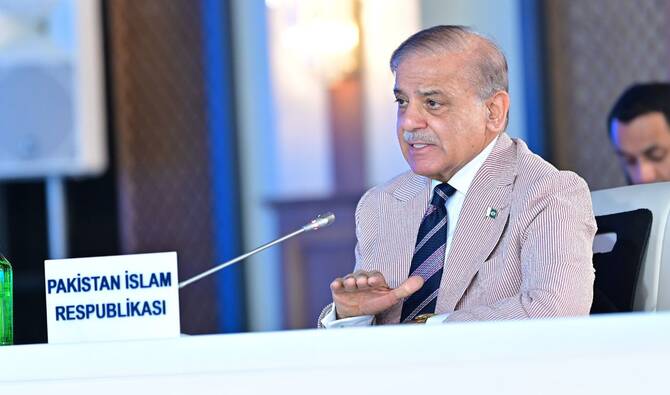

ISLAMABAD: The leaders of Pakistan, Turkiye and Azerbaijan met on Wednesday at a trilateral summit in Lachin and pledged to work together for the goal of economic development and regional prosperity and to turn their brotherhood into a “strategic partnership.”
Pakistan’s Prime Minister Shehbaz Sharif arrived in Azerbaijan on Tuesday on the third stopover of a five-day regional diplomacy tour that also saw him visit Iran and Turkiye. Turkiye is a longtime ally of Pakistan, while Baku and Islamabad have moved closer in recent years with a flurry of visits and bilateral agreements.
Turkish President Recep Tayyip Erdogan and Azerbaijan’s President Ilham Aliyev had openly pledged support for Pakistan during its latest military confrontation with archrival India earlier this month.
“I am confident that our time-tested relationship would not only be beneficial for the wellbeing of our own people but also contribute to peace and prosperity in the region and beyond,” Sharif said during his address at the summit.
“This trilateral format is both very timely and of great importance and … gives us the necessary political ownership and the impetus to move forward collectively and in unison in all spheres of our common interest.”
Addressing the summit, the president of Azerbaijan said the three leaders had come together for the “strategic development” of their countries and to work on “shared goals.”
“Political, valid economic, energy, mutual investment, transportation, defense, agriculture, information, technology, and other spheres are the ones where there are ample opportunities to advance cooperation through joint projects,” Aliyev said, adding that Azerbaijan had invested over $20 billion in the Turkish economy and was prepared to invest $2 billion into Pakistan’s.
He also said Azerbaijan envisaged closer cooperation with Pakistan’s defense industry.
“We do believe there is great potential and it’s of great importance. Joint military exercises and projects in the defense industry amplify the potential of our armed forces or defense cooperation ensures peace and stability across a vast geography,” Aliyev said.
There have been widespread reports in recent weeks that Azerbaijan may have dramatically increased its procurement from Pakistan of JF-17 “Thunder” light multirole fighter aircraft from an initial 16 units to a staggering 40, in a deal reportedly valued at $4.2 billion.
The aircraft in question are said to be the latest and most advanced iteration of the JF-17 family— Block III— a 4.5-generation fighter co-developed by Pakistan and China and hailed as one of the most cost-effective combat aircraft in the current global market.
“STRATEGIC PARTNERSHIP”
Speaking at the summit, Erdogan said the three countries had a combined population of approximately 350 million and an economic size of $1.5 trillion.
“I would like to particularly emphasize that we stand behind each and every step toward transforming our relations into a strategic partnership,” he said.
“Our foreign ministers will carry out the required work to institutionalize our trilateral cooperation, and they will prepare a strong framework that reflects the common vision of our countries, particularly in the fields that shape our common agenda such as trade, investments, transportation, energy, defense, industry, and the fight against terrorism.”
He said Turkiye, Azerbaijan and Pakistan would institutionalize their cooperation by holding regular trilateral summits and ministerial meetings.
“We will deepen our cooperation in the field of defense and maintain our common commitment to fight against terrorism and against transnational threats,” the Turkish president said.
“We will aim to take joint steps in the fields of trade facilitation, investment promotion and digital transformation. In the field of transportation, which constitutes a quite strategic dimension of our cooperation, we will jointly contribute to projects such as the development of roads, the Middle Corridor and the North South Transport Corridor.”
The Middle Corridor, also known as the Trans-Caspian International Transport Route, is a major trade route connecting China to Europe. It passes through several countries, including Türkiye, Georgia, Azerbaijan, and Kazakhstan, offering an alternative to the Northern Corridor and the Suez Canal. Türkiye plays a significant role in the Middle Corridor, particularly at the European end, and has invested in infrastructure to improve its connectivity to Central Asia and Europe.
The International North–South Transport Corridor (INSTC) is a 7,200-kilometer multi-modal transportation network that connects India, Iran, Azerbaijan, and Russia, with routes also extending to Central Asia and Europe. It utilizes ship, rail, and road routes to facilitate the movement of freight between these countries.


