

Labor members pressure Australian govt to impose Israel sanctions

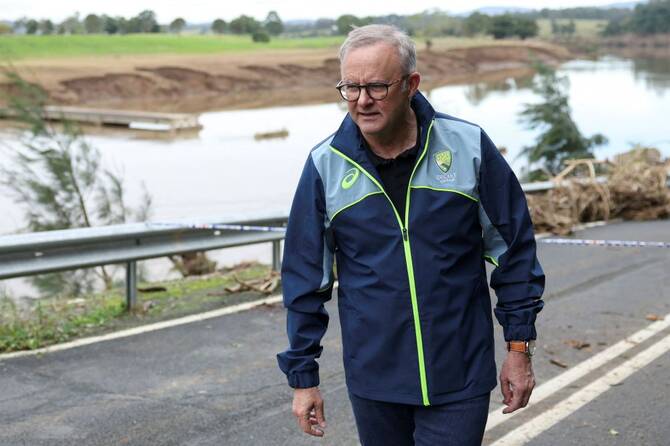
Australia’s Prime Minister Anthony Albanese visits a flood affected area, in Wingham, Australia, May 27, 2025. (Reuters)
Short Url
Updated 28 May 2025
Follow

Labor members pressure Australian govt to impose Israel sanctions

  • Campaigner: ‘There is a deep frustration that Australia has failed to move beyond words’
  • PM Albanese: Gaza blockade ‘an outrage’ and ‘completely untenable’

LONDON: Australia’s Labor government is under pressure from its own party activists to impose sanctions on Israel.

A motion will be put to members of the party drafted by the Labor Friends of Palestine group to call on Prime Minister Anthony Albanese to impose measures on people and groups involved in war crimes in Gaza and the displacement of Palestinians in the West Bank. It also calls on the government to “redouble” efforts to secure a ceasefire.

LFP’s Peter Moss told The Guardian: “There is a deep frustration that Australia has failed to move beyond words and take effective action under international law to protect the Palestinian people and hold Israel accountable.”

He added: “We are seeing a surge in anger and frustration among Labor members and the broader community. Labor Friends of Palestine is signing up a stream of new members horrified by the genocide.
“There are many Labor voters and supporters who cannot accept Australia’s failure to act effectively under international law to stop the starvation.”

Last week, Australia condemned Israel’s months-long blockade of the Gaza Strip, signing a statement alongside 22 other nations including the UK, Canada and New Zealand.

Foreign Minister Penny Wong said Israel “cannot allow the suffering” in Gaza to continue, and statements by several Israeli ministers about the situation in the Palestinian enclave are “abhorrent and outrageous.”

Wong made the remarks after holding talks with her Israeli counterpart Gideon Saar on Friday.
But the Australian government did not go as far as to say it was considering targeted sanctions, unlike fellow signatories the UK, Canada and France, which is co-chairing a UN meeting in June on Palestinian statehood with Saudi Arabia. Australia is set to participate in the conference.

Moss told The Guardian: “At a minimum, Australia should immediately support the statement from the UK, France and Canada and prepare sanctions targeted at Israeli officials responsible for using starvation as a weapon of war.”

On Monday, Albanese called Israel’s blockade — preventing vital aid reaching millions of Palestinian civilians — “completely untenable” and “an outrage,” adding that he had conveyed his feelings personally to Israeli President Isaac Herzog.

Labor MP Ed Husic praised Albanese’s comments on ABC radio station on Tuesday, but said Australia needs to do more to pressure Israel and alleviate the suffering of Palestinians.

He added that sanctions of individuals and organizations are “probably under consideration” by the government to “exert maximum international pressure to stop this blockade.”

At an event for Gaza at Parliament House on Tuesday night, Sen. David Pocock, an independent, said: “If the horror unfolding in Gaza is not our country’s red line for stronger action, then I don’t know what is.”

Mohammed Mustafa, a British doctor who has been working in Gaza, also spoke at the event, calling on the Australian government to do more.

“You don’t have to be a major player to feed children. You don’t have to be a major player to heal children,” he said. “We need healers in the Middle East, and Australia can be the healer. It can lead the world.”


Hungary says it will block a key EU loan to Ukraine until Russian oil shipments resume

Updated 9 sec ago
Follow

Hungary says it will block a key EU loan to Ukraine until Russian oil shipments resume

  • Szijjártó said: “As long as Ukraine blocks the resumption of oil supplies to Hungary, Hungary will block European Union decisions that are important and favorable for Ukraine”
  • Hungary’s decision to block the key funding came two days after it suspended diesel shipments

BUDAPEST: Hungary will block a planned 90-billion-euro ($106-billion) European Union loan to Ukraine until the flow of Russian oil through the Druzhba pipeline resumes, Hungary’s foreign minister said.
Russian oil shipments to Hungary and Slovakia have been interrupted since Jan. 27 after what Ukrainian officials said was a Russian drone attack damaged the Druzhba pipeline, which carries Russian crude across Ukrainian territory and into Central Europe.
Hungary and Slovakia, which have both received a temporary exemption from an EU policy prohibiting imports of Russian oil, have accused Ukraine — without providing evidence — of deliberately holding up supplies. Both countries ceased shipping diesel to Ukraine this week over the interruption in oil flows .
In a video posted on social media Friday evening, Foreign Minister Péter Szijjártó accused Ukraine of “blackmailing” Hungary by failing to restart shipments. He said his government would block a massive interest-free loan the EU approved in December to help Kyiv to meet its military and economic needs for the next two years.
“We will not give in to this blackmail. We do not support Ukraine’s war, we will not pay for it,” Szijjártó said. “As long as Ukraine blocks the resumption of oil supplies to Hungary, Hungary will block European Union decisions that are important and favorable for Ukraine.”
Hungary’s decision to block the key funding came two days after it suspended diesel shipments to its embattled neighbor and only days before the fourth anniversary of Russia’s full-scale invasion.
Nearly every country in Europe has significantly reduced or entirely ceased Russian energy imports since Moscow launched its war in Ukraine on Feb. 24, 2022. Yet Hungary and Slovakia — both EU and NATO members — have maintained and even increased supplies of Russian oil and gas.
Hungary’s nationalist Prime Minister Viktor Orbán has long argued Russian fossil fuels are indispensable for its economy and that switching to energy sourced from elsewhere would cause an immediate economic collapse — an argument some experts dispute.
Widely seen as the Kremlin’s biggest advocate in the EU, Orbán has vigorously opposed the bloc’s efforts to sanction Moscow over its invasion, and blasted attempts to hit Russia’s energy revenues that help finance the war. His government has frequently threatened to veto EU efforts to assist Ukraine.
On Saturday, Slovakia’s populist Prime minister Robert Fico said his country will stop providing emergency electricity supplies to Ukraine if oil is not flowing through the Druzhba by Monday. Orbán’s chief of staff, Gergely Gulyás, said earlier this week that Hungary, too, was exploring the possibility of cutting off its electricity supplies to Ukraine.
Not all of the EU’s 27 countries agreed to take part in the 90-billion-euro loan package for Kyiv. Hungary, Slovakia and the Czech Republic opposed the plan, but a deal was reached in which they did not block the loan and were promised protection from any financial fallout.