

Trump says ‘Golden Dome’ free for Canada — if it joins US

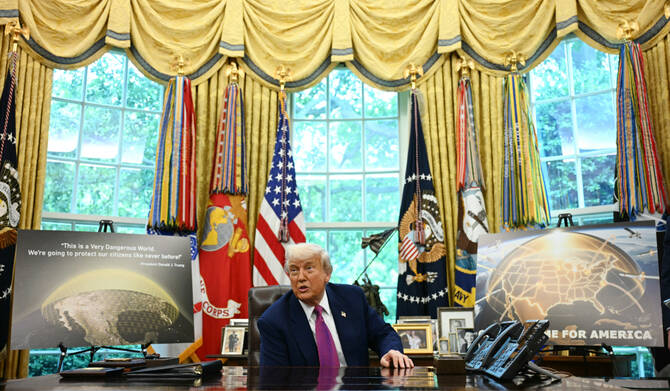
US President Donald Trump speaks about the Golden Dome missile defense shield, in the Oval Office of the White House on May 20, 2025, in Washington, DC. (AFP)
Short Url
Updated 28 May 2025
Follow

Trump says ‘Golden Dome’ free for Canada — if it joins US

  • “I told Canada, which very much wants to be part of our fabulous Golden Dome System, that it will cost $61 Billion Dollars if they remain a separate, but unequal, Nation,” Trump posted on his Truth Social network

WASHINGTON: President Donald Trump said Tuesday that Canada could join his proposed “Golden Dome” missile defense system for free — but only if it becomes part of the United States.
Otherwise it would cost Canada $61 billion to be part of the system, said Trump, who has repeatedly called for the United States’ northern neighbor to become the 51st state.
Canada has expressed interest in joining the missile system — plans for which Trump unveiled last week to defend against a wide array of enemy weapons — but has firmly rejected any loss of sovereignty.
“I told Canada, which very much wants to be part of our fabulous Golden Dome System, that it will cost $61 Billion Dollars if they remain a separate, but unequal, Nation,” Trump posted on his Truth Social network.
“But (it) will cost ZERO DOLLARS if they become our cherished 51st State. They are considering the offer!“
There was no immediate response from Canada to Trump’s claims.
Trump announced plans for the “Golden Dome” system a week ago, saying it would eventually cost around $175 billion and would be operational by the end of his term in 2029.
Experts say the scheme faces huge technical and political challenges, and could cost far more than he has estimated to achieve its goals.
Trump also said at the time that Canada was interested in joining the missile system. Canadian Prime Minister Mark Carney then confirmed that his country had held “high level” talks on the issue.
NATO members Canada and the United States are partners in continental defense through the North American Aerospace Defense Command (NORAD).
But the scheme now seems set to add to the tensions that Trump has sparked with Canada.
Carney politely but firmly dismissed Trump’s calls for Canada to become part of the United States when he visited the White House earlier this month, saying his country was “never for sale.”
The Canadian premier and Trump did however appear to smooth over some of the strains over the tariffs that the US president has slapped on Ottawa.


US, Ukraine hail ‘productive’ Miami talks but no breakthrough

Updated 6 sec ago
Follow

US, Ukraine hail ‘productive’ Miami talks but no breakthrough

  • Representatives from Ukraine, Russia, and Kyiv’s European allies, held separate talks hosted by US special envoy Steve Witkoff
  • Russia's delegation said recent proposed changes to Trump's “20-point plan”  to end the war were a non-starter

MIAMI, Florida: US and Ukrainian envoys issued a joint statement on Sunday that hailed “productive and constructive” talks in Miami but did not announce any apparent breakthrough in efforts to end the war with Russia.

Top representatives from both Ukraine and Russia, as well as Kyiv’s European allies, have been in southern Florida over the past several days for a series of separate talks hosted by US President Donald Trump’s special envoy, Steve Witkoff.
The meetings were the latest in a weeks-long diplomatic blitz over plans to end the war, after Washington last month presented a 28-point proposal widely seen as echoing the Kremlin’s demands.
It has since been redrafted following Ukraine and Europe’s involvement, though its contents have not been publicly disclosed.
“Over the last three days in Florida, the Ukrainian delegation held a series of productive and constructive meetings with American and European partners,” Witkoff and Ukraine’s top negotiator, Rustem Umerov, said in separate statements on X.
They said a bilateral US-Ukraine meeting focused on developing and aligning positions on “four key documents” — a “20-point plan,” a “Multilateral security guarantee framework,” a “US Security guarantee framework for Ukraine” and an “economic & prosperity plan.”
“Particular attention was given to discussing timelines and the sequencing of next steps,” they said, without announcing any further meetings.
National security advisers from Kyiv’s European allies “also joined the discussions to align on a shared strategic approach between Ukraine, the United States, and Europe,” the statements added.
Russian envoy Kirill Dmitriev was also in southern Florida and met with the US delegation, which included billionaire real estate developer Witkoff and Trump’s son-in-law Jared Kushner.
Witkoff on Sunday similarly said that the meetings with Dmitriev were “productive and constructive.”
Earlier, the Kremlin said recent proposed changes to the plan to end the war were a non-starter.
Dmitriev “should receive information about what has been developed by the Americans and Europeans” in the plan and report that back to Moscow later, Kremlin’s spokesman Dmitry Peskov told state TV.
Moscow, which invaded Ukraine in February 2022, sees Europe as pro-war and argues that its participation in the talks only hinders them.

War rages on 

While little is known of the latest peace plans, Kyiv is likely to be expected to surrender some territory — a prospect resented by many Ukrainians — in exchange for US security guarantees.
Though envoys from both Moscow and Kyiv were in town, the Kremlin had earlier ruled out three-way talks.
Ukrainian President Volodymyr Zelensky earlier described the talks as “constructive” and said they were “moving at a fairly rapid pace.”
He nevertheless cautioned that “much depends on whether Russia feels the need to end the war for real.”
He also hailed this week as “historic” for Ukraine, thanking Europe for pledging $100 billion of funding over the next two years.
Moscow’s troops have been steadily advancing at the eastern front in recent months. Putin on Friday hailed the Russian army’s territorial gains — and threatened more in the coming weeks.
Just over the week, “Russia has launched approximately 1,300 attack drones, nearly 1,200 guided aerial bombs, and 9 missiles of various types” against Ukraine, Zelensky said.
Most of them have pummeled the Black Sea region of Odesa, where relentless strikes wrought havoc on ports, bridges and energy facilities, killing eight people Saturday.
In the eastern Sumy region, Russian troops attempted a breakthrough in an area previously spared from an intense ground offensive. Russian forces forcibly moved 50 people from a local village, said Kyiv.
“Russian invaders have stolen five dozen civilian people, mostly elderly women, from a tiny Ukrainian village Grabovske, right across the state border in the Sumy region,” Foreign Minister Andriy Sybiga said.
Russia made no comment on the matter.