

Lebanon PM says media is key to nation’s peace after conflict

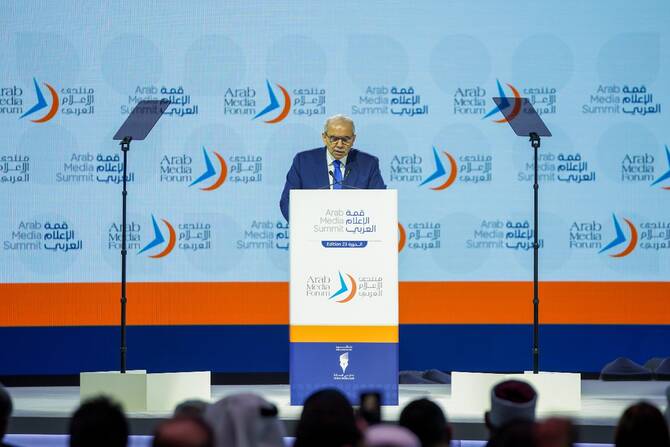
“We are back — back to our state and back to our Arab identity,” Salam declared, concluding his speech and receiving emphatic applause from the audience. (AN photo Gaith Tanjour)
Short Url
Updated 27 May 2025
Follow

Lebanon PM says media is key to nation’s peace after conflict

  • Nawaf Salam thanks UAE, GCC, criticizes Israel for ‘violations’
  • Media must be ‘neutral and a shared space for understanding’

DUBAI: Lebanon’s Prime Minister Nawaf Salam has emphasized the pivotal role of the media in shaping a new era of peace and prosperity for Lebanon.

“We are at a historical juncture in our country, especially when it comes to media. We want a living Arab media that creates the future and doesn’t linger on the past,” Salam said during his address on Tuesday at the Arab Media Summit in Dubai.

Since Lebanon’s ceasefire agreement with Israel in November, the country has been racing to rebuild — physically, socially, and politically.

“We are back — back to our state and back to our Arab identity,” Salam declared, concluding his speech and receiving emphatic applause from the audience.

He credited the UAE and GCC for their support in Lebanon’s recovery, noting the significance of Emirati citizens returning to visit the country.

“I want to thank the GCC, and especially the UAE and its leaders such as His Highness President Mohammed bin Zayed Al-Nahyan, who kept their promise and allowed our Emirati brothers to travel to Lebanon,” he said.

Highlighting the media’s power in shaping public discourse, Salam acknowledged both its potential for progress and its risk of harm.

“Seventy-five percent of the world’s population has a smartphone; 67 percent are connected to the internet, and 57 percent receive news through social media,” he said.

“Media is becoming a tool for misinformation and the spread of distorted context.”

In a country marked by decades of political and sectarian divides, Salam stressed the importance of media neutrality in his nation.

“We don’t want the media to be loyal to us. We want it to be professional, neutral, and a shared space for understanding,” he stated.

Despite progress, Salam warned that Lebanon’s path forward remains complex, but harnessing the influence of the media was a critical tool for improving conditions in Lebanon, and maintaining sovereignty.

“We still have commitments,” he said, referring to the implementation of UN Security Council Resolution 1701. “We continue to face occupation of our land and ongoing violations from Israel.”

He reassured, however, that while the media can be a “maker of peace and war,” Lebanon would prioritize a neutral media outlet — free from sectarian ties — that upholds truth for the well-being of all Lebanese citizens.

“I speak to you not only as a prime minister, but as Lebanese citizen, I have lived through the pain and hope, and I also believe that when words are honest and true, they can be a bridge to building humanity between communities.”

“Lebanon is making its comeback from its crises, based on the principle of reform and sovereignty. Our vision for Lebanon is not just imagined, it is a project.

“We want a state of decision and a country that is enshrined in its Arab identity and to become a bridge from the east to the west,” he said.

“We are back, we are back to our state and back to our Arab identity,” he said.


University of Hong Kong hosts the first Saudi Economic Forum to boost China–Saudi ties

Updated 17 December 2025
Follow

University of Hong Kong hosts the first Saudi Economic Forum to boost China–Saudi ties

  • The high-level event served as a new platform for bilateral dialogue and cross-sector collaboration

RIYADH: The University of Hong Kong (HKU) has hosted the first-ever Saudi Economic Forum in Riyadh, bringing together nearly 100 senior officials, academics, and business leaders to deepen cooperation between China and Saudi Arabia in education, innovation, and economic growth.

Held under the theme “Enhancing the Global Competitiveness of Chinese and Saudi Institutions,” the forum marked a significant milestone in advancing strategic alignment between China’s Belt and Road Initiative and Saudi Vision 2030.

The high-level event served as a new platform for bilateral dialogue and cross-sector collaboration, with participants exploring joint opportunities in investment, technology, renewable energy, and artificial intelligence.

Professor Hongbin Cai, dean of the faculty of business and economics at HKU, said the university aspires to become a “knowledge bridge” between the two nations, leveraging its global standing and extensive international networks. He noted that educational collaboration would be a cornerstone of the Saudi–Chinese partnership.

Saudi Arabia’s Assistant Deputy Minister of Investment, Fahad Al-Hashem, emphasized the depth of the China–Saudi partnership, noting that bilateral trade now exceeds $150 billion, with a growth rate of around 30 percent annually.

He reaffirmed the Kingdom’s openness to partnerships with China’s leading universities and technology companies, particularly in future-focused sectors aligned with Vision 2030, including education, digital transformation, AI, and clean energy.

The forum featured panel discussions on cross-border education, global city development, and technology transfer, with experts stressing the importance of joint ventures in the digital economy and smart infrastructure.

Participants said Saudi Arabia could benefit from China’s successful experiences in energy transition, infrastructure modernization, and innovation ecosystems as it builds globally competitive cities and institutions.

The Saudi Economic Forum concluded with calls for sustained academic and corporate partnerships to enhance institutional excellence and global competitiveness. Organizers said the initiative will continue to facilitate knowledge exchange and support national transformation goals in both countries, namely in the fields of technology and innovation.