

Lebanon PM says media is key to nation’s peace after conflict

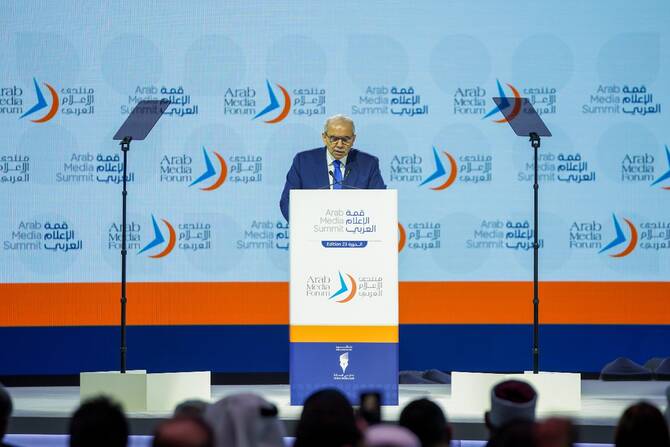
“We are back — back to our state and back to our Arab identity,” Salam declared, concluding his speech and receiving emphatic applause from the audience. (AN photo Gaith Tanjour)
Short Url
Updated 27 May 2025
Follow

Lebanon PM says media is key to nation’s peace after conflict

  • Nawaf Salam thanks UAE, GCC, criticizes Israel for ‘violations’
  • Media must be ‘neutral and a shared space for understanding’

DUBAI: Lebanon’s Prime Minister Nawaf Salam has emphasized the pivotal role of the media in shaping a new era of peace and prosperity for Lebanon.

“We are at a historical juncture in our country, especially when it comes to media. We want a living Arab media that creates the future and doesn’t linger on the past,” Salam said during his address on Tuesday at the Arab Media Summit in Dubai.

Since Lebanon’s ceasefire agreement with Israel in November, the country has been racing to rebuild — physically, socially, and politically.

“We are back — back to our state and back to our Arab identity,” Salam declared, concluding his speech and receiving emphatic applause from the audience.

He credited the UAE and GCC for their support in Lebanon’s recovery, noting the significance of Emirati citizens returning to visit the country.

“I want to thank the GCC, and especially the UAE and its leaders such as His Highness President Mohammed bin Zayed Al-Nahyan, who kept their promise and allowed our Emirati brothers to travel to Lebanon,” he said.

Highlighting the media’s power in shaping public discourse, Salam acknowledged both its potential for progress and its risk of harm.

“Seventy-five percent of the world’s population has a smartphone; 67 percent are connected to the internet, and 57 percent receive news through social media,” he said.

“Media is becoming a tool for misinformation and the spread of distorted context.”

In a country marked by decades of political and sectarian divides, Salam stressed the importance of media neutrality in his nation.

“We don’t want the media to be loyal to us. We want it to be professional, neutral, and a shared space for understanding,” he stated.

Despite progress, Salam warned that Lebanon’s path forward remains complex, but harnessing the influence of the media was a critical tool for improving conditions in Lebanon, and maintaining sovereignty.

“We still have commitments,” he said, referring to the implementation of UN Security Council Resolution 1701. “We continue to face occupation of our land and ongoing violations from Israel.”

He reassured, however, that while the media can be a “maker of peace and war,” Lebanon would prioritize a neutral media outlet — free from sectarian ties — that upholds truth for the well-being of all Lebanese citizens.

“I speak to you not only as a prime minister, but as Lebanese citizen, I have lived through the pain and hope, and I also believe that when words are honest and true, they can be a bridge to building humanity between communities.”

“Lebanon is making its comeback from its crises, based on the principle of reform and sovereignty. Our vision for Lebanon is not just imagined, it is a project.

“We want a state of decision and a country that is enshrined in its Arab identity and to become a bridge from the east to the west,” he said.

“We are back, we are back to our state and back to our Arab identity,” he said.


Jailed French journalist files appeal in Algeria’s top court: lawyers

Updated 15 December 2025
Follow

Jailed French journalist files appeal in Algeria’s top court: lawyers

  • Gleizes was arrested in May 2024 after traveling to Tizi Ouzou in northeastern Algeria’s Kabylia region — home to the Amazigh Kabyle people — to write about the country’s most decorated football club, Jeunesse Sportive de Kabylie

ALGIERS: French journalist Christophe Gleizes, sentenced to seven years behind bars in Algeria on terror-related charges, has filed an appeal seeking a new trial with the country’s highest court, his lawyers said Sunday.
“Christophe Gleizes registered an appeal at (the court of) Cassation” on Sunday, the deadline for filing, his French lawyer Emmanuel Daoud told AFP in a message, declining to comment further.
Gleizes’ Algerian lawyer Amirouche Bakouri made a similar announcement on Facebook.
Earlier this month, an Algerian appeals court upheld the seven-year prison term for the sportswriter, who was first convicted of “glorifying terrorism” in June.
Gleizes was arrested in May 2024 after traveling to Tizi Ouzou in northeastern Algeria’s Kabylia region — home to the Amazigh Kabyle people — to write about the country’s most decorated football club, Jeunesse Sportive de Kabylie.
In 2021, he had met in Paris with the head of the Movement for the Self-Determination of Kabylie (MAK), a foreign-based group designated a terrorist organization by Algiers earlier that year.
At this month’s appeal hearing, Gleizes had said he did not know the MAK had been listed as a terrorist organization, and asked the court’s forgiveness for his “journalistic mistakes.”
The court’s decision to uphold his sentence was denounced by the rights group Reporters Without Borders (RSF), as well as the French government.
Gleizes’s jailing comes at a time of diplomatic friction between Paris and Algiers that began last year when France officially backed Moroccan sovereignty over the disputed Western Sahara region, where Algeria backs the pro-independence Polisario Front.
He is currently France’s only journalist imprisoned abroad, according to RSF, and French President Emmanuel Macron has vowed to work toward his release.

Mother makes plea

The mother of the jailed journalist Christophe Gleizes wrote a letter to Algeria’s president requesting he pardon her son from his seven-year sentence on terror-related charges.
“I respectfully ask you to consider granting Christophe a pardon, so that he may regain his freedom and his family,” Sylvie Godard wrote in the letter, which was dated December 10 and seen by AFP on Monday.
“Nowhere in any of his writings will you find any trace of statements hostile to Algeria and its people,” she wrote in her letter to President Abdelmadjid Tebboune.