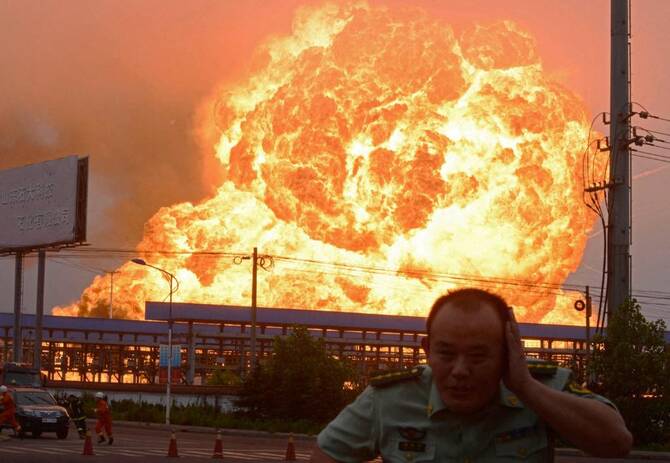
HONG KONG: A large explosion took place at a chemical plant in China’s eastern province of Shandong on Tuesday, state media said, but gave no immediate details of casualties, while unverified social media images showed smoke billowing high over the plant.
Emergency services swung in to begin rescue and treatment efforts after the blast, just before noon in the workshop of Shandong Youdao Chemical, broadcaster CCTV said, but gave no further details.
Posts on Chinese social media platform Weibo after the explosion showed shattered glass in nearby villages, with residents saying they had felt its vibrations.
Shandong Youdao Chemical is owned by Himile Group, which also owns listed Himile Mechanical, shares of which were down nearly 4 percent on Tuesday afternoon.
Youdao was set up in August 2019 in the Gaomi Renhe chemical park in the provincial city of Weifang, its website says, sprawling across more than 700 acres (47 hectares), with more than 300 employees.
It develops, produces and sells technology for pesticides, pharmaceuticals and related fine chemical intermediates.


Large blast hits chemical plant in China’s Shandong
https://arab.news/v34kx
Large blast hits chemical plant in China’s Shandong

- Posts on Chinese social media platform Weibo after the explosion showed shattered glass in nearby villages


Venezuela advances amnesty bill that could lead to mass release of political prisoners
- Such an amnesty is a central demand of the country’s opposition and human rights organizations with backing from the United States
CARACAS: Venezuela’s legislature on Thursday advanced an amnesty bill proposed by acting President Delcy Rodríguez that could lead to the release of hundreds of opposition leaders, journalists and human rights activists detained for political reasons.
Such an amnesty is a central demand of the country’s opposition and human rights organizations with backing from the United States. But the contents of the bill have not been released publicly, and rights groups have so far reacted with cautious optimism — and with demands for more information.
The bill, introduced just weeks after the US military captured then-President Nicolás Maduro, still requires a second debate that has yet to be scheduled. Once approved, it must be signed by Rodríguez before it can go into effect.
In announcing the bill late last month, Rodríguez told a gathering of justices, magistrates, ministers, military brass and other government leaders that the ruling party-controlled National Assembly would take up the legislation with urgency.
“May this law serve to heal the wounds left by the political confrontation fueled by violence and extremism,” she said in a pre-taped televised event. “May it serve to redirect justice in our country, and may it serve to redirect coexistence among Venezuelans.”
Rights groups, fearing some political detainees will be excluded, want more details about the requirements for amnesty before any final vote.
The Venezuelan Program for Education-Action in Human Rights, or PROVEA, issued a statement emphasizing that the bill must be made public urgently due to its potential impact on victims’ rights and broader Venezuelan society.
Based on what is known so far about the legislation, the amnesty would cover a broad timeline, spanning the administration of the late Hugo Chávez from 1999 to 2013 and that of his political heir, Maduro, until this year. It would exclude people convicted of murder, drug trafficking, and serious human rights violations, reports indicate.


