

‘Posterity won’t forgive us’: Pakistan urges world powers to secure ceasefire for Gaza

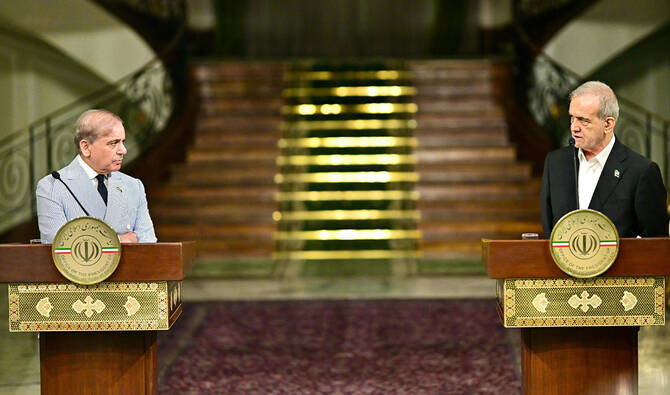
Prime Minister of Pakistan, Shehbaz Sharif, giving a joint press statement with President of Iran, Masoud Pezeshkian, in Tehran, Iran, on May 26, 2025. (PID)
Short Url
Updated 27 May 2025
Follow

‘Posterity won’t forgive us’: Pakistan urges world powers to secure ceasefire for Gaza

  • Israel’s military offensive has killed 53,900 Palestinians since Oct. 2023, according to Gaza health authorities
  • With food still critically short after nearly three-month blockade, Washington says it is working to restore ceasefire

ISLAMABAD: Pakistani Prime Minister Shehbaz Sharif on Monday called on international powers to ensure a lasting and immediate ceasefire in Gaza, warning that “posterity will not forgive us” if Israel’s military offensive in the besieged enclave continued.

Fierce Israeli attacks are ongoing, including most recently on a school building where dozens of Palestinians sheltering inside were killed.

With food still critically short after a nearly three-month blockade, Washington says it is working to restore a ceasefire more than 19 months into the war, but progress is elusive.

“We condemn the untold stories of miseries and atrocities in the land of Gaza where more than 50,000 Palestinians have been martyred and as I speak this story of bloodbath continues,” Sharif said in Tehran at a joint press conference with Iran’s President Masoud Pezeshkian.

“It’s high time that international community uses its influence to bring ceasefire and lasting ceasefire in that part of the world, otherwise posterity will not forgive us.”

Israel launched its latest air and ground war in Gaza after a cross-border attack by the Hamas group on October 7, 2023, which killed 1,200 people by Israeli tallies, with 251 hostages abducted into Gaza. The war has killed more than 53,900 Palestinians since, according to Gaza health authorities, and devastated the coastal strip. 

The entire 2.1 million population of Gaza is facing prolonged food shortages, with nearly half a million people in a catastrophic situation of hunger, acute malnutrition, starvation, illness and death, according to the World Health Organization. Food security groups say more than 93 percent of children in Gaza, about 930,000, are at risk of famine. Using satellite data, the United Nations estimated in February that 69 percent of the structures in Gaza have been damaged or destroyed.

With most of Gaza’s two million population squeezed into an ever narrowing zone on the coast and in the area around the southern city of Khan Younis by Israel’s military operation, international pressure to get aid in quickly has ratcheted up.

Israel’s initial blockade on Gaza, immediately following the October 7 attacks, prevented the entry of humanitarian aid for several weeks. As the war progressed, aid has been allowed in limited quantities.

Israel has recently announced that a new aid system, sponsored by the United States and run by private contractors, will soon begin operations from four distribution centers in the south of Gaza, but many details of how the system will work remain unclear. The UN has already said it will not work with the new system, which it says will leave aid distribution conditional on Israel’s political and military aims.

Israel says its forces will only provide security for the centers and will not distribute aid themselves.

Even as the aid has begun to slowly trickle in, the Israeli military has continued its intensified ground and air operation launched last week, which Prime Minister Benjamin Netanyahu said would end with Israel taking full control of the Gaza Strip.


Islamabad hits back after Indian minister blames Pakistan army for ‘ideological hostility’

Updated 10 sec ago
Follow

Islamabad hits back after Indian minister blames Pakistan army for ‘ideological hostility’

  • Jaishankar tells a public forum most of India’s problems with Islamabad stem from Pakistan’s military establishment
  • Pakistan condemns the remarks, accusing India of waging a propaganda drive to deflect from its destabilizing actions

ISLAMABAD: Pakistan accused India on Sunday of running a propaganda campaign to malign its state institutions, a day after Indian External Affairs Minister Subrahmanyam Jaishankar attributed what he described as Pakistan’s “ideological hostility” toward New Delhi to the country’s powerful army.

Addressing a public forum in New Delhi, Jaishankar said most of India’s problems with Pakistan stemmed from its military establishment, which he argued had cultivated and sustained an entrenched animosity toward India.

His remarks came months after a brief but intense military confrontation between the nuclear-armed neighbors, during which both sides exchanged artillery and missile fire and deployed drones and fighter jets.

Responding to the comments, Pakistan’s Foreign Office spokesperson Tahir Andrabi called them “highly inflammatory, baseless and irresponsible.”

“Pakistan is a responsible state and its all institutions, including armed forces, are a pillar of national security, dedicated to safeguarding the sovereignty and territorial integrity of the country,” Andrabi said in a statement. “The May 2025 conflict vividly demonstrated Pakistan armed forces’ professionalism as well as their resolve to defend the motherland and the people of Pakistan against any Indian aggression in a befitting, effective yet responsible manner.”

“The attempts by Indian leadership to defame Pakistan’s state institutions and its leadership are a part of a propaganda campaign designed to distract attention from India’s destabilising actions in the region and beyond as well as state-sponsored terrorism in Pakistan,” he said, adding that such “incendiary rhetoric” showed the extent of India’s disregard for regional peace and stability.

Andrabi said that rather than making “misleading remarks about the armed forces of Pakistan,” India should confront the “fascist and revisionist Hindutva ideology that has unleashed a reign of mob justice, lynchings, arbitrary detentions and demolition of properties and places of worship.”

He warned that the Indian state and its leadership had become hostage to “this terror in the name of religion.”

India and Pakistan have fought three wars since independence in 1947. They have also engaged in countless border skirmishes and major military standoffs, including the 1999 Kargil conflict.

The four-day conflict in May 2025 ended with a US-brokered ceasefire, after Washington said both sides had expressed willingness to pursue dialogue.

Pakistan said it was ready to discuss all outstanding issues, but India declined talks.


-End