

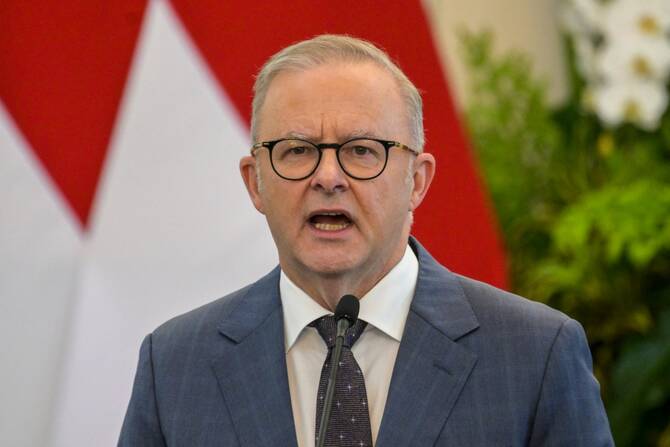
Australian PM calls Israel’s defense of Gaza blockade ‘completely untenable’

Australia’s prime minister Anthony Albanese has strongly criticized Israel’s ongoing blockade of humanitarian aid into Gaza, calling the move “an outrage” and the Israeli government’s justifications “completely untenable.” (AFP/File Photo)
Short Url
Updated 26 May 2025
Follow

Australian PM calls Israel’s defense of Gaza blockade ‘completely untenable’

  • Idea of democratic state withholding supplies ‘an outrage,’ Anthony Albanese says
  • Australian lawmaker urges government to terminate defense contracts with Israel

LONDON: Australia’s prime minister has strongly criticized Israel’s ongoing blockade of humanitarian aid into Gaza, calling the move “an outrage” and the Israeli government’s justifications “completely untenable.”

Speaking at a press conference on Monday, Anthony Albanese said: “Israel’s actions are completely unacceptable. It is outrageous that there be a blockade of food and supplies to people who are in need in Gaza. People are starving. The idea that a democratic state withholds supply is an outrage.”

His comments follow Australia’s decision to join 22 other countries — including the UK, Canada and New Zealand — in condemning Israel over the restricted flow of aid into the war-torn Palestinian territory.

The UN has warned that the entire population of Gaza is facing famine, describing the 80-day blockade as potentially “the cruelest phase of this cruel conflict.”

Albanese said he conveyed Australia’s “deep concern” directly to Israeli President Isaac Herzog during a meeting in Rome last week.

“I made it very clear that Australia finds these actions as completely unacceptable and we find Israel’s excuses and explanations completely untenable and without credibility,” The Guardian newspaper quoted him as saying.

“That is (a position) I have indicated clearly and directly to the Israeli government. It’s one that we will continue to be part of international statements as we were last week.”

While reaffirming that Hamas should have no future role in governing Gaza or the West Bank and calling for the release of remaining Israeli hostages taken during the Oct. 7 attacks, Albanese urged Israel to respect humanitarian obligations.

“States which are democratic states have a responsibility to behave in a way that is consistent with international law and with humanitarian concerns,” he said.

“The whole world is concerned about what has occurred with the blockade and Australia will continue to make clear statements on that.”

Meanwhile, Australian Foreign Minister Penny Wong condemned the “abhorrent and outrageous” recent comments from members of the government of Israeli Prime Minister Benjamin Netanyahu, saying Israel “cannot allow the suffering” in Gaza to continue.

The statements from Albanese and Wong come amid growing domestic pressure.

Labor Party lawmaker Ed Husic wrote in The Guardian last week that Australia “can and should be doing more” and called on the government to summon the Israeli ambassador and demand the immediate, freer flow of aid.

“Australia has a proud tradition of refusing to be silent on the world stage when it comes to defending vulnerable and oppressed people,” he said.

“We can be emboldened by our legacy of doing so. Two million starving people in Gaza need all the help we can muster alongside others.”

On Monday, Greens Sen. David Shoebridge renewed calls for the government to go further by terminating defense contracts with Israeli arms manufacturers and their subsidiaries.

Despite Netanyahu promising last week to ease the 11-week siege to prevent a “starvation crisis,” aid agencies have said the situation in Gaza is becoming critical.

UN Secretary-General Antonio Guterres said on Friday that what Israel had authorized “amounts to a teaspoon of aid when a flood of assistance is required.”

The Israeli military said 107 aid trucks entered Gaza on Thursday, but the UN and aid groups argue the quantity is grossly inadequate. Israel accuses Hamas of diverting supplies, a claim disputed by the UN and humanitarian organizations.


Thai and Cambodian top diplomats meet in China to solidify ceasefire

Updated 58 min 22 sec ago
Follow

Thai and Cambodian top diplomats meet in China to solidify ceasefire

  • The ceasefire agreement comes with a 72-hour observation period, at the end of which Thailand agreed to repatriate 18 Cambodian soldiers it has held as prisoners since earlier fighting in July

BEIJING: Top diplomats from Thailand and Cambodia kicked off two days of talks in China on Sunday as Beijing seeks to strengthen its role in mediating the two countries’ border dispute, a day after they signed a new ceasefire.
The ceasefire agreement signed on Saturday calls for a halt to weeks of fighting along their contested border that has killed more than 100 people and displaced over half a million in both countries.
Thai Foreign Minister Sihasak Phuangketkeow and Cambodian Foreign Minister Prak Sokhonn were set to meet in China’s southwestern Yunnan province for talks mediated by their Chinese counterpart, Wang Yi.
The talks aim to ensure a sustained ceasefire and promote lasting peace between the countries, according to a statement by Sihasak’s office.
Wang was scheduled to join both bilateral meetings with each of the diplomats and a trilateral talk on Monday.
China has welcomed the ceasefire announcement, which freezes the front lines and allows for displaced civilians to return to their homes near the border.
“China stands ready to continue to provide (the) platform and create conditions for Cambodia and Thailand to have fuller and more detailed communication,” a Chinese Foreign Ministry statement read.
The ceasefire agreement comes with a 72-hour observation period, at the end of which Thailand agreed to repatriate 18 Cambodian soldiers it has held as prisoners since earlier fighting in July. Their release has been a major demand of the Cambodian side.
China has sought to position itself as a mediator in the crisis, along with the United States and Malaysia.
A July ceasefire was brokered by Malaysia and pushed through by pressure from US President Donald Trump, who threatened to withhold trade privileges unless Thailand and Cambodia agreed.
Despite those deals, Thailand and Cambodia carried on a bitter propaganda war, and minor cross-border violence continued, erupting into heavy fighting in early December.
Prak Sokhonn, in a statement after his meeting with Wang, expressed deep appreciation for China’s “vital role” in supporting the ceasefire.
China also announced 20 million yuan ($2.8 million) of emergency humanitarian aid for Cambodia to assist the displaced.
The first batch of Chinese aid, including food, tents and blankets, arrived in Cambodia on Sunday, Wang Wenbin, Chinese ambassador to Cambodia, wrote on Facebook.
Sihasak said Sunday he hoped the meetings would convey to China that it should both support a sustainable ceasefire and send a signal to Cambodia against reviving the conflict or attempting to create further ones.
“Thailand does not see China merely as a mediator in our conflict with Cambodia but wants China to play a constructive role in ensuring a sustainable ceasefire by sending such signals to Cambodia as well,” he said.