Pakistani PM makes peace offer to India during visit to Iran 

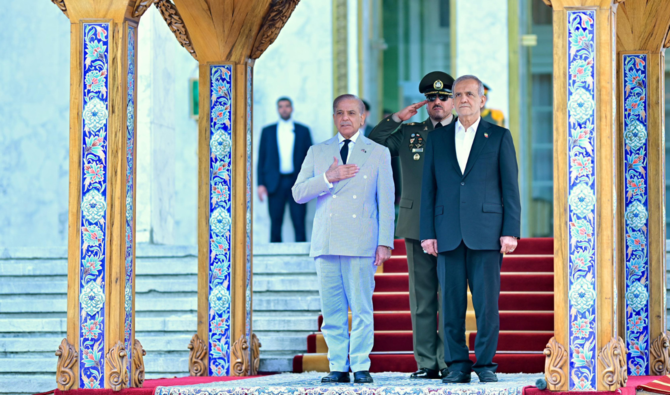
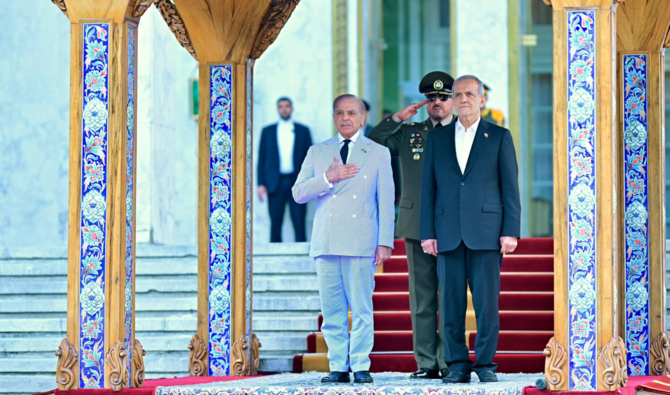
Prime Minister Shehbaz Sharif and President of Iran Dr. Masoud Pezeshkian (R) stand as the Pakistani PM receives a Guard of Honor at Sa'dabad Palace in Tehran, on May 26, 2025. (PMO)
Short Url
Updated 26 May 2025
Follow

Pakistani PM makes peace offer to India during visit to Iran 

  • PM Sharif says ready to discuss water sharing, terrorism and Kashmir dispute if India was “serious”
  • PM arrived in Iran after visit to Turkiye as part of regional diplomacy tour following India standoff

ISLAMABAD: Pakistani Prime Minister Shehbaz Sharif made a peace offer to India during a visit to Tehran today, Monday, saying Islamabad was ready to hold talks on water sharing, countering terrorism and the Kashmir dispute if New Delhi was “serious.”

The two nuclear-armed nations have just emerged from their worst military conflict in decades earlier this month, when they launched missiles and drones deep into each other’s territories and exchanged gunfire on their de facto border, the Line of Control, until a ceasefire was announced on May 10. Nearly 70 people combined were killed on both sides of the border. 

India had hit Pakistan first, saying it targeted “terrorist infrastructure” in response to an April 22 militant attack in Indian-administered Kashmir that New Delhi accused Islamabad of being behind — a charge it denies. After the attack, India also unilaterally suspended the 1960 Indus Waters Treaty that governs the sharing of river waters between the two neighbors. 

The Muslim-majority Himalayan region of Kashmir is claimed by both India and Pakistan and has been the focus of several wars and diplomatic stand-offs.

“We wanted peace, we want peace and we will work for peace in the region through talks, on the table, and resolve our outstanding issues,” Sharif said in a joint press conference with Iranian President Masoud Pezeshkian.

Among the issues Pakistan wanted to discuss, the PM said, was the Kashmir conflict, which he said needed to be resolved according to several resolutions passed by the UN Security Council, including one which says a plebiscite should be held to determine the future of the mostly Muslim region of Kashmir.

“We are ready to talk for the sake of peace on water issues with our neighbor, we are ready to talk to promote trade and also counter terrorism if they are serious, but if they choose to remain the aggressor then we shall defend our country and territory,” Sharif said. 

“But if they accept my offer of peace, then we will show that we really want peace, seriously and sincerely.”

The Iranian president also welcomed the ceasefire established between Pakistan and India. 

“Undoubtedly, settling differences through dialogue and through a peaceful manner is the precondition for sustainable peace and development at the national, regional and international levels,” Pezeshkian said. 

“We believe that in the region, sustaining the sustainable security and trying to create friendly relations with our neighboring countries is among the common policies of Iran and Pakistan.”

REGIONAL DIPLOMACY TOUR

Sharif arrived in Iran today, Monday, after a visit to Turkiye as part of a regional diplomacy tour following the latest military standoff with India. 

Iran’s foreign minister Abbas Araqchi had called for restraint and visited both nations following India’s first strikes on Pakistan on May 7, setting off nearly four days of fighting.

On Sunday, Sharif reached Turkiye as the first stop in the diplomacy tour to nations that were either supportive of Islamabad during the latest crisis with India, or that helped mediate the conflict. After Iran, he will go onwards to Tajikistan and Azerbaijan.

Turkish President Tayyip Erdogan spoke by phone with Sharif on May 7 to convey his solidarity after India first hit Pakistan and Azad Kashmir with missiles. Leaders from the two nations had several contacts subsequently and it is widely believed that Turkiye played an important role, besides the US, UAE and Saudi Arabia, in convincing India and Pakistan to back off and agree to a ceasefire. The two nations have strong ties, both being largely Muslim countries and sharing historical links.

Iran’s leadership also offered to mediate the conflict and there were several contacts between its foreign minister and the Pakistani PM and other leaders. 


Pakistan stocks recover as oil supply fears ease after Islamabad seeks Red Sea route— analyst

Updated 05 March 2026
Follow

Pakistan stocks recover as oil supply fears ease after Islamabad seeks Red Sea route— analyst

  • Pakistan has sought Saudi help to secure oil supplies via Red Sea port after Iran’s closure of Strait if Hormuz
  • Analyst says higher crude oil prices, expectations of IMF releasing next loan tranche also triggered bullish activity

ISLAMABAD: Pakistani stocks marked a sharp recovery when trading closed on Thursday, as institutional activity increased following Islamabad’s move to seek crude oil supplies through the Red Sea port eased oil supply fears, a financial analyst said. 

Pakistani stocks have recorded a sharp decline this week, with the benchmark KSE-100 index recording its largest-ever single-day decline on Monday when it plunged 16,089 points. Escalating conflict in the Middle East triggered panic selling at the Pakistani bourse, forcing a temporary trading halt on Monday. 

The KSE-100 index, however, gained 3.49 percent or 5,433.46 points to close at 161,210.67 when trading ended on Thursday, up from the previous close of 155,777.21 points, according to Pakistan Stock Exchange’s (PSX) data.

Pakistan’s Petroleum Minister Ali Pervaiz Malik met Saudi Ambassador Nawaf bin Said Al-Malki on Wednesday to discuss Iran’s closure of the key Strait of Hormuz, which has threatened Pakistan’s energy supply. Roughly 20 percent of the global oil and gas supply passes through the route. Saudi Arabia indicated it could facilitate shipments through the Red Sea port of Yanbu, offering an alternative route if Gulf shipping lanes remain disrupted, the petroleum ministry said on Wednesday. 

“Stocks staged a sharp recovery at PSX amid institutional activity on easing fuel supply fears after KSA [Kingdom of Saudi Arabia] commits oil supplies through the Red Sea port,” Ahsan Mehanti, chief executive officer at Arif Habib Commodities, told Arab News.

He said higher global crude oil prices and expectations of the International Monetary Fund releasing its next tranche of the $7 billion loan for Pakistan also helped bullish activity at the PSX.

An IMF mission was in Pakistan to hold talks on the third review of a $7 billion Extended Fund Facility multi-year program, and for the second review of the $1.4 billion Resilience and Sustainability Facility this week.

However, the delegation left for Türkiye amid tensions in the Gulf. Pakistani officials have said talks are likely to continue virtually in the coming days. 

Pakistani brokerage Topline Securities said in its daily market review report that strong institutional buying “turned the tide” on Thursday after the market’s recent overreaction to regional issues.

The report added that Hub Power Company (HUBC), Oil & Gas Development Company (OGDC), Fauji Fertilizer Company (FFC), Engro Corporation (ENGROH), and Meezan Bank Limited (MEBL) collectively contributed 2,197 points to the KSE benchmark’s gain.

Topline Securities said 723 million shares were traded on Thursday, with K-Electric Limited (KEL) stealing the spotlight as more than 1.17 billion shares changed hands.

Pakistani investors are closely monitoring developments in the Gulf, particularly around energy routes and further retaliatory actions, as the conflict’s trajectory remains uncertain.