

OPEC+ output hike puts Pakistan in ‘sweet spot’ — analysis 

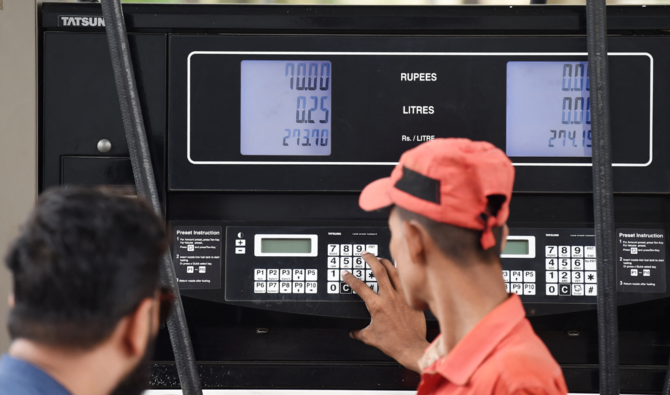
An employee prepares to fill petrol in a vehicle at a fuel station in Karachi on August 1, 2023. (AFP/ file)
Short Url
Updated 26 May 2025
Follow

OPEC+ output hike puts Pakistan in ‘sweet spot’ — analysis 

  • Saudi Arabia, Russia, six other OPEC+ members have surprised markets by announcing sharp hike in oil production for May, June 
  • Analysts believe development is “broadly positive” for Pakistan’s macroeconomic outlook and its equity market

ISLAMABAD: Despite oil trading low at $60, the Organization of the Petroleum Exporting Countries and their allies — collectively known as OPEC+ — is expected this week to continue to further open the taps, a development that analysts believe is “broadly positive” for Pakistan’s macroeconomic outlook and the equity market.

In past months, Saudi Arabia, Russia and six other OPEC+ members have surprised markets by announcing a sharp increase in oil production for May and June despite the low prices. 

This week the cartel will hold two meetings, one online on Wednesday with all OPEC+ members to discuss the group’s common strategy, and one on Sunday with just the eight member states, known as the “V8,” that have made the largest cuts in recent years.

“During the group’s upcoming meeting on June 1, members are likely to approve a production increase that is three times larger than the previously planned hike of 137k barrels per day,” Pakistani brokerage house Topline Securities said in an analysis, saying the “aggressive” output hike had put Pakistan in a “sweet spot.”

“We believe this development is broadly positive for Pakistan’s macroeconomic outlook, with positive spillover for equity market, which is trading below historical valuation multiples.”

Topline said companies reliant on Re-gasified Liquefied Natural Gas such as Tariq Glass Industries, Ghani Glass Limited, and Descon Oxychem Limited were set to gain from declining feedstock prices and poised for margin expansion in the coming quarters. 

“On the other hand, exploration and production companies may face earnings pressure due to weaker oil prices but improved cash recoveries and enhanced liquidity could support their cash flow generation,” Topline said. 

“Overall, we maintain a bullish stance on the equity market, supported by improving macro fundamentals. However, a key risk remains the upcoming federal budget, particularly the possibility of adverse tax measures on capital gains or corporate profits, could temper investor sentiment.”

Analysts expect the V8 to up production by 411,000 barrels a day for July — the same as in May and June — whereas the initial plan called for an increase of just 137,000 barrels.

This could further weigh down prices already slumping to lows last seen during the pandemic, which hit global demand.

OPEC+ have justified their change in strategy by citing “current healthy market fundamentals, as reflected in the low oil inventories.”

With inputs from AFP


Pakistan’s president defends ongoing strikes in Afghanistan, urges Kabul to dismantle militants

Updated 02 March 2026
Follow

Pakistan’s president defends ongoing strikes in Afghanistan, urges Kabul to dismantle militants

  • Afghanistan on Thursday launched attacks in retaliation for Pakistani airstrikes the previous Sunday
  • Pakistan’s military says it is only targeting Afghan military installations to avoid civilian casualties

ISLAMABAD: Pakistan’s president on Monday defended his country’s ongoing military strikes in neighboring Afghanistan, saying Islamabad tried all forms of diplomacy before targeting militants operating from Afghan territory, and called on the Taliban government in Kabul to disarm groups responsible for attacks in Pakistan.

Pakistan earlier said it is in “open war” with Afghanistan, alarming the international community. The border area remains a stronghold for militant organizations including Al-Qaeda and the Daesh (Islamic State) group.

“(The Afghan Taliban) must choose to dismantle the terror groups that survive on conflict and its war economy,” Asif Ali Zardari said during a speech to lawmakers, adding that “no state accepts serial attacks on its soil.”

Afghanistan on Thursday launched attacks in retaliation for Pakistani airstrikes the previous Sunday. Since then, Pakistan has carried out operations along the border, with Information Minister Attaullah Tarar claiming the killing of 435 Afghan forces and the capture of 31 Afghan positions.

Kabul has denied such claims.

In Afghanistan, the deputy government spokesman Hamdullah Fitrat said Pakistan’s military fired mortar shells at a refugee camp in eastern Kunar province, killing three children and injuring three others.

Afghanistan’s defense ministry said Afghan forces carried out strikes targeting a Pakistani military facility near Paktia province, causing “substantial losses and heavy casualties.”

Pakistan’s military did not respond to questions. It has said Pakistan is only targeting Afghan military installations to avoid civilian casualties.

Pakistan has witnessed a surge of violence in recent months and blames it on the outlawed Pakistani Taliban, known as Tehreek-e-Taliban Pakistan or TTP. It operates both inside Pakistan and from Afghan territory.
Islamabad accuses Afghanistan’s Taliban government of providing safe havens for the TTP, which Kabul denies.

The latest cross-border fighting ended a ceasefire brokered by Qatar and Turkiye in October. The two sides failed to reach a permanent agreement during talks in Istanbul.

Zardari reiterated Pakistan’s call for talks, saying, “We have never walked away from dialogue.”

The Pakistani leader again accused Afghanistan of acting as a proxy for India by sheltering militant groups.

“Stop being used by another country as a battlefield for their ambitions,” he said.

Zardari cited a recent report from the United Nations Security Council’s monitoring team that described the presence of militant groups in Afghanistan as an extra-regional threat.