

Israeli minister Ben Gvir, settlers storm Al-Aqsa compound

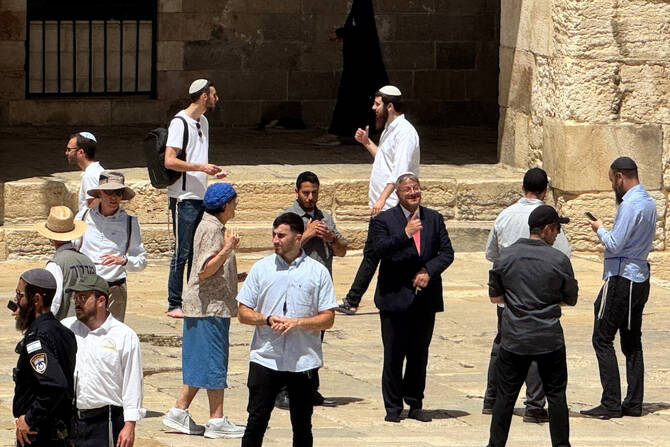
Israeli National Security Minister Itamar Ben-Gvir visits the Al-Aqsa compound during Jerusalem’s Day, in Jerusalem’s Old City May 26, 2025. (Reuters)
Short Url
Updated 26 May 2025
Follow

Israeli minister Ben Gvir, settlers storm Al-Aqsa compound

  • More than 900 extremist Jewish settlers, accompanied by Israeli police, storm holy site
  • Large groups of young Israeli Jews marched shouting “Death to Arabs” and “May your village burn”

DUBAI: Far-right Israeli National Security Minister Itamar Ben Gvir on Monday stormed the Al-Aqsa Mosque compound during controversial “Jerusalem Day” celebrations marking Israel’s 1967 capture of East Jerusalem — a move that further heightened tensions in the occupied city.

His visit coincided with the entry of more than 900 extremist Jewish settlers, accompanied by Israeli police, into the courtyards of the sacred site — known to Jews as the Temple Mount — according to the Jerusalem Islamic Waqf Department.

The group included Knesset members and rabbis who performed what the Waqf described as “provocative Talmudic rituals” throughout the compound. In one incident, a settler raised an Israeli flag and danced in the eastern section of Al-Aqsa, a move viewed by Palestinians as a violation of the site's fragile status quo, which prohibits non-Muslim prayer.

The Waqf also reported that settlers attempted to bring Torah scrolls through the Mughrabi Gate, while hundreds more gathered in Al-Buraq Square and near Qattanin Gate to perform religious rituals and dances.

Meanwhile, Israeli extremist Knesset member Moshe Feiglin was reportedly planning to visit the site later in the day after awarding a medal to a retired Israeli soldier who took part in the 1967 occupation of Jerusalem.

Tensions escalated further in the surrounding areas as large groups of young Israeli Jews — many wrapped in flags and chanting nationalist slogans — marched through Muslim neighborhoods of the Old City. Some were heard shouting “Death to Arabs” and “May your village burn” as they moved through the narrow alleyways, where Palestinian shops had closed early in anticipation of violence.

Volunteers from the pro-peace groups Standing Together and Free Jerusalem attempted to position themselves between the marchers and Palestinian residents to de-escalate tensions. Despite their efforts, confrontations flared. “This is our home, this is our state,” one protester shouted at a Palestinian woman. “Go away from here!” she replied, in Hebrew.

Police deployed heavily throughout the area, erecting iron barriers at key entry points including Damascus Gate, and heavily restricting Palestinian access. At one point, an Israeli officer was seen raising his arms in celebration and embracing a marcher — a moment that underscored the increasingly blurred lines between law enforcement and nationalist demonstrators.

The annual “Flag March,” expected to pass through densely populated Palestinian areas such as Al-Wad Street and Damascus Gate, has long been viewed as a flashpoint for violence, with settler provocations and harassment of Muslim worshippers reportedly intensifying in recent days.


Spain highlights importance of Gaza reconstruction

Palestinian prime minister, Mohammed Mustafa, and the Spanish foreign minister, Jose Manuel Albares. (AP)
Updated 02 January 2026
Follow

Spain highlights importance of Gaza reconstruction

  • Spain officially recognized Palestine as a state in May 2024, in a coordinated move alongside Ireland and Norway

RAMALLAH: The Palestinian prime minister, Mohammed Mustafa, and the Spanish foreign minister, Jose Manuel Albares, on Friday discussed the latest developments in the West Bank and Gaza Strip.
During their telephone conversation they emphasized the need to intensify international efforts to end the Israeli occupation and halt attacks and settler violence, and to secure the release of Palestinian funds held by Israeli authorities.
They affirmed the importance of ongoing efforts relating to plans for the reconstruction of Gaza, and Europe’s significant role in this process. Mustafa and Albares highlighted the need to unify Palestinian institutions in Gaza with those in the West Bank, with the aim of establishing a Palestinian state in line with international resolutions, including last year’s New York Declaration.
They also discussed coordination between their countries, and the strengthening of Spain’s political, diplomatic and financial support for Palestine, and Mustafa thanked Spain for its ongoing support.
Spain officially recognized Palestine as a state in May 2024, in a coordinated move alongside Ireland and Norway. Estephan Salameh, the Palestinian finance and planning minister, is set to visit Spain this month to discuss enhanced cooperation, particularly in the areas of development and reconstruction. Meanwhile, Israel continues operating in the occupied West Bank.
The Palestinian Prisoners media office said on Friday that Israel carried out numerous raids across the territory, including the major cities of Ramallah and Hebron, according to The Associated Press.
Nearly 50 people were detained, following the arrest of at least 50 other Palestinians on Thursday, most of those in the Ramallah area.
As 2026 begins, the shaky 12-week-old ceasefire between Israel and Hamas has largely ended large-scale Israeli bombardment of Gaza. 
But Palestinians are still being killed by Israeli fire, especially along the so-called Yellow Line that delineates areas under Israeli control, and the humanitarian crisis is compounded by frequent winter rains and colder temperatures.
On Friday, American actor and film producer Angelina Jolie visited the Rafah border crossing between Egypt and the Gaza Strip. 
The only crossing between the territory and a country other than Israel, it remains closed despite Palestinian requests to reopen it to people and aid.
Jolie met with members of the Red Crescent on the Egyptian side of the Rafah border crossing and then visited a hospital in the nearby city of Arish to speak with Palestinian patients on Friday, according to Egyptian officials.
Aid groups say not enough shelter materials are getting into Gaza during the truce.