

Pakistani PM to meet Erdogan today in first leg of regional diplomacy tour

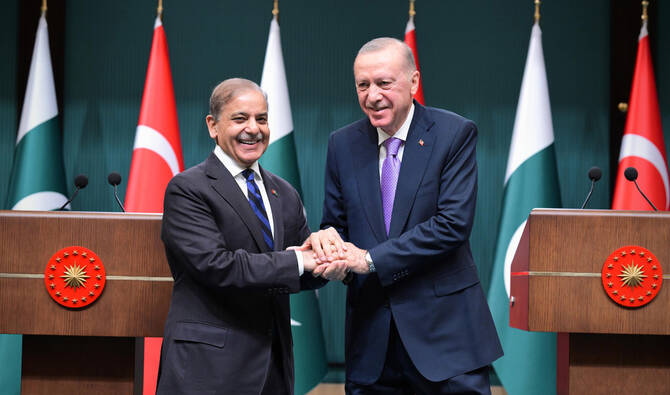
Turkiye’s President Recep Tayyip Erdogan shaking hands with Pakistan’s Prime Minister Shehbaz Sharif (left) after addressing a joint press conference in Ankara on April 22, 2025. (PID/File)
Short Url
Updated 25 May 2025
Follow

Pakistani PM to meet Erdogan today in first leg of regional diplomacy tour

  • Sharif will visit Iran, Azerbaijan, Tajikistan and Turkiye on five-day visit
  • All four nations supported Pakistan in recent military standoff with India

ISLAMABAD: Prime Minister Shehbaz Sharif on Sunday started a five-day regional diplomacy tour with a trip to Turkiye where he will hold talks with Turkish President Tayyip Erdogan in Istanbul, Erdogan’s office said.

Sharif will go onwards from Turkiye to Iran, Azerbaijan and Tajikistan, four nations that openly supported Pakistan in a military standoff with India earlier this month when the two nuclear-armed neighbors traded missile, drone and artillery strikes for days, killing around 70 people on both sides. A ceasefire was reached on May 10. 

The conflict, the worst between the neighbors in decades, was triggered by a militant attack on tourists in Indian-administered Kashmir on April 22 that New Delhi blamed on Pakistan. Islamabad denies involvement. 

“During the meeting, bilateral relations, regional and international issues, including the fight against terrorism, will be discussed,” Erdogan’s head of communications, Fahrettin Altun, said on X.

The PM’s office in Islamabad released footage of Sharif departing on the tour and said he would hold wide-ranging discussions with the leaders of Turkiye, Iran, Azerbaijan and Tajikistan on “an entire range of issues covering bilateral relations and matters of regional and international importance.”

“He will thank friendly countries for the support they have given to Pakistan during the recent crisis with India,” the PMO statement added. 

Erdogan spoke by phone with Sharif on May 7 to convey his solidarity after India first hit Pakistan and Azad Kashmir with missiles. Leaders from the two nations had several contacts subsequently and Turkiye publicly took Islamabad’s side. It is widely believed that Turkiye played an important role, besides the US, UAE and Saudi Arabia, in convincing India and Pakistan to back off and agree to a ceasefire. The two nations have historically strong ties. 

Bitter rivals India and Pakistan have fought three wars, including two over the disputed region of Kashmir, since gaining independence from British rule in 1947. Both claim the Himalayan territory in its entirety but rule it in part. They both acquired nuclear weapons in 1998.


Pakistan president meets UAE counterpart, explores trade, investment opportunities

Updated 27 January 2026
Follow

Pakistan president meets UAE counterpart, explores trade, investment opportunities

  • Asif Ali Zardari is in UAE on four-day visit to strengthen bilateral ties, review bilateral cooperation
  • Both sides discuss regional, international developments, reaffirm commitment to promote peace

ISLAMABAD: President Asif Ali Zardari met his UAE counterpart Sheikh Mohammed bin Zayed Al-Nahyan in Abu Dhabi on Tuesday during which both sides explored new opportunities in trade, investment, energy and other sectors, Zardari's office said. 

Zardari arrived in Abu Dhabi on Monday evening with a high-level delegation on a four-day official visit to the UAE to review trade, economic and security cooperation. 

"The leaders discussed ways to further deepen the longstanding and brotherly relations between Pakistan and the UAE," a statement from Zardari's office said about his meeting with the UAE president. 

"They reviewed the full spectrum of bilateral cooperation and explored new opportunities in trade, investment, energy, infrastructure, technology, and people-to-people exchanges, highlighting the significant potential for expanding economic and strategic partnership.

Zardari highlighted the significance of Al-Nayhan's visit to Pakistan last month, the statement said, expressing appreciation for the UAE's continued support for strengthening bilateral ties.

It said both sides also exchanged views on a range of regional and international developments, reaffirming their commitment to promoting peace, stability and sustainable development.

The meeting was also attended by Pakistan's First Lady Aseefa Bhutto-Zardari, the Pakistani president's son Bilawal Bhutto-Zardari, who is also the chairman of the Pakistan Peoples Party, Interior Minister Mohsin Naqvi and Pakistan's ambassador to the UAE. 

ZARDARI MEETS AD PORTS CEO

Zardari earlier met AD Ports Group CEO Captain Mohamed Juma Al-Shamisi to discuss the group's investment initiatives in Karachi. 

"Both sides agreed that the expansion and modernization of port infrastructure would strengthen trade flows and support Pakistan’s broader economic development and country’s seaborne trade," the President's Secretariat said in a statement.

It added that Zardari described the AD Ports Group's long-term investment and expanding role in Pakistan's maritime and logistics sector as a key pillar of Pakistan–UAE economic cooperation.

Pakistan and the UAE maintain close political and economic relations, with Abu Dhabi playing a pivotal role in supporting Islamabad during periods of financial stress through deposits, oil facilities and investment commitments. 

The UAE is Pakistan's third-largest trading partner, after China and the United States, and a key destination for Pakistani exports, particularly food, textiles and construction services.

The Gulf state is also home to more than 1.5 million Pakistani expatriates, one of the largest overseas Pakistani communities in the world, who contribute billions of dollars annually in remittances, a crucial source of foreign exchange for Pakistan’s economy.

Beyond trade and labor ties, Pakistan and the UAE have steadily expanded defense and security cooperation over the years, including military training, joint exercises and collaboration in counter-terrorism and regional security matters.