
RIYADH: Conflict-hit Middle Eastern countries have suffered severe economic shocks, with output losses surpassing 60 percent of gross domestic product in some cases, a senior International Monetary Fund official said.
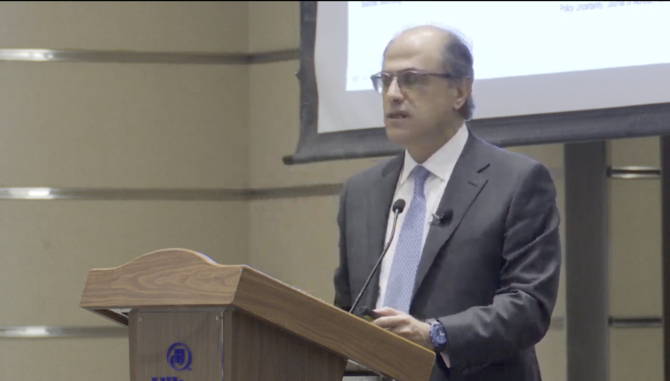
Speaking at an event on Global and Regional Economic Developments and Outlook in Riyadh, Jihad Azour, director of the IMF’s Middle East and Central Asia Department, identified Lebanon, Syria, the West Bank, and Gaza as among the most affected.
The ongoing conflicts have severely disrupted economic activities, infrastructure, and trade in these areas, leading to deep recessions and humanitarian challenges that have compounded the economic fallout.
“Those countries over the last few years have been subjected to a lot of suffering, with a strong negative economic impact, with loss of outputs that could exceed 50 or 60 percent of GDP,” Azour said.
He noted that the ripple effects of these conflicts have extended beyond their immediate borders, saying: “Those conflicts did not only affect countries who were subjected … but also had an impact on the neighborhood.”
According to Azour, Egypt lost around $7 billion in Suez Canal revenues in under a year, largely due to disruptions in maritime trade routes. Meanwhile, Jordan saw a drop in tourism revenue, a sector crucial to its economic output and employment.
The director highlighted that global trade tensions are another major contributor to economic uncertainty, citing the sharp increase in tariffs.
“The rise in tariffs was extremely high. Went from something, for example, for the US — then less than 5 percent — to a peak of 30 percent. This is a big change in such a short period of time,” he said.
He emphasized that rapid developments, whether geopolitical or economic, are defining today’s global landscape, making it increasingly difficult for nations to maintain consistent projections.
“We are at a moment where history is accelerated and developments are shaped very quickly,” he said.
In contrast to the turmoil facing some countries, Azour highlighted the relative stability and resilience of the Gulf Cooperation Council economies.
Reflecting on the region’s evolving economic landscape, Azour said that diversification efforts have helped GCC nations weather global uncertainty.
“GCC economies have benefited from the effort of diversification to maintain a level of growth that could withstand any volatility in oil prices or any cut in oil production,” he said.
He continued: “Over the last three to four years, we had a sustainable level of growth around 3 to 4 percent, 5 percent in certain cases. Thanks to the reforms and to the acceleration of transformation, this has helped GCC countries to maintain a high level of growth, despite the fact that the agreement under the OPEC+ has been extended several times.”
Looking ahead, the IMF official expressed cautious optimism, suggesting that despite the current uncertain environment, the economic outlook across the region remains positive, particularly for oil-exporting nations.
“Let me first say that we expect, despite this maybe foggy background, we expect economies to recover this year across the board, in most of the countries in the region, yet the pickup of growth is going to be stronger in the oil-exporting countries, in particular in GCC, where we expect it also to increase by 1 percent this year and another 1 percent in 2026,” he said.
According to Azour, the anticipated recovery is largely fueled by strong performance and a stable contribution from non-oil sectors across the Gulf, driven by long-term diversification efforts.
He also offered a more hopeful outlook for countries affected by conflict, noting signs of stabilization and early recovery.
“We expect the post-conflict countries to preserve a certain level of growth this year and for some to start recovering,” he said.
Azour added: “The good news is inflation is still under control in most of the countries except a few where the level of inflation is still at double-digit, but for most of the countries, it’s already now getting closer to their objective set in their monetary policy.”
In a region facing mounting challenges, the IMF’s outlook underscores that reform, stability, and smart investment aren’t just options — they’re imperatives for resilience.