

Pakistan PM to begin five-day tour Sunday of Central Asia, Turkiye and Iran

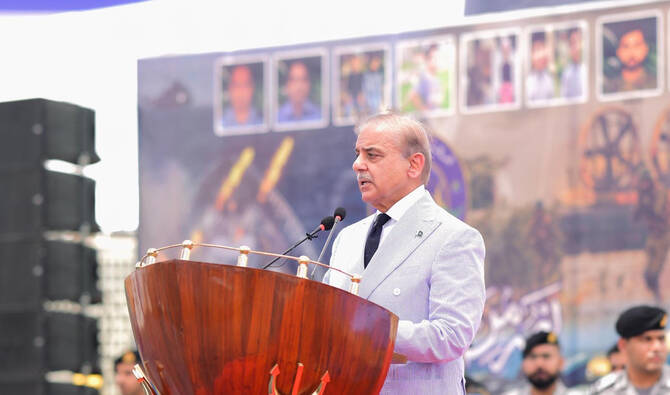
Pakistan Prime Minister Shehbaz Sharif addresses the officers and sailors of Pakistan Navy at Naval Dockyard in Karachi on May 19, 2025. (Photo courtesy: Handout/PMO)
Short Url
Updated 24 May 2025
Follow

Pakistan PM to begin five-day tour Sunday of Central Asia, Turkiye and Iran

  • The development comes two weeks after Pakistan and India traded missile, drone and artillery strikes before agreeing to a truce on May 10
  • During the four-day conflict, several friendly nations supported Pakistan’s demand for a probe into an attack that triggered the standoff

ISLAMABAD: Prime Minister Shehbaz Sharif will embark on Sunday on a five-day tour of Turkiye, Iran, Azerbaijan and Tajikistan to hold discussions about matters of regional and international importance, the Pakistani foreign office said, weeks after a military conflict between Pakistan and India.

Pakistan and India this month traded missile, drone and artillery strikes for days, killing 70 people, before agreeing to a US-brokered ceasefire on May 10.

The conflict was triggered by an attack on tourists in Indian-administered Kashmir on April 22 that New Delhi blamed on Pakistan. Islamabad denies complicity.

During the conflict Several friendly nations supported Pakistan’s demand for a credible, international probe into the attack as they urged the nuclear-armed archfoes to exercise restraint.

“The prime minister will have wide-ranging discussions with the leaders of these countries on an entire range of issues covering bilateral relations and matters of regional and international importance,” the Pakistani foreign office said.

“He will also have the opportunity to express the deepest appreciation and acknowledgment for the support extended to Pakistan by the friendly countries during the recent crisis with India.”

Bitter rivals India and Pakistan have fought three wars, including two over the disputed region of Kashmir, since gaining independence from British rule in 1947. Both claim the Himalayan territory in its entirety but rule it in part.

The latest conflict between the two was the deadliest in more than two decades and raised fears that it could spiral into a full-blown war.

During his visit aimed at furthering Pakistan’s diplomatic outreach, Sharif will also attend the International Conference on Glaciers in Dushanbe, Tajikistan, according to the Pakistani foreign office.

The conference, to be held on May 29-30, aims to advance global efforts in climate adaptation and resilience, with a specific focus on addressing glacial melting.

Pakistan is highly vulnerable to climate change, facing numerous impacts like rising temperatures and increased frequency of extreme weather events.

Officials say unusually high temperatures in Pakistan’s northern areas have resulted in rapid melting of glaciers, warning that the prolonged phenomenon could lead to water shortages and threaten lives in the longer run.

Pakistan reports current account surplus in Jan. owing to improved trade, remittances

Updated 17 February 2026
Follow

Pakistan reports current account surplus in Jan. owing to improved trade, remittances

  • Pakistan’s exports crossed the $3 billion mark in Jan. as the country received $3.5 billion in remittances
  • Last month, IMF urged Pakistan to accelerate pace of structural reforms to strengthen economic growth

ISLAMABAD: Pakistan recorded a current account surplus of more than $120 million in January, the country’s finance adviser said on Tuesday, attributing it to improved trade balance and remittance inflows.

Pakistan’s exports rebounded in January 2026 after five months of weak performance, rising 3.73 percent year on year and surging 34.96 percent month on month, according to data released by the country’s statistics bureau.

Exports crossed the $3 billion mark for the first time in January to reach $3.061 billion, compared to $2.27 billion in Dec. 2025. The country received $3.5 billion in foreign remittances in Jan. 2026.

Khurram Schehzad, an adviser to the finance minister, said Pakistan reported a current account surplus of $121 million in Jan., compared to a current account deficit of $393 million in the same month last year.

“Improved trade balance in January 2026, strong remittance inflows, and sustained momentum in services exports (IT/Tech) continue to reinforce the country’s external account position,” he said on X.

Pakistan has undergone a difficult period of stabilization, marked by inflation, currency depreciation and financing gaps, and international rating agencies have acknowledged improvements after Islamabad began implementing reforms such as privatizing loss-making, state-owned enterprises (SOEs) and ending subsidies as part of a $7 billion International Monetary Fund (IMF) loan program.

Late last month, the IMF urged Pakistan to accelerate the pace of these structural reforms to strengthen economic growth.

Responding to questions from Arab News at a virtual media roundtable on emerging markets’ resilience, IMF’s director of the Middle East and Central Asia Jihad Azour said Islamabad’s implementation of the IMF requirements had been “strong” despite devastating floods that killed more than 1,000 people and devastated farmland, forcing the government to revise its 4.2 percent growth target to 3.9 percent.

“What is important going forward in order to strengthen growth and to maintain the level of macroeconomic stability is to accelerate the structural reforms,” he said at the meeting.

Azour underlined Pakistan’s plans to privatize some of the SOEs and improve financial management of important public entities, particularly power companies, as an important way for the country to boost its capacity to cater to the economy for additional exports.

“This comes in addition to the effort that the authorities have made in order to reform their tariffs, which will allow the private sector of Pakistan to become more competitive,” the IMF official said.