


DEIR AL-BALAH, Gaza Strip: At least 60 people were killed by Israeli strikes across Gaza in a 24-hour period, Gaza’s health ministry said Friday, as Israel pressed ahead with its military offensive and let in minimal aid to the strip.
The dead included 10 people in the southern city of Khan Younis, four in the central town of Deir Al-Balah and nine in the Jabaliya refugee camp in the north, according to the Nasser, Al-Aqsa and Al-Ahli hospitals where the bodies were brought.
Israel is facing mounting international criticism for its latest offensive and pressure to let aid into Gaza amid a catastrophic humanitarian crisis. The strip has been under an Israeli blockade for nearly three months, according to the United Nations. Experts have warned that many of Gaza’s 2 million residents are at high risk of famine.
Even the US, a staunch ally, has voiced concerns over the hunger crisis.
The strikes that lasted into Friday morning came a day after Israeli tanks and drones attacked a hospital in northern Gaza, igniting fires and causing extensive damage, Palestinian hospital officials said on Thursday. Videos taken by a health official at Al-Awda Hospital show walls blown away and thick black smoke billowing wreckage.
Israel said it will continue to strike Hamas until all of the 58 Israeli hostages are released — fewer than half of whom are believed to be alive, according to Israel — and until Hamas disarms.
Suspect charged with murder over deaths of Israeli Embassy staffers in Washington
The strikes come a day after two Israeli Embassy staffers were shot while leaving a reception for young diplomats at the Capital Jewish Museum, in Washington, DC. The suspect told police he “did it for Palestine,” according to court documents filed Thursday as he was charged with murder. He didn’t enter a plea.
On Thursday night, Israel’s Prime Minister Benjamin Netanyahu called the killings in Washington horrific and blasted France, the UK and Canada for proposing to establish a Palestinian state.
“Because by issuing their demand, replete with a threat of sanctions against Israel — against Israel, not Hamas — these three leaders effectively said they want Hamas to remain in power,” he said.
Earlier this week the three leaders issued one of the most significant criticisms by close allies of Israel’s handling of the war in Gaza and its actions in the West Bank, threatening to take “concrete actions” if the government did not cease its renewed military offensive and significantly lift restrictions on humanitarian aid.
Aid starts entering, but agencies say nothing like enough
Amid pressure, Israel started letting in aid. Israeli officials said Friday they let in more than 100 trucks of aid, including flour, food, medical equipment and drugs. The trucks came in through the Kerem Shalom crossing.
But UN agencies say the amount is woefully insufficient, compared with around 600 trucks a day that entered during a recent ceasefire and that are necessary to meet basic needs. UN agencies say Israeli military restrictions and the breakdown of law and order in Gaza make it difficult to retrieve and distribute the aid. As a result, little of it has so far reached those in need.
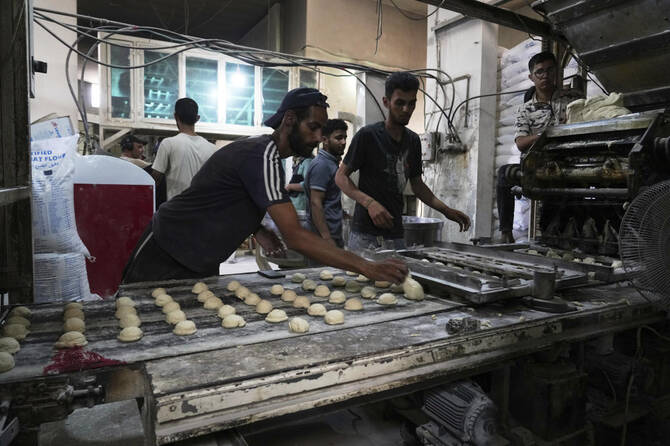
The World Food Program said on Friday said that 15 of its trucks were looted Thursday night in southern Gaza while going to WFP-supported bakeries.
It said that hunger and desperation about whether food was coming in is contributing to rising insecurity, and called on Israel to allow greater volumes of food to enter, faster and more efficiently.
Israel says the aid now is to bridge the gap until a US backed initiative starts soon. A group known as the Gaza Humanitarian Foundation will take over aid distribution in Gaza, and armed private contractors would guard the distribution. Israel says the system is needed because Hamas siphons off significant amounts of aid. The UN denies that claim.
On Friday a Geneva-based advocacy group said it was taking legal action to urge Swiss authorities to monitor the foundation.
TRIAL International, which focuses on international justice, said it made legal submissions to make sure that the privately-run foundation, which is listed in the Geneva commercial registry, abides by Swiss law, notably on the activities of private security groups.
The Gaza Humanitarian Foundation didn’t immediately respond to request for comment.
No movement on ceasefire negotiations in Doha
Earlier this week, Netanyahu said he was recalling his high-level negotiating team from the Qatari capital, Doha, after a week of ceasefire talks failed to bring results. A working team will remain.
Qatari Prime Minister and Foreign Minister Mohammed bin Abdulrahman Al Thani said a “fundamental gap” remained between the two parties and that none of the proposals was able to bridge their differences.
Hamas said no real ceasefire talks have taken place since last week in Doha. The group accused Netanyahu of “falsely portraying participation” and attempting to “mislead global public opinion” by keeping Israel’s delegation there without engaging in serious negotiations.
The war in Gaza began when Hamas-led militants attacked southern Israel, killing some 1,200 people, mostly civilians, and abducting 251 others. The militants are still holding 58 captives, around a third of whom are believed to be alive, after most of the rest were returned in ceasefire agreements or other deals.
Israel’s retaliatory offensive, which has destroyed large swaths of Gaza, has killed more than 53,000 Palestinians, mostly women and children, according to Gaza’s Health Ministry, which doesn’t differentiate between civilians and combatants in its count.


