


KARACHI: Business confidence has significantly improved among investors in Pakistan that is largely attributed to macroeconomic stability, declining inflation and anticipated improvements in business conditions over the next six months, a survey by Pakistan’s Overseas Investors Chamber of Commerce and Industry (OICCI) revealed on Thursday.
The Business Confidence Index (BCI) Survey – Wave 27, conducted across Pakistan in March-April 2025, shows the overall business confidence improved by 16 percentage points from negative 5 percent to positive 11 percent, compared to the previous Wave 26 survey in October-November 2024.
The Manufacturing sector led the recovery, improving from negative 3 percent to positive 15 percent, followed by the Retail/Wholesale sector, which rose from negative 18 percent to positive 2 percent in the latest survey. The Services sector maintained a steady outlook and jumped from 2 percent to 10 percent positive.
“The uptick in business confidence is a clear sign that our economic direction is on the right track. We are focused on creating a conducive environment for investment, supporting private sector growth, and ensuring long-term macroeconomic resilience,” Finance Minister Muhammad Aurangzeb was quoted as saying by the OICCI.
“The improved sentiment among businesses is both encouraging and a validation of our collective efforts.”
The development comes more than a week after the International Monetary Fund (IMF) approved a loan program review for Pakistan, unlocking a $1 billion payment which the State Bank of Pakistan said had been received. A fresh $1.4 billion loan was also approved under the IMF’s climate resilience fund.
Since averting a default in 2023, the South Asian country has been making rigorous efforts to boost its economy by offering various incentives to investors, particularly from abroad.
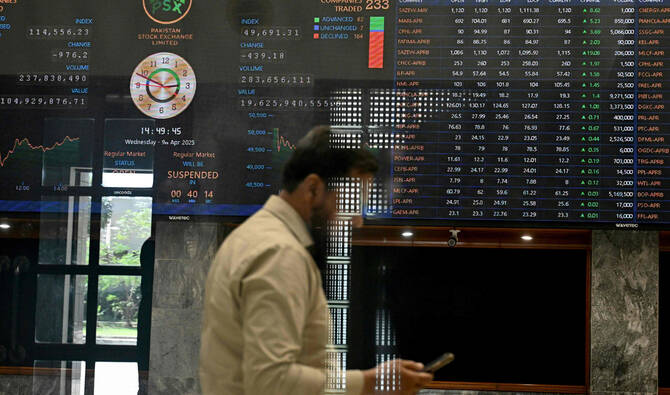
Pakistan’s stocks, which rose more than 80 percent last year, have largely resisted selling pressures in recent weeks, despite the country’s conflict with India that saw the two sides strike each other with missiles, drones and artillery.
Commenting on the survey’s findings, OICCI President Yousaf Hussain said the overall business confidence had shown a notable improvement across the business community over the past two years.
“This sharp recovery in the Business Confidence in the latest Wave 27 reflects the resilience of Pakistan’s business sector and its readiness to seize emerging growth opportunities,” he said.
“It is heartening to see positive momentum across key sectors, which reflects improved sentiment and growing trust in the country’s economic direction.”
Hussain said there must be greater policy consistency, transparency and active engagement with key stakeholders, including OICCI members, to maintain this growing positivity in the business confidence.
The BCI Wave 27 survey revealed increased optimism for the next six months, with 45 percent of the respondents expressing positive expectations.
“Key contributors to this positive outlook include economic growth, improved government policies, investment climate,” the survey report read.
“Despite the positive trend, 53 percent of the survey respondents reported a negative outlook on business conditions over the past six months, which is a substantial improvement from 66 percent negative sentiments in Wave 26. The key concerns indicated in the survey related to political stability, Rupee FX parity, Energy, and trade policies.”
The BCI of foreign investors, who OICCI members randomly selected for the survey, showed a remarkable increase from positive 6 percent to 17 percent, according to the findings.
This improvement is primarily attributed to better global business climate, an improved industry environment in Pakistan over the past six months, and expectations of increased capital investment in the coming six months.
“The latest BCI Wave 27 results were better than anticipated, with positive expectations reflected across all major sectors. Employment prospects, expansion plans, and investment expectations demonstrated notable gains, particularly in the Manufacturing and Retail sectors,” OICCI Secretary-General Abdul Aleem said.
“Despite notable improvement on the overall BCI, the new investment plans overall showed an improvement of 19 percent, but remained negative, which is an area of concern and needs to be addressed to further accelerate economic growth, energize large-scale manufacturing, trade and export.”


