


SEOUL: North Korea is seeking to arrest those responsible for the failed launch of its second naval destroyer, as it denied the warship suffered major damage – a claim quickly met with outside skepticism.
A statement from North Korea on its handling of the botched launch came after leader Kim Jong Un expressed fury over an incident that he said was caused by criminal negligence. The main military committee said Friday that those responsible would be held responsible for an “unpardonable criminal act.”
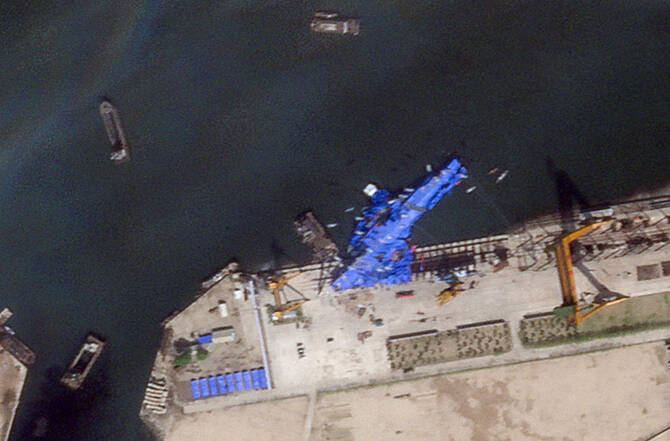
Satellite imagery on the site showed vessel lying on its side and draped in blue covers, with parts of it submerged. North Korea says it’ll take about 10 days to repair its damage, but outside observers question that timeframe because damage to the ship appeared much worse than what North Korea claims.
Here is what you need to know about the failed ship launch:
How much damage was there to the ship
North Korea’s state news agency, KCNA, said Friday that the severity of the damage to the 5,000-ton-class destroyer was “not serious” as it canceled an earlier assessment that the bottom of the hull had been left with holes.
It said the hull on the starboard side was scratched and some seawater had flowed into the stern section. But it said it’ll take a total of 10 days to pump up the seawater, set the ship upright and fix the scratches.
It’s almost impossible to verify the assessment because of the extremely secretive nature of North Korea. It has a history of manipulating or covering up military-related setbacks, policy fiascoes and other mishaps, though it has periodically acknowledged some in recent years.
Lee Illwoo, an expert with the Korea Defense Network in South Korea, said the North Korean warship likely suffered much worse damage, including the flooding of its engine room located in the stern section, and holes in the starboard. He said North Korea could simply set the ship upright, paint it and claim the ship has been launched, but that repairs could take more than a year as the replacement of an engine requires cutting the hull.
Why the ship’s launch failed
According to the North Korean account, the destroyer was damaged when a transport cradle on the ship’s stern detached early during a launch ceremony at the northeastern port of Chongjin on Wednesday.
Moon Keun-sik, a navy expert who teaches at Seoul’s Hanyang University, said North Korean workers are probably not familiar with launching a 5,000-tonne-class warship, which is nearly three times heavier than its existing main navy ships.
Observers say North Korea tried to launch the destroyer sideways, a method it has never used for warships, although it has previously employed it with big cargo and passenger ships.
Compared with those non-military vessels, Lee sad it would be more difficult to maintain balance with the destroyer because it’s equipped with heavy weapons systems. He suspected North Korean scientists and workers likely did not factor that in.
How Kim has reacted
The damaged ship is assessed as the same class as North Korea’s first destroyer, launched with great fanfare last month with a floating dry dock at a western shipyard. It is North Korea’s biggest and most advanced warship to date, and Kim called its construction “a breakthrough” in modernizing North Korea’s naval forces to cope with what he calls US-led security threats.
Subsequently, a failure to launch the second destroyer was an embarrassment for Kim. But by disclosing it to both internally and externally, Kim could be trying to show his resolve in modernizing naval forces and boost discipline at home. He ordered officials to thoroughly investigate the case and repair the warship before a high-level ruling Workers’ Party meeting in late June.
North Korea said Friday the country’s Central Military Commission summoned Hong Kil Ho, manager of the Chongjin shipyard, as it begun its investigation of the failed launch.
“No matter how good the state of the warship is, the fact that the accident is an unpardonable criminal act remains unchanged, and those responsible for it can never evade their responsibility for the crime,” the commission said, according to state media.
Kim Dong-yub, a professor at the University of North Korean Studies in Seoul, said North Korea appears to be using the failed launch as a chance to strengthen the ruling party’s control over science and technological sectors.
Lee Choon Geun, an honorary research fellow at South Korea’s Science and Technology Policy Institute, said that North Korea’s handling of the damaged warship could have long-term consequences for its defense science sector, especially if military scientists face harsh punishment.
“If scientists are held severely accountable, I would say the future of North Korea’s defense science doesn’t look very bright, as it would be a sign that political responsibility is being prioritized over technical accountability,” Lee wrote on Facebook.


