

Modi remarks on damaging Pakistani water, economy and army against ‘responsible statecraft’ — FO

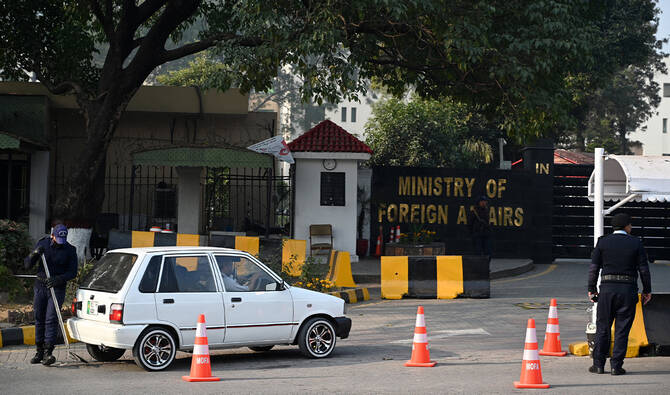
A Pakistani police officer checks a vehicle stand entering the Ministry of Foreign Affairs in Islamabad on January 18, 2024. (AFP/File)
Short Url
Updated 23 May 2025
Follow

Modi remarks on damaging Pakistani water, economy and army against ‘responsible statecraft’ — FO

  • India last month said it was suspending the Indus Waters Treaty in a slew of measures over an April 22 attack in Indian-administered Kashmir
  • Islamabad maintains the treaty, which guarantees water for 80 percent of Pakistani farms, is legally binding and no party can unilaterally suspend it

ISLAMABAD: The Pakistani foreign office (FO) on Friday criticized Indian Prime Minister Narendra Modi for his remarks on denying water to Pakistan from rivers flowing through India as well as economic and military consequences for Islamabad, saying they violated “the norms of responsible statecraft.”

Modi said on Thursday Pakistan will not get water from rivers over which India has rights, and that Pakistan’s army and economy will have to “pay a heavy price for every terrorist attack,” upping the rhetoric in a standoff over water access.

India last month said it was suspending the Indus Waters Treaty in a slew of measures after the killing of 26 people in an April 22 attack in Indian-administered Kashmir that New Delhi blamed on Islamabad, a charge Pakistan dismisses.

In its response to Modi’s comments at an event in Rajasthan, the Pakistani foreign office said such statements not only reflect a “deliberate attempt to mislead the public but also violate the norms of responsible statecraft.”

“Resorting to threats and boasting about military action against a sovereign nation is a grave breach of the United Nations Charter and established principles of international law,” it said.

“This dangerous approach undermines regional peace and stability.”

Any move to stop Pakistan accessing the water would have a devastating impact. The Indus treaty, brokered by the World Bank in 1960, guarantees water for 80 percent of Pakistan’s farms from three rivers that flow from India. The nuclear-armed neighbors have already clashed in their worst military fighting in nearly three decades before agreeing to a ceasefire on May 10.

Islamabad maintains the treaty is legally binding and no party can unilaterally suspend it, with its Attorney General Mansoor Usman Awan saying that Pakistan is willing to talk about or to address any concerns India may have.

The foreign office said Pakistan remains a consistent and proactive partner in the global fight against militancy and any insinuation seeking to associate Pakistan with “acts of terrorism is factually incorrect and patently misleading.”

“It is a tactic often employed to divert attention from India’s own internal challenges, particularly its repressive policies [in Kashmir],” it said on Friday.

India and Pakistan share a troubled relationship since they got independence from British rule in 1947, and have fought three wars, two of them over the Himalayan region of Kashmir, which they both claim in full but rule in part.

India accuses Pakistan of backing armed separatists in Kashmir. Pakistan denies this and says it only offers diplomatic and political support to Kashmiris.

Pakistan’s prime minister and military have also accused “Indian terror proxies” of involvement in a suicide bomb blast on an army school bus in Pakistan’s restive Balochistan province that killed five people, including three children, on Wednesday. India rejected the allegation.
Both nations have retaliated since the April attack by halting trade, closing borders and suspending most visas.

The Pakistani foreign office urged the Indian leadership to exercise restraint, saying such escalatory statements only exacerbate tensions.
“India should demonstrate maturity by resolving outstanding disputes through peaceful dialogue and diplomacy,” it said.

“Pakistan remains firmly committed to peaceful coexistence, regional stability, and constructive engagement. However, our desire for peace should not be misconstrued as weakness... Any misadventure or aggression will be met with a resolute and proportionate response. Pakistan has demonstrated its resolve in the past and will do so again, if required.”


Pakistan reports current account surplus in Jan. owing to improved trade, remittances

Updated 17 February 2026
Follow

Pakistan reports current account surplus in Jan. owing to improved trade, remittances

  • Pakistan’s exports crossed the $3 billion mark in Jan. as the country received $3.5 billion in remittances
  • Last month, IMF urged Pakistan to accelerate pace of structural reforms to strengthen economic growth

ISLAMABAD: Pakistan recorded a current account surplus of more than $120 million in January, the country’s finance adviser said on Tuesday, attributing it to improved trade balance and remittance inflows.

Pakistan’s exports rebounded in January 2026 after five months of weak performance, rising 3.73 percent year on year and surging 34.96 percent month on month, according to data released by the country’s statistics bureau.

Exports crossed the $3 billion mark for the first time in January to reach $3.061 billion, compared to $2.27 billion in Dec. 2025. The country received $3.5 billion in foreign remittances in Jan. 2026.

Khurram Schehzad, an adviser to the finance minister, said Pakistan reported a current account surplus of $121 million in Jan., compared to a current account deficit of $393 million in the same month last year.

“Improved trade balance in January 2026, strong remittance inflows, and sustained momentum in services exports (IT/Tech) continue to reinforce the country’s external account position,” he said on X.

Pakistan has undergone a difficult period of stabilization, marked by inflation, currency depreciation and financing gaps, and international rating agencies have acknowledged improvements after Islamabad began implementing reforms such as privatizing loss-making, state-owned enterprises (SOEs) and ending subsidies as part of a $7 billion International Monetary Fund (IMF) loan program.

Late last month, the IMF urged Pakistan to accelerate the pace of these structural reforms to strengthen economic growth.

Responding to questions from Arab News at a virtual media roundtable on emerging markets’ resilience, IMF’s director of the Middle East and Central Asia Jihad Azour said Islamabad’s implementation of the IMF requirements had been “strong” despite devastating floods that killed more than 1,000 people and devastated farmland, forcing the government to revise its 4.2 percent growth target to 3.9 percent.

“What is important going forward in order to strengthen growth and to maintain the level of macroeconomic stability is to accelerate the structural reforms,” he said at the meeting.

Azour underlined Pakistan’s plans to privatize some of the SOEs and improve financial management of important public entities, particularly power companies, as an important way for the country to boost its capacity to cater to the economy for additional exports.

“This comes in addition to the effort that the authorities have made in order to reform their tariffs, which will allow the private sector of Pakistan to become more competitive,” the IMF official said.