

Islamabad to present evidence of Indian involvement in Balochistan school bus bombing at UN

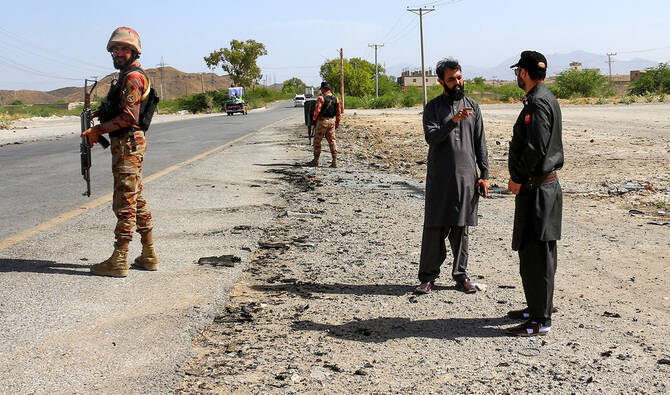
Security personnel stand guard at the site of a school bus bombing in Khuzdar district of Balochistan province on May 21, 2025. (AFP)
Short Url
Updated 23 May 2025
Follow

Islamabad to present evidence of Indian involvement in Balochistan school bus bombing at UN

  • India has denied any involvement in the attack that killed six people, including four school children
  • Pakistan’s UN envoy says many countries have expressed concern over India’s suspension of IWT

ISLAMABAD: Pakistan will raise the recent militant attack on a school bus in the southwestern Balochistan province at the United Nations (UN) and present evidence of Indian involvement to the international community, said the country’s top diplomat at the UN on Thursday.

At least six people, including four children, were killed on Wednesday when a vehicle-borne improvised explosive device targeted a school bus en route to an army-run school in the Khuzdar district.

Balochistan has witnessed a separatist insurgency for decades, though it has intensified more recently, with groups like the Baloch Liberation Army (BLA) carrying out high-casualty attacks on civilians and security forces.

Pakistan says such militant outfits are backed by India, though New Delhi denies the claim. The Indian administration also distanced itself from the Khuzdar school bus bombing, attributing such acts of violence to Pakistan’s “internal failures.”

“This was a heinous terrorist act directed against children, against students, [which is] totally unacceptable and condemnable,” Ambassador Asim Iftikhar Ahmad, Pakistan’s Permanent Representative to the United Nations, told Arab News in an interview.

“Pakistan is going to share the evidence [of Indian involvement] with the members of the international community, including in the UN,” he continued.

Ahmad said Pakistan had also provided evidence of India’s involvement in “terrorist activities” in the past, adding it was going to do it again.

He maintained New Delhi had been committing “terrorism” in Pakistan both directly and through its proxies.

He informed Pakistan would present a dossier to the UN and its member states to highlight a clear pattern of Indian involvement in militant violence aimed at destabilizing Pakistan, particularly Balochistan.

“The dossier will contain information about who is involved [and] what are the linkages,” he added.

The envoy said Pakistan had, in the past, proposed the listing of Indian nationals involved in orchestrating violent activities in Pakistan.

“Some of the members of the Security Council … did not act responsibly and in fact they block such listings,” he informed, adding it was the collective responsibility of all UN members to assess the situation objectively and not protect India unnecessarily.

Asked about India’s unilateral suspension of the Indus Waters Treaty (IWT), the ambassador said Pakistan had already raised the issue at the Security Council, as the move was highly escalatory and posed an existential threat to the country.

“We discussed this … during the meeting of the Security Council that was held on 5th of May, where a number of members of the Security Council expressed concern because it is clearly viewed by the international community as a violation of international law,” he said.


In Karachi, a café where Ramadan means feeding anyone who arrives hungry

Updated 10 sec ago
Follow

In Karachi, a café where Ramadan means feeding anyone who arrives hungry

  • Karachi’s Cafe Mehmood has offered free meals to the needy for nearly four decades
  • Restaurant owners say paying customers and charity diners receive the same quality food

KARACHI: As the call to Maghrib prayer echoes through Karachi’s Sindhi Muslim Housing Society, long rows of people seated along a busy roadside begin to break their fast. Plates of fruit, samosas and glasses of the rose-flavored drink Rooh Afza move down the line as men, women and children share the evening meal after a long day of fasting in the city’s humid heat.

The gathering is a familiar Ramadan scene outside Cafe Mehmood, a modest restaurant in Pakistan’s largest city that has quietly sustained one of Karachi’s longest-running traditions of feeding the hungry.

Operating since the 1980s, the eatery is well known not only for its food but for a daily dastarkhwan, a communal meal spread laid out for anyone who arrives hungry. Donations collected from visitors and well-wishers help fund the initiative, allowing the restaurant to provide meals throughout the year to people who cannot afford to pay.

The tradition reflects a wider culture of charitable food distribution in Pakistan, particularly during Ramadan, when mosques, community groups and businesses organize iftar meals for fasting Muslims. In Karachi, a sprawling city of more than 20 million people, such initiatives often fill gaps in a fragile social safety net.

“Around 12,000 people come to this dastarkhwan daily and derive benefit from it,” said Imran Khan, the eldest son of one of the restaurant’s founders.

Pakistan, a country of more than 240 million people, has struggled with rising living costs in recent years following economic turmoil marked by inflation, currency depreciation and higher energy prices. For many families dependent on daily wages or informal employment, free community meals can provide an essential lifeline.

Cafe Mehmood’s story began in 1985, when three brothers opened the restaurant and named it after one of them, Mehmood. The charitable meals started modestly when the founders began serving food to a handful of people sitting on the footpath outside the restaurant.

Over time, word spread and more people began arriving. Donations from visitors and well-wishers helped expand the effort into a large-scale operation feeding thousands each day.

Communal meal spreads are common across Karachi, particularly during Ramadan, but the scale and schedule of the dastarkhwan outside Cafe Mehmood sets it apart.

“There are no specific [meal] timings,” Khan said. “It starts at seven in the morning and runs until 12 at midnight. During that period if anyone comes empty stomach, they are fed well.”

During Ramadan, however, the restaurant focuses its efforts on iftar and the meals that continue until the pre-dawn suhoor.

The service runs throughout the year, pausing only on three days annually: Eid Al-Fitr and the first two days of Eid Al-Adha. 

According to Khan, the restaurant prepares iftar for around 2,000 to 2,500 people each day, followed by dinner for roughly the same number.

To manage the demand, Cafe Mehmood operates a separate kitchen dedicated to preparing food for the charity meals. Inside the restaurant, customers who pay for their meals sit at tables, while outside, those who cannot afford to pay are served at long communal spreads laid out on the street.

Yet the owners say the difference is only in where the food is served, not in its quality.

“We make sure there is no compromise on quality while the taste, hygiene and service is similar to what we offer to our customers,” said Ismail Saeed, one of the founders’ grandsons who joined the family business five years ago.

Today, the restaurant and its charitable kitchen are run by the next generation: six members of the founding families and their nine sons.

Saeed said he had long wanted to take part in continuing the tradition.

“It has been a part of our genes since the beginning to help the needy, not just in terms of food but otherwise as well,” he said.

“We were provided with a platform through which we could do it, so I was always very keen about it.”

The charity meals are sustained through a combination of restaurant contributions and public donations. Visitors frequently stop by to give cash, while others transfer money online after learning about the initiative.

For those who cannot attend the communal meal spreads in person, the restaurant also distributes food parcels, particularly to women and people registered as deserving beneficiaries.

A typical meal served through the charity program includes chicken or beef gravy with two flatbreads, costing around Rs110 (about $0.39) per serving.

Despite its popularity, Cafe Mehmood historically avoided promoting its charitable work. For the family that runs the joint, the goal has remained simple: that no one who comes to their door leaves hungry.

“It was also the need of the hour,” Saeed said.
