

Islamabad defends nuclear safety after former US national security adviser warns of risks

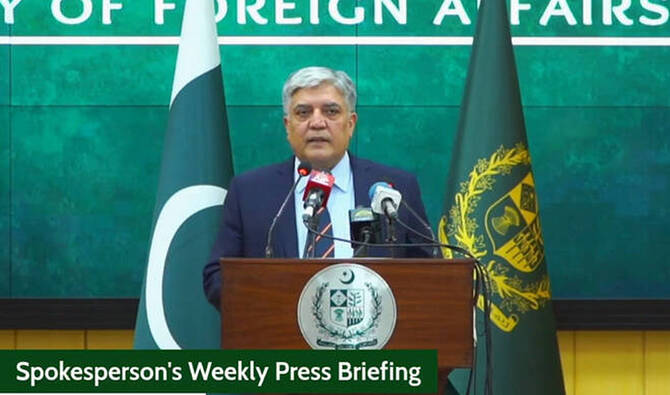
The screengrab taken from the press conference of Pakistan’s Ministry of Foreign Affairs shows the foreign office’s spokesperson Shafqat Ali Khan addressing the weekly media briefing in Islamabad on May 16, 2025. (Screengrab/MOFA)
Short Url
Updated 23 May 2025
Follow

Islamabad defends nuclear safety after former US national security adviser warns of risks

  • John Bolton tells an Indian media outlet Pakistan’s nuclear weapons could fall into the wrong hands
  • Pakistan says the world should be more concerned about India’s ‘extremists’ controlling nuclear arms

ISLAMABAD: Pakistan said on Thursday it was fully confident in the safety and security of its nuclear weapons after former US National Security Adviser John Bolton expressed concern they could fall “into the hands of terrorists or irresponsible commanders” in an interview with an Indian media outlet.

Bolton’s remarks came days after Indian Defense Minister Rajnath Singh called for Pakistan’s nuclear arsenal to be placed under the supervision of the International Atomic Energy Agency, citing concerns about their safety.

Responding to a media query, foreign office spokesperson Ambassador Shafqat Ali Khan said Pakistan had a robust nuclear command and control system and a comprehensive security regime in place.

“It is ironic that John Bolton’s remarks were prompted by a statement from Rajnath Singh, a leader affiliated with a Hindu extremist organization, known for repeatedly issuing threats of aggression against Pakistan,” he said.

“In reality, the international community should be more concerned about India’s nuclear arsenal being controlled by individuals like Rajnath Singh, who harbor well-documented hostility toward Pakistan and Muslims, and exhibit dangerous delusions of grandeur,” he added.

Khan further warned of broader risks stemming from India’s domestic political trends.

“The escalating radicalization of India’s political landscape, media and segments of its society raises legitimate nuclear security concerns,” he said.

“These concerns are further exacerbated by the persistence of a nuclear black market in India, highlighting serious deficiencies in its nuclear security framework, as evidenced by recurring incidents of theft and illicit trafficking of sensitive nuclear materials.”

The renewed war of words between the two countries follows a sharp military escalation earlier this month.

The two nuclear-armed neighbors agreed to a US-brokered ceasefire on May 10, but diplomatic tensions have remained high, with both sides continuing to trade barbs over militant violence, water sharing and nuclear security.


Pakistan deputy PM directs authorities to monitor food prices ahead of Ramadan 

Updated 27 January 2026
Follow

Pakistan deputy PM directs authorities to monitor food prices ahead of Ramadan 

  • Prices of essential food items surge during holy month of Ramadan due to hoarding, profiteering by traders
  • Deputy PM Ishaq Dar directs authorities to prevent artificial price hikes, exploitation of consumers in Ramadan

ISLAMABAD: Pakistan’s Deputy Prime Minister Ishaq Dar on Tuesday directed authorities to monitor prices of essential food items ahead of Ramadan to prevent artificial price hikes and consumers from getting exploited, his office said. 

Pakistani increasingly shop for essential food items during the holy month of Ramadan, as millions across the country fast from dawn till sunset. Prices of essential food items surge during the holy month every year as traders often indulge in hoarding and profiteering. 

Dar chaired a meeting to review the availability and prices of essential commodities across the country on Tuesday, his office said. 

“DPM/FM [foreign minister] directed federal & provincial authorities to continue close monitoring, particularly in view of the approaching month of Ramazan, to prevent any artificial price hike or exploitation of consumers by unscrupulous elements,” Dar’s office said in a statement.

A central moon sighting committee in Pakistan, the Ruet-e-Hilal Committee, determines when Ramadan begins. The Islamic month is expected to start this year after mid-February, around Feb. 17 or Feb. 18.

Pakistan’s government also announces subsidies for the masses during the holy month to lower the prices of essential food items. 

In 2024, the Shehbaz Sharif-led government announced a Ramadan package comprising a subsidy of $26.8 million (Rs7.5 billion) to lower the prices of essential items for over 30,96,00,000 families.