

Islamabad defends nuclear safety after former US national security adviser warns of risks

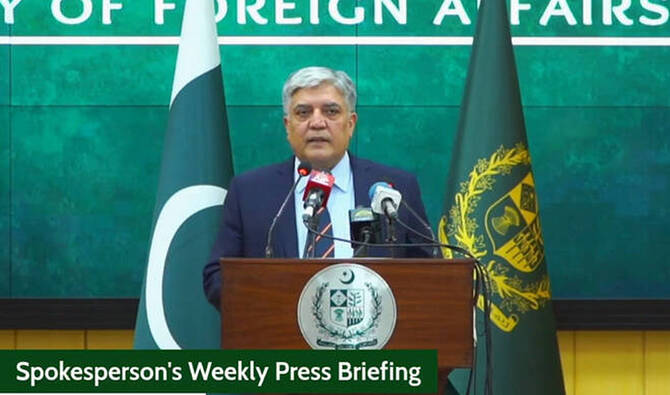
The screengrab taken from the press conference of Pakistan’s Ministry of Foreign Affairs shows the foreign office’s spokesperson Shafqat Ali Khan addressing the weekly media briefing in Islamabad on May 16, 2025. (Screengrab/MOFA)
Short Url
Updated 23 May 2025
Follow

Islamabad defends nuclear safety after former US national security adviser warns of risks

  • John Bolton tells an Indian media outlet Pakistan’s nuclear weapons could fall into the wrong hands
  • Pakistan says the world should be more concerned about India’s ‘extremists’ controlling nuclear arms

ISLAMABAD: Pakistan said on Thursday it was fully confident in the safety and security of its nuclear weapons after former US National Security Adviser John Bolton expressed concern they could fall “into the hands of terrorists or irresponsible commanders” in an interview with an Indian media outlet.

Bolton’s remarks came days after Indian Defense Minister Rajnath Singh called for Pakistan’s nuclear arsenal to be placed under the supervision of the International Atomic Energy Agency, citing concerns about their safety.

Responding to a media query, foreign office spokesperson Ambassador Shafqat Ali Khan said Pakistan had a robust nuclear command and control system and a comprehensive security regime in place.

“It is ironic that John Bolton’s remarks were prompted by a statement from Rajnath Singh, a leader affiliated with a Hindu extremist organization, known for repeatedly issuing threats of aggression against Pakistan,” he said.

“In reality, the international community should be more concerned about India’s nuclear arsenal being controlled by individuals like Rajnath Singh, who harbor well-documented hostility toward Pakistan and Muslims, and exhibit dangerous delusions of grandeur,” he added.

Khan further warned of broader risks stemming from India’s domestic political trends.

“The escalating radicalization of India’s political landscape, media and segments of its society raises legitimate nuclear security concerns,” he said.

“These concerns are further exacerbated by the persistence of a nuclear black market in India, highlighting serious deficiencies in its nuclear security framework, as evidenced by recurring incidents of theft and illicit trafficking of sensitive nuclear materials.”

The renewed war of words between the two countries follows a sharp military escalation earlier this month.

The two nuclear-armed neighbors agreed to a US-brokered ceasefire on May 10, but diplomatic tensions have remained high, with both sides continuing to trade barbs over militant violence, water sharing and nuclear security.


Authorities begin action against vehicles without e-tags in Pakistani capital

Updated 5 sec ago
Follow

Authorities begin action against vehicles without e-tags in Pakistani capital

  • Capital administration made e-tags mandatory for all vehicles in Islamabad in Nov.
  • Vehicles already equipped with a motorway tag, or m-tag, do not require an e-tag

ISLAMABAD: Authorities have begun action against vehicles plying roads in the Pakistani capital of Islamabad without electronic tags, or e-tags, the Islamabad administration said on Sunday, in a move aimed at streamlining traffic management and improving monitoring at the city’s entry and exit points.

The capital administration made e-tags mandatory for all vehicles in Islamabad in Nov. last year to enhance security in the city. Vehicles already equipped with a motorway tag, or m-tag, do not require an e-tag.

The move is aimed at regulating traffic flow, improving record-keeping, and ensuring that vehicles entering the federal capital are properly registered within the system, according to the officials.

The enforcement relies on e-tag readers installed at entry and check points across the capital, which automatically identify untagged vehicles and allow authorities to take action without manual checks.

“Vehicles without m-tags are being stopped at various checkpoints,” the Islamabad administration said in a statement, citing a top excise official. “Citizens are requested to get the tags installed as soon as possible to avoid legal trouble.”

Readers are fully operational at various check points across the city to identify vehicles without e-tags, according to the statement. Installation of e-tags is also underway at 17 points set up in different areas.

“A total of 166,888 vehicles have so far been successfully issued m-tags,” the statement read.

Last month, Interior Minister Mohsin Naqvi also reviewed Islamabad’s monitoring system and said reforms in Safe City project operations and the effective use of technology were the “need of the hour,” according to his ministry.

“Under the Capital Smart City initiative, citizen services such as Rescue 1122, traffic management, security, and the Capital Development Authority (CDA) would be integrated into a centralized system,” Naqvi said.