

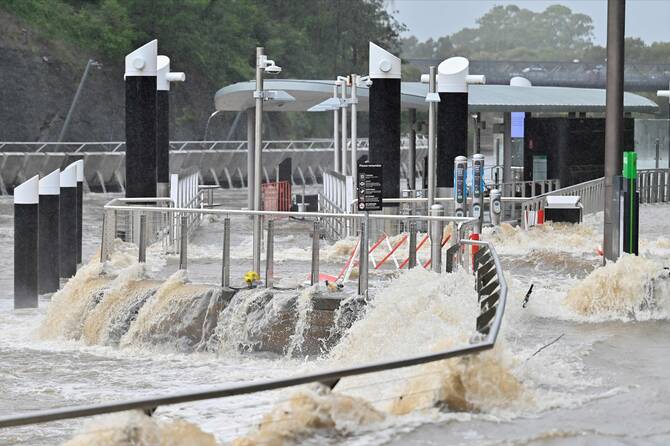
Record floods devastate eastern Australia

People clambered atop cars, houses and highway bridges before helicopters winched them away. (AFP)
Short Url
Updated 23 May 2025
Follow

Record floods devastate eastern Australia

  • State Emergency Service said more than 2,000 workers had been deployed on rescue and recovery missions

MAITLAND: Record floods cut a destructive path through eastern Australia on Friday, caking houses in silt, washing out roads and separating 50,000 people from help.
Four bodies have been pulled from vast tides of floodwater engulfing parts of northern New South Wales, a fertile region of rivers and valleys some 400 kilometers (250 miles) up the coast from Sydney.
Salvage crews were preparing to launch a major clean-up operation as waters started receding Friday morning, surveying the damage from half a year’s worth of rain dumped in just three days.
“So many businesses have had water through and it’s going to be a massive cleanup,” said Kinne Ring, mayor of the flood-stricken farming town of Kempsey.
“Houses have been inundated,” she told national broadcaster ABC.
“There’s water coming through the bottom of houses, it’s really awful to see and the water is going to take a bit of time to recede.”
State Emergency Service boss Dallas Burnes said more than 2,000 workers had been deployed on rescue and recovery missions.
“A real focus for us at the moment will be resupplying the isolated communities,” he said, adding that 50,000 people were still stranded.
Burnes said rescue crews had plucked more than 600 people to safety since waters started rising earlier this week.
People clambered atop cars, houses and highway bridges before helicopters winched them away.
Although the floods were easing, Burnes said the stagnant lakes of muddy water still posed a threat — including from snakes that may have slithered into homes in search of shelter.
“Floodwaters have contaminants. There can be vermin, snakes. You need to assess those risks.
“Electricity can also pose a danger as well.”
The storms have dumped more than six months’ worth of rain over three days, the government weather bureau has said, smashing flood-height records in some areas.
“These are horrific circumstances,” Prime Minister Anthony Albanese said Friday as he traveled into the disaster zone.
“The Australian Defense Force will be made available. There’s going to be a big recovery effort required,” he told local radio.
“There’s been massive damage to infrastructure and we’re going to have to all really pitch in.”
In the town of Taree, business owner Jeremy Thornton said the “gut-wrenching” flood was among the worst he had seen.
“It is pretty tough, we’ve had a few moments but you have to suck it up and push on,” he told AFP on Thursday.
“We are reliving it every second — hearing the rain, hearing the helicopters, hearing the siren.”
Locals spotted dead cows washing up on beaches after swollen rivers swept them from their pastures inland.
The government has declared a natural disaster, unlocking greater resources for affected areas.

From the arid outback to the tropical coast, swaths of Australia have recently been pummelled by wild weather.
The oceans surrounding Australia have been “abnormally warm” in recent months, according to Australia’s government weather bureau.
Warmer seas evaporate more moisture into the atmosphere, which can eventually lead to more intense rains.
Although difficult to link to specific disasters, climate change is already fueling more extreme weather patterns, scientists warn.
Flood modelling expert Mahdi Sedighkia said this week’s emergency offered “compelling evidence” of how climate change could affect regional weather patterns.


Single ‘digital nation-state’ is not a far-fetched notion, Melania Trump tells UN Security Council

Updated 5 sec ago
Follow

Single ‘digital nation-state’ is not a far-fetched notion, Melania Trump tells UN Security Council

  • US first lady argues that AI and global connectivity could reshape education, help reduce conflict and empower children worldwide
  • Societies rooted in knowledge foster innovation, tolerance and moral reasoning, while those shaped by ignorance risk disorder and conflict, she says

NEW YORK CITY: The idea of a single digital nation-state is “not so far-fetched,” US First Lady Melania Trump told the UN Security Council on Monday.
She argued that artificial intelligence and global connectivity could reshape education, help reduce conflict and empower children worldwide.
The US holds the rotating presidency of the council for March, and as she presided over its first meeting of the month Trump said technology was erasing borders and creating what she described as a shared intellectual future.
“Perhaps this idea isn’t so far-fetched,” she said, pointing to the rise of digital currencies, blockchain-based payment systems, and AI-driven databases she argued were already transforming media and financial markets.
Trump thanked the US’s fellow council members — the UK, France, Russia, China, Greece, the Democratic Republic of Congo, Denmark, Panama, Liberia, Somalia, Colombia, Pakistan, Bahrain and Latvia — for their role in efforts to maintain international security.
The responsibility for preventing conflict “must be applied evenly and should never be carried out lightly,” she said. Her remarks focused in particular on the role of education as the foundation of peace and stability.
“A nation that makes learning sacred protects its books, its language, its science and its mathematics. It protects its future,” Trump said, arguing that societies rooted in knowledge foster innovation, tolerance and moral reasoning, while those shaped by ignorance risk disorder and conflict.
Education is widely recognized as a fundamental human right, she added, yet many children and young adults around the world remain barred from the chance to attend high school or university. The losses arising from this squandered potential, from potential medical breakthroughs to possible advances in food security and technology, are borne not only by the individual countries involved but by humanity as a whole, she said.
Trump called for the expansion of global access to technology to help bridge the digital divide, noting that about 6 billion people, 70 percent of the world’s population, now use mobile devices and the internet.
“If our nations band together, we can close the technological divide,” she said, describing a world in which a farmer on a remote Greek island, a student in Somalia and a resident of New York City can all tap into centuries of accumulated human knowledge.
AI was democratizing access to information once confined to university libraries, she added, and redefining participation in the global “economy of ideas.”
She continued: “Conflict arises from ignorance. Knowledge creates understanding, replacing fear with peace and unity.”
Trump called on council members to safeguard learning and promote access to higher education, urging them to “build a future generation of leaders who embrace peace through education.”
She added: “The path to peace depends on us taking responsibility to empower our children through education and technology.”