

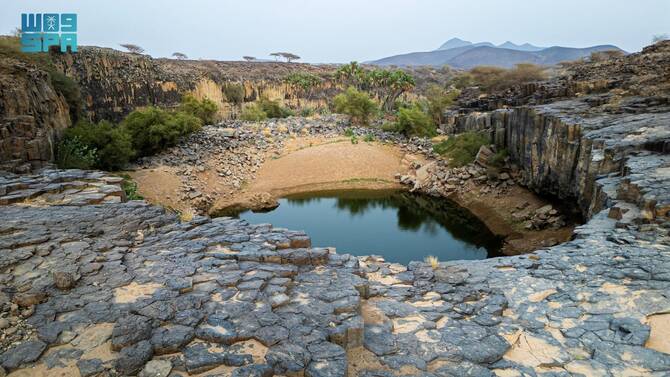
Aseer’s nature-sculpted basalt columns tell ancient volcanic tales

These formations are not just rigid rock structures, but natural sculptures. (SPA)
Short Url
Updated 24 May 2025
Follow

Aseer’s nature-sculpted basalt columns tell ancient volcanic tales

  • Meticulously shaped, the basalt columns stand tall as timeless witnesses
  • They are among the most remarkable and rarest geological phenomena in the Kingdom

RIYADH: Deep within the mountains and plains of Aseer, nature unveils one of its most magnificent geological masterpieces in the form of the region’s basalt columns.

Meticulously shaped, they stand tall as timeless witnesses, narrating chapters of the province’s rich volcanic history.

These formations are not just rigid rock structures, but natural sculptures, shaped over millions of years, embodying a harmonious blend of natural beauty and scientific depth.

The basalt columns of Asir are among the most remarkable and rarest geological phenomena in the Kingdom, captivating the attention of visitors and science enthusiasts.

Composed of volcanic rock formed from slowly cooled lava flows, these columns have shrunk and cracked over time, creating stunning geometric shapes, often hexagonal, pentagonal, or quadrilateral, with astonishing natural precision.

King Saud University Seismic Studies Center director and Saudi Society for Geosciences president Prof. Abdullah Al-Amri shared exciting insights.  

He highlighted the Asir region’s rich geological formations, which can be found in several captivating locations, including Muhayil Asir, Jabal Mishrif in Al-Harajah, Qarn Mujal east of Tendha, Wadi Al-Asran, and the coastal area between Al-Qahma and Al-Barak, nestled within the Black Mountain range.

Al-Amri noted that these formations have been recognized since ancient times.

Renowned geographer Abu Muhammad Al-Hasan Al-Hamdani described them in his book “Sifat Jazirat Al-Arab” as part of the Sarat Janb range, stretching from the north of Dhahran Al-Janub to the north of Sarat Ubaida, now known as Harrat Al-Sarat.

A Cenozoic volcanic field, Harrat Al-Sarat covers around 700 square km and boasts towering mountains like Jabal Ferwa, which rises 3,004 meters above sea level, and Jabal Zalm, standing at 2,575 meters.

Saudi Geological Survey spokesperson Tariq Aba Al-Khail elaborated on the fascinating formation of basalt columns.

The unique structures arise from thermal contraction when lava cools and solidifies, resulting in vertical cracks at right angles to the cooling surface.

While the columns typically appear vertical, they may bend or tilt depending on the cooling conditions.

Aba Al-Khail likened the formations to the cracking of clay as it dries, but instead, they occur in igneous rocks, particularly basalt, and can also be found in andesite, trachyte, and rhyolite.

He explained that the remarkable formations date back around 30 million years and have been discovered in the southwestern volcanic lava fields, such as Harrat Al-Barak.

The phenomenon holds significant scientific value, offering researchers the opportunity to explore ancient volcanic activity in the Arabian Peninsula.

Decoder

Basalt Columns of Asir

Dating back around 30 million years, these magnificent geological masterpieces stand tall as timeless witnesses, narrating chapters of the rich volcanic history of Saudi Arabia's southwestern province of Asir. The basalt columns are among the most remarkable and rarest geological phenomena in the Kingdom, captivating the attention of visitors and science enthusiasts.


KSrelief initiates treatment in Jordan for cancer-stricken Gaza girl

Updated 26 December 2025
Follow

KSrelief initiates treatment in Jordan for cancer-stricken Gaza girl

  • Roza Al-Dreimli was transferred to Jordan through the initiative of KSrelief, amid the Gaza war that has destroyed hospitals 
  • She is currently under assessment and observation at the King Hussein Cancer Center, ahead of treatment

AMMAN: A cancer-stricken Palestinian girl from Gaza is now undergoing clinical observation prior to treatment at a specialist hospital in Jordan, thanks to the Saudi aid agency KSrelief. 

Roza Al-Dreimli was transported to Amman from the Gaza Strip through the initiative of the King Salman Humanitarian Aid and Relief Center (KSrelief) as part of Saudi Arabia’s continued commitment to providing life-saving aid and medical care to Palestinians suffering from critical health conditions, the Saudi Press Agency (SPA) reported on Friday. 

The report said that Roza’s case was prioritized due to the complexity of her condition, as assessments indicated a need for advanced treatment of cancerous cells at the base of the brain. She is now at the King Hussein Cancer Center (KHCC). 

"Under the supervision of a medical team specialized in pediatric brain tumors, she is currently undergoing intensive clinical monitoring and precise periodic examinations to assess the tumor’s response to treatment, ensure control of the condition, and prevent any potential neurological or visual complications resulting from the tumor’s location," SPA said.

The family expressed profound gratitude for KSrelief’s swift intervention, noting that the specialized care provided at KHCC has renewed their hope for their daughter’s recovery. 

Such specialized care is currently unavailable in the Gaza Strip because of the destruction of hospitals during 26 months of bombardment by the Israeli military. 

Israel systematically destroyed homes and commercial buildings  and infrastructure in the Palestinian enclave in retaliation to the Oct. 7, 2023, raid by Hamas of Israeli border villages, during which the militant group killed more than 1,200 people  and took 254 hostages.