

Pakistani generals vow to ‘decimate’ militants a day after school bus bombing kills four children

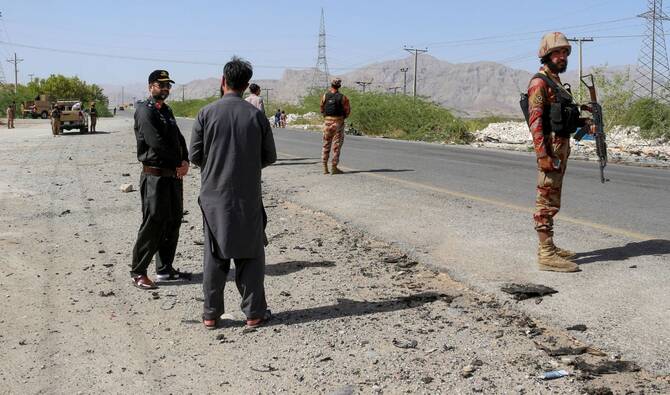
Security personnel stand guard at the site of a school bus bombing in Khuzdar district of Balochistan province on May 21, 2025. (AFP)
Short Url
Updated 22 May 2025
Follow

Pakistani generals vow to ‘decimate’ militants a day after school bus bombing kills four children

  • The meeting terms the attack a ‘reprehensible violation’ of international norms due to the deliberate targeting of children
  • Field Marshal Asim Munir describes the people of Pakistan as the military’s ‘greatest strength’ following the India standoff

ISLAMABAD: Pakistan’s top generals on Thursday vowed to “decimate” militant groups operating in its western provinces of Balochistan and Khyber Pakhtunkhwa, a day after a vehicle-borne improvised explosive device targeted a school bus in the Khuzdar district in the southwest, killing four children and two adults.

The military’s pledge follows a sharp escalation in militant violence across Pakistan, particularly in Balochistan, where separatist groups like the Baloch Liberation Army (BLA) have launched increasingly coordinated attacks on civilians and security forces. Earlier this year, a BLA assault on a passenger train led to a hostage situation, reflecting the growing scale and sophistication of the insurgency.

Islamabad has repeatedly accused India of backing these groups to destabilize the country, an allegation New Delhi has denied, attributing Pakistan’s security troubles to internal failures.

Thursday’s statement followed a meeting of Pakistan’s top army leadership to review the country’s internal and external security environment. The huddle, chaired by Field Marshal Asim Munir, was the first since a recent military standoff with India, during which both sides exchanged missile and drone attacks.

“The Forum deliberated in depth on the threat posed by India-backed terrorist proxies operating in Balochistan and Khyber Pakhtunkhwa,” the military’s media wing, Inter-Services Public Relations (ISPR), said in a statement.

“The Forum resolved that Pakistan will never allow its peace to be compromised by externally sponsored terrorism,” it continued. “The Armed Forces, in close synergy with intelligence and law enforcement agencies, will pursue all proxies and facilitators of terrorism with unrelenting resolve. These hostile elements, trained and financed to incite chaos and fear, will be dismantled and decimated with full force of national will and institutional strength.”

The generals condemned the Khuzdar attack as a “reprehensible violation” of international norms, particularly due to the deliberate targeting of children.

They also offered prayers for victims of both the Khuzdar bombing and recent casualties from Operation Bunyanum Marsoos, the military campaign launched in response to Indian strikes.

Field Marshal Munir reiterated Pakistan’s strategic stance on national defense, declaring that “no one can coerce Pakistan through the use or threat of force.”

He also praised the professionalism and readiness of the armed forces and lauded the resilience of Pakistani civilians, youth and political leadership during recent hostilities.

“The people of Pakistan are our greatest strength,” he said during the meeting. “We remain committed to their trust and expectations in our shared struggle against any foreign aggression, terrorism and extremism.”


Pakistan saw up to 17% drop in cross-border attacks after Afghan border closure — think tank

Updated 5 sec ago
Follow

Pakistan saw up to 17% drop in cross-border attacks after Afghan border closure — think tank

  • CRSS calls 2025 the deadliest year in a decade with 3,417 violence-linked fatalities nationwide
  • Violence remained concentrated in the western provinces as security forces killed 2,060 militants

ISLAMABAD: Pakistan recorded a sharp decline in cross-border militant attacks and violence-linked fatalities in the final months of 2025 after it closed its border with Afghanistan in October, even as the country endured its deadliest year in a decade overall, according to an annual security report released by a local think tank on Wednesday.

Pakistan has frequently accused Afghanistan of sheltering proscribed armed factions, such as the Tehreek-e-Taliban Pakistan (TTP) and the Balochistan Liberation Army (BLA), in the past, while also pointing a finger at the Taliban administration in Kabul for “facilitating” their attacks against Pakistani civilians and security forces.

The Center for Research and Security Studies (CRSS) said in its report that terrorist attacks fell by nearly 17% in December, following a 9% decline in November, after Pakistan shut the border on Oct. 11. It noted that violence-linked fatalities among civilians and security personnel also declined in the final quarter of the year, falling by nearly 4% and 19% respectively in November and December.

“Pakistan recorded a significant drop in cross-border terrorist attacks and violence-linked fatalities after it closed down the border to Afghanistan,” CRSS said.

Despite the late-year decline, the think tank said 2025 “went by as the most violent year for Pakistan in a decade,” with overall violence surging nearly 34% year-on-year.

Fatalities rose from 2,555 in 2024 to 3,417 in 2025 — an increase of 862 deaths — extending a five-year upward trend in violence that coincides with the Taliban’s return to power in Afghanistan in 2021, the report said.

“2025 marked another grim year for Pakistan’s security landscape,” it added, noting that violence has increased every year since 2021, with annual surges of nearly 38% in 2021, over 15% in 2022, 56% in 2023, nearly 67% in 2024 and 34% in 2025. 

REGIONAL CONCENTRATION

Violence remained heavily concentrated in Pakistan’s northwestern Khyber Pakhtunkhwa (KP) and southwestern Balochistan provinces, which together accounted for more than 96% of all fatalities and nearly 93% of violent incidents nationwide.

KP was the worst-hit region, recording 2,331 fatalities in 2025 — a 44% increase from 1,620 deaths in 2024 — accounting for more than 82% of the net national rise in violence.

Balochistan saw fatalities rise from 787 to 956, an increase of nearly 22%.

In contrast, Punjab and Sindh recorded relatively low levels of violence, together accounting for less than 3% of total casualties, which CRSS said pointed to “relative containment of violence despite the provinces’ large populations.”

The report also flagged the spread of violence into previously calmer regions, with Azad Jammu and Kashmir recording 15 fatalities in 2025 after reporting no violence a year earlier.

MILITANT DEATH TOLL

CRSS said 2025 was also the deadliest year in a decade for militant groups, with outlaws accounting for more than 60% of all fatalities.

“2025 turned out to be the deadliest year for outlaws in a decade,” the report said, with 2,060 militants killed during at least 392 security operations, surpassing the combined fatalities of civilians and security personnel.

Security forces, however, remained the primary targets of militant groups.

The army and Frontier Corps recorded 374 fatalities, including 22 officers, while police suffered 216 casualties.

The TTP claimed responsibility for the largest share of attacks on security personnel, followed by the BLA, the Baloch Liberation Front (BLF) and Daesh’s regional chapter.