

Pakistan will not get water over which India has rights, India PM Modi says

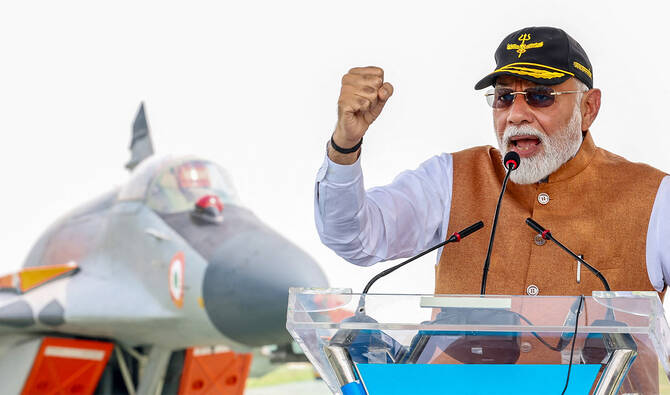
This handout photograph released on May 13, 2025, by the Indian Press Information Bureau (PIB) shows India's Prime Minister Narendra Modi addressing armed force personnel during his visit to Adampur Airforce Base in India's state of Punjab. (Indian Press Information Bureau/AFP)
Short Url
Updated 22 May 2025
Follow

Pakistan will not get water over which India has rights, India PM Modi says

  • India suspended the 1960 Indus Waters Treaty last month after a militant attack in Indian-administered Kashmir
  • Pakistan has denied involvement and this month engaged in the worst military confrontation with India in decades 

NEW DELHI: Pakistan will not get water from rivers over which India has rights, Indian Prime Minister Narendra Modi said on Thursday, a month after a deadly attack in Indian-administered Kashmir led New Delhi to suspend a key river water-sharing treaty between the neighbors.

The suspension of the Indus Waters Treaty, negotiated by the World Bank in 1960, was among a slew of measures announced by India against Pakistan last month after the April 22 attack that killed 26 men, mostly Hindu tourists.

New Delhi had said the attack was backed by Pakistan – an accusation Islamabad denied – and the nuclear-armed neighbors were involved in their worst military fighting in nearly three decades before agreeing to a ceasefire on May 10.

“Pakistan will have to pay a heavy price for every terrorist attack ... Pakistan’s army will pay it, Pakistan’s economy will pay it,” Modi said at a public event in the northwestern state of Rajasthan, which borders Pakistan.

The Indus treaty provides water for 80 percent of Pakistan’s farms from three rivers that flow from India but Pakistan’s finance minister said this month that its suspension was not going to have “any immediate impact.”

The ceasefire between the countries has largely held, with Indian Foreign Minister Subrahmanyam Jaishankar saying that there is no exchange of fire currently and “there has been some repositioning of forces accordingly.”

“If there are acts of the kind we saw on April 22, there will be a response, we will hit the terrorists,” Jaishankar told Dutch news outlet NOS.

“If the terrorists are in Pakistan, we will hit them where they are,” he added.

There was no immediate response from Pakistan to comments by Modi and Jaishankar.

India and Pakistan have shared a troubled relationship since they were carved out of British India in 1947, and have fought three wars, two of them over the Himalayan region of Kashmir, which they both claim in full but rule in part.

New Delhi also blames Pakistan for supporting Islamist separatists battling security forces in its part of Kashmir, but Islamabad denies the accusation.

The arch rivals have taken several measures against each other since the April attack in Kashmir, including suspension of trade, closure of land borders, and suspension of most visas.


Pakistan joins OIC, Islamic nations to reject Israel’s recognition of Somaliland

Updated 28 December 2025
Follow

Pakistan joins OIC, Islamic nations to reject Israel’s recognition of Somaliland

  • Foreign ministers of 21 Islamic nations, OIC issue joint statement to condemn Israel’s move to recognize breakaway African region
  • Joint statement describes Israel’s move as a “grave violation of the principles of international law and the United Nations Charter“

ISLAMABAD: Pakistan on Sunday joined the Organization of Islamic Cooperation (OIC) and other Arab and Islamic nations in condemning Israel’s recognition of Somaliland, a breakaway African region, calling it a violation of international law and reaffirming its support for the sovereignty and territorial integrity of Somalia. 

Israel this week announced it had recognized Somaliland — a self-declared region that broke away from Somalia in 1991 but has not previously been recognized by any United Nations member state — triggering condemnation from Somalia and criticism from regional bodies.

The joint statement shared by Pakistan’s foreign ministry on Sunday was endorsed by the foreign ministers of 20 other Muslim countries including Jordan, Egypt, Saudi Arabia, Palestine, Qatar, Libya, Iran, Iraq, Türkiye, Yemen and others as well as the OIC. 

“Their unequivocal rejection of Israel’s recognition of the ‘Somaliland’ region of the Federal Republic of Somalia on 26 December 2025, given the serious repercussions of such unprecedented measure on peace and security in the Horn of Africa, the Red Sea, and its serious effects on international peace and security as a whole, which also reflects Israel’s full and blatant disregard to international law,” the joint statement said. 

The statement said Israel’s recognition constitutes a “grave violation of the principles of international law and the United Nations Charter,” pointing out that it reflects Tel Aviv’s expansionist agenda.

The Muslim states said they reject any measures that undermine Somalia’s unity, territorial integrity or sovereignty over its entire territory.

“The full rejection of any potential link between such a measure and any attempts to forcibly expel the Palestinian people out of their land, which is unequivocally rejected in any form as a matter of principle,” the statement said.

The statement was referencing international media reports earlier this year that said Israel and the US had reached out to East African states, including Somaliland, to take in Palestinians from Gaza.

Pakistan’s foreign office on Saturday issued a separate statement condemning Israel’s recognition of Somaliland. 

“Pakistan strongly condemns any attempts to undermine the sovereignty, unity, and territorial integrity of Somalia, and rejects, in this regard, the announcement made by Israel recognizing the independence of the so-called Somaliland region of the Federal Republic of Somalia,” the foreign office had said. 

Somalia’s government has said Israel’s recognition of Somaliland violates its sovereignty, while the African Union has opposed unilateral recognition of breakaway regions on the continent.

Israeli Prime Minister Benjamin Netanyahu said on Friday his country had recognized Somaliland “in the spirit of the Abraham Accords,” referring to US-brokered deals that helped establish ties between Israel and Arab states.