

Irish rapper charged over Hezbollah flag at London concert: police

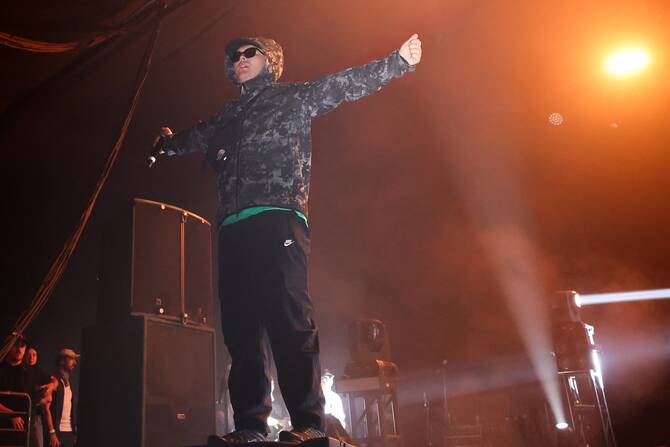
Mo Chara from Irish Hip Hop trio Kneecap performs onstage during the 2025 Coachella Valley Music and Arts Festival at Empire Polo Club in Indio, California, Apr. 11, 2025. (AFP)
Short Url
Updated 22 May 2025
Follow

Irish rapper charged over Hezbollah flag at London concert: police

  • Liam O’Hanna, 27, known by his stage name Mo Chara, is accused of showing support for a proscribed group
  • The rapper, from Belfast, is scheduled to appear at Westminster Magistrates’ Court on June 18, police said

LONDON: A member of Irish rap group Kneecap has been charged with a terror offense for allegedly displaying a Hezbollah flag at a London concert, police said on Wednesday.
Liam O’Hanna, 27, known by his stage name Mo Chara, is accused of showing support for the Lebanese militant group, who are proscribed by British authorities, during a performance on November 21.
London’s Metropolitan Police said officers from its Counter Terrorism Command launched an investigation after a video of the event surfaced online in April.
O’Hanna is accused of displaying a flag “in such a way or in such circumstances as to arouse reasonable suspicion that he is a supporter of a proscribed organization” in contravention of the 2000 Terrorism Act.
The rapper, from Belfast, is scheduled to appear at Westminster Magistrates’ Court on June 18, police said.
The group had been scheduled to perform at a festival in London on Friday.
The charge follows growing scrutiny of Kneecap’s performances after footage circulated online showing provocative political statements made by the band on stage.
One video appeared to show a band member shouting: “Up Hamas, up Hezbollah.”

The band has since released a statment on their offical Instagram rejecting the charge and said they will "fight in every court."


A post shared by KNEECAP (@kneecap32)

Those groups, in Gaza and in Lebanon, are banned as terror organizations in the UK and it is a crime to express support for them.


Political messaging

The band, known for its confrontational style and Irish nationalist messaging, has denied supporting violence or banned groups.
It said video footage had been “deliberately taken out of context.”
The backlash led to the cancelation of several of the group’s shows, including in southwest England and Germany.
The group’s songs include “Get Your Brits Out” and “Better Way To Live.”
The controversy has sparked a wider debate about artistic expression and political censorship.
The family of Conservative MP David Amess, who was fatally stabbed by an Daesh group follower in 2021, called for an apology while the party leader Kemi Badenoch called for the band to be banned.
In a statement in April, the band denied promoting extremist views and apologized to the families of Amess and Jo Cox, who was murdered in 2016 by a neo-Nazi sympathizer a week before the divisive Brexit referendum.
“We do not, and have never, supported Hamas or Hezbollah,” the group said.
Nearly 40 musicians and groups, including Pulp, Paul Weller, Primal Scream and Massive Attack, have publicly backed Kneecap, accusing authorities of suppressing creative freedom.
Irish Prime Minister Micheal Martin had urged the band to clarify whether they supported the groups or not.
An attack in Israel by Hamas militants on October 7, 2023, resulted in the deaths of 1,218 people, mostly civilians, according to an AFP tally based on official Israeli figures.
Israel’s military response in Gaza has triggered a humanitarian crisis, with the territory’s health ministry on Tuesday putting the death toll at 53,655.


Austrian parliament approves headscarf ban in schools

Updated 2 sec ago
Follow

Austrian parliament approves headscarf ban in schools

  • In 2019 the country introduced a ban on headscarves in primary schools, but the constitutional court struck it down
  • Rights groups and activists have long argued that banning headscarves still amounts to telling a woman what to wear
VIENNA: Austrian lawmakers on Thursday voted by a large majority in favor of a law banning headscarves in schools for girls under 14, a move rights groups and experts say is discriminatory and could deepen societal division.
Austria’s conservative-led government — under pressure with anti-immigration sentiment is running high — proposed the ban earlier this year, arguing it is aimed at protecting girls “from oppression.”
In 2019 the country introduced a ban on headscarves in primary schools, but the constitutional court struck it down.
This time the government insists that its law is constitutional, though experts have suggested it could be seen as discriminating against one religion — Islam — and putting children in an uncomfortable position.
The law prevents girls younger than 14 from wearing headscarves that “cover the head in accordance with Islamic traditions” in all schools.
After a debate Thursday, only the opposition Green party voted against the ban.
Ahead of the vote, lawmaker Yannick Shetty of the liberal NEOS said the headscarf “is not just an item of clothing” but “sexualizes girls.”
“When a girl... is told that she must hide her body... to protect herself from the gaze of men, it’s not a religious ritual, but oppression,” Integration Minister Claudia Plakolm said when presenting the bill.
The ban, which applies to “all forms” of the Islamic veil including hijabs and burqas, would take full effect with the start of the new school year in September, Plakolm said.
From February, an initial period would be launched during which the new rules would be explained to educators, parents and children with no penalties for breaking them.
But for repeated non-compliance, parents would face fines ranging from €150 to €800 ($175-930).
The government said that about 12,000 girls would be affected by the new law.
‘Stigmatized’
Rights groups and activists have long argued that banning headscarves still amounts to telling a woman what to wear, instead of allowing her the freedom to decide on her own.
Organizations including Amnesty International Austria have criticized the bill.
Amnesty said it “constitutes blatant discrimination against Muslim girls” and described it as an “expression of anti-Muslim racism.”
Such measures risk “fueling existing prejudices and stereotypes against Muslims,” the group warned.
The draft law has also drawn criticism from the IGGOe, the body officially recognized as representing the country’s Muslim communities.
It said the ban “jeopardizes social cohesion,” saying “instead of empowering children, they are stigmatized and marginalized.”
Angelika Atzinger, managing director of the Amazone women’s rights association, said a headscarf ban “sends girls the message that decisions are being made about their bodies and that this is legitimate.”
Her comments appeared in a statement published by the anti-racism group SOS Mitmensch, which also opposes the proposed law.
Austria’s anti-immigration, far-right Freedom Party (FPOe) said the ban did not go far enough, however. They want it extended to all students, teachers and other staff.
In France, authorities banned school children in 2004 from wearing signs of religious affiliation such as headscarves, turbans or Jewish skullcaps, on the basis of the country’s secular laws, which are meant to guarantee neutrality in state institutions.