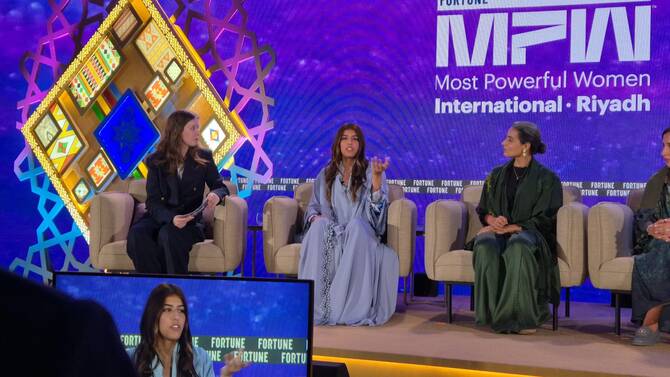
Zamzam Al-Hammadi: UAE teen fighter making history in the cage and beyond

Al-Hammadi spoke during the “Playing to Win: Women, Sports, and Breaking Barriers” panel. supplied
Short Url
Updated 21 May 2025
Follow

Zamzam Al-Hammadi: UAE teen fighter making history in the cage and beyond

  • Martial artist prepares for professional debut in PFL MENA as she inspires a new generation of Arab female athletes

Riyadh: At just 17, Zamzam Al-Hammadi is rapidly emerging as one of the Middle East’s most promising athletes and a trailblazer for women in combat sports.

The Emirati martial artist recently took center stage at the Fortune Most Powerful Women International Summit in Riyadh, where she joined an elite panel of regional sports pioneers to discuss the evolving role of women in athletics.

The summit, hosted at the St. Regis Riyadh, was aligned with Saudi Arabia’s Vision 2030 and brought together more than 125 influential women from across sectors.

Al-Hammadi spoke during the “Playing to Win: Women, Sports, and Breaking Barriers” panel alongside motorsport driver Mashael Al-Obaidan, boxing advocate Rasha Alkhamis, and Aalia Al-Rasheed, head of the women’s football department at the Saudi Arabian Football Federation.

A decorated Brazilian jiu-jitsu and mixed martial arts competitor, Al-Hammadi has already clinched global youth titles under the International Mixed Martial Arts Federation and JJIF World Youth Championships. Now, she is poised to make history as the first female fighter from the UAE to sign a professional MMA contract with the Professional Fighters League.

“Joining the PFL is a dream come true,” Al-Hammadi said. “Being a part of the PFL MENA roster means that I’ll be competing on a bigger platform, and more eyes will be on me. That reach opens the door for global sponsorships, endorsements and partnerships, and that’s going to be a massive deal for me and my family.”

Her rise reflects a broader momentum in women’s sports across the region. With an unbeaten amateur record and a growing following, Al-Hammadi is set to debut in the second season of PFL MENA, a league that has already reshaped the regional MMA landscape.


Zamzam Al-Hammadi is rapidly emerging as one of the Middle East’s most promising athletes. supplied

Being the first female fighter from the UAE to become a professional in MMA comes with a responsibility, Al-Hammadi said. “I want to be one of the best to ever step foot inside the PFL SmartCage. I want to become a champion, and I want to be able to inspire young athletes, young girls like myself, to follow their dreams and work toward achieving their goals, especially in an industry where there aren’t a lot of female fighters that come from the Middle East.”

Al-Hammadi’s passion for martial arts runs deep. She comes from a family of fighters, with her sister Ghala also training in combat sports and her mother, Nada Al-Nuaymi, a seasoned judo and jiu-jitsu practitioner. This generational dedication emphasizes her position as both a pioneer and a role model.

Speaking at the summit, Al-Hammadi highlighted the rapid growth of MMA, particularly for women. She said that the sport has never let them down. “Now, if we watch, all around the world, the fans are cheering for the females more than the males, so this is something good,” she said.

She also praised SURJ Sports Investment, whose partnership with the PFL has been central to the success of the league’s expansion into the Middle East.

“For me, SURJ Sports Investment is really helping the PFL to organize, especially now that we have four events in the Middle East,” Al-Hammadi said. “When it comes to martial arts, most people are thinking outside of the Middle East, but now after seeing and discovering the talent that we have here in the Middle East, and also in Africa, for me it’s just awesome.”

As she prepares for her professional debut in the PFL SmartCage, Al-Hammadi remains focused on both performance and purpose. Her goal: Not only to win titles but to pave the way for a new generation of female fighters in the Arab world.

“More than just making history,” she said, “I want to make an impact.”


Football’s return to Syrian pitches brings fanfare — and friction

Updated 31 December 2025
Follow

Football’s return to Syrian pitches brings fanfare — and friction

RIYADH: Just 10 days after the first anniversary of Syria’s Liberation Day, and one week after the historic performance of the country’s football team at the 2025 Arab Cup — where they reached the quarterfinals — domestic football returned as the Syrian Premier League kicked off its new season.

While league football has continued intermittently since a one-year suspension in 2011, this season represents a notable shift.

For the first time since 2017, the competition features 16 teams playing a full round-robin format — a return to structural normality after years of disrupted campaigns, withdrawals and operational challenges caused by conflict and deteriorating infrastructure.

Foreign players have also returned in significant numbers. A total of 25 overseas players are registered across the 16 clubs in what is now known as the “Prime TV” Syrian Premier League, following the broadcaster’s acquisition of domestic broadcasting rights for the season.

Yet despite the sense of renewal, the league’s reset has been far from smooth. Average attendances remain well below pre-war levels, while the season itself was delayed multiple times before eventually beginning in mid-December — a schedule that is now expected to extend deep into the summer months.

Concerns over facilities and fan safety have already sparked internal tension. The anticipated Matchday Two fixture between Tishreen and Hottin — also known as the Latakia Derby — was postponed by the Syrian Football Association until further notice. No official explanation was provided, but stadium readiness and crowd safety has been at the core of football discussion in Syria.

Supporters have also voiced their frustration over the newly announced ticket prices. Entry fees increased from 5,000 Syrian pounds ($0.45) to 15,000 SYP, a threefold rise announced by the SFA and widely cited as a factor behind subdued crowds.

Infrastructure remains a pressing issue. Historic venues such as Khalid Ibn Al-Walid Stadium in the city of Homs are still not cleared to host games due to pitch conditions and safety requirements, reinforcing the sense of uneven progress — advances made, but frequently offset by new obstacles.

Operational shortcomings were evident as early as the first game of the season. In the opening fixture between Al-Shorta and Hottin, a formal warning was issued to the former by the Disciplinary and Ethics Committee due to a breach in organizational arrangements for the match, including the failure to provide ball boys, which led to a five-minute delay to kick-off.

Political sensitivities have not been easy to navigate either. Al-Karamah were fined 1,500,000 SYP after fans directed verbal abuse at Al-Wahda player Milad Hamad, due to previous political posts made on his Facebook account.

Five days later, Al-Wahda announced Hamad’s suspension from all sporting activities pending review by the relevant committee at the SFA. “This decision comes in solidarity with all our beloved Syrian fans and as a reaffirmation of our commitment to the unity of our people and our land, and to the fact that the blood of our martyrs in the Syrian Revolution has not been shed in vain,” the club said in a statement posted via their official Facebook page.

Rebuilding a sustainable football system in Syria has proven complex. The league’s return has brought moments of excitement alongside renewed tension — a reminder that restoring domestic football is not simply about restarting competition, but about addressing the structures that support it. The Syrian Football Association was contacted for comment, but did not respond.