

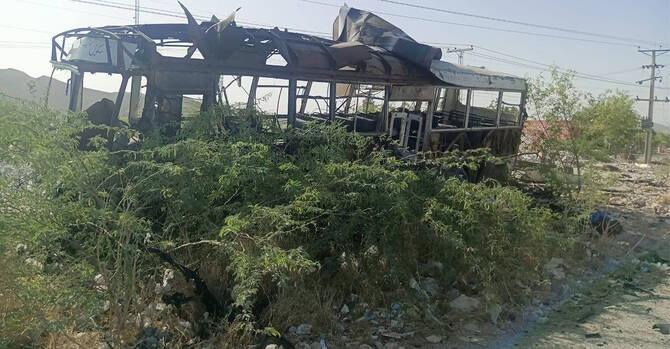

KARACHI: The chief minister of Pakistan’s southwestern Balochistan province said on Wednesday six people, including four children, were killed in a militant attack on a school bus, with a government official saying the bus had been en route to an army-run school.
The attack took place in Balochistan’s Khuzdar district. The bus was on its way to drop students off at a military school in the area, Yasir Iqbal, the administrator of Khuzdar district, told media.
“These coward terrorists attacked them [school bus] with a vehicle-borne IED and in that attack, 46 children were traveling on that bus, of which four children have been martyred and the rest are injured,” Balochistan Chief Minister Sarfraz Bugti told media.
“Firstly, we condemn this incident, we strongly condemn it. Children are innocent and they have nothing to do with wars.”
The Pakistan military blamed “Indian terror proxies” for being behind the attack.
Tensions between nuclear-armed neighbors Pakistan and India are high after they struck a ceasefire on May 10 following their most intense military confrontation in decades.
Both countries accuse the other of supporting militancy on each other’s soil — a charge both capitals deny.
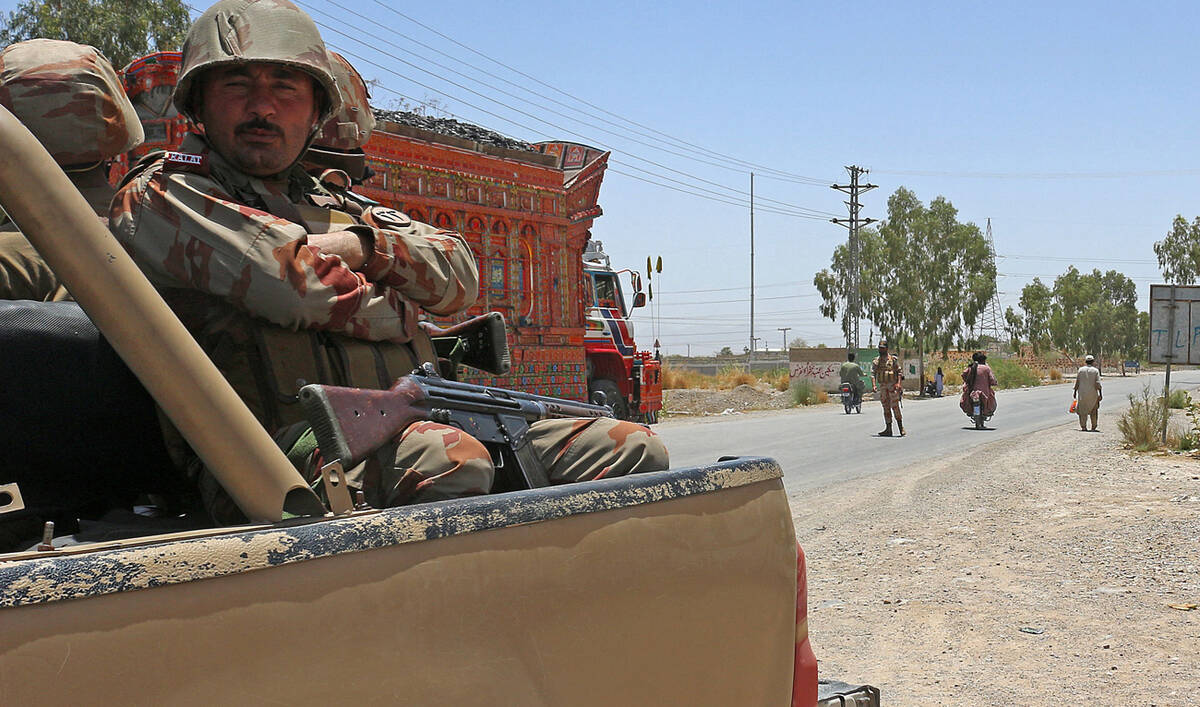
Security personnel guard along a street near the site of a school bus bombing in the Khuzdar district of Balochistan province on May 21, 2025. (AFP)
The latest military escalation, in which the two countries traded missiles, drones and artillery fire, was sparked after India accused Pakistan of supporting militants who attacked dozens of tourists in Indian-administered Kashmir on April 22, killing 26. Islamabad denies involvement.
“After having miserably failed in the battlefield, through these most heinous and cowardly such like acts [attacking school bus], Indian proxies have been unleashed to spread terror and unrest in Balochistan and Khyber Pakhtunkhawa,” the army said in a statement, referring to two Pakistani provinces.
The Indian foreign ministry has rejected the accusations in a statement, saying it condoles the loss of lives in such incidents while criticizing Pakistan for blaming New Delhi for Islamabad’s own “failings” and “internal issues.”
There was no immediate claim of responsibility for the attack, but suspicion is likely to fall on separatist groups such as the Balochistan Liberation Army, which in March blew up a railway track and took passengers from a train hostage, killing 31.
Reacting to the incident, US Chargé d’Affaires Natalie Baker condemned “the brutal, unconscionable attack on a school bus,” saying the murder of children was beyond comprehension.
“We grieve with the families who lost loved ones, and our thoughts are with those recovering,” she added. “No child should ever fear going to school. We stand with those in Pakistan working to end this violence.”
UNICEF also expressed shock at the development.
“This devastating violence and needless suffering must end,” it said. “Enough is enough. Children are not, and must never be, the targets of violence.”
Southwestern Balochistan is Pakistan’s largest province by area, but smallest by population and most impoverished. The region of some 15 million people is home to key mining projects and a deep seaport that China is building but has been roiled by a decades-old insurgency.
“Targeting innocent children is a barbaric act, those responsible deserve no leniency,” Interior Minister Mohsin Naqvi said in a statement, describing the attack as a “vile conspiracy to destabilize the country.”
Wednesday’s attack was reminiscent of one of the deadliest militant attacks in Pakistan’s history when over 130 children were killed in a military school in the northern city of Peshawar in 2014. That attack was claimed by the Pakistani Taliban group.
With inputs from Reuters


