WASHINGTON: US Secretary of State Marco Rubio said Tuesday he expected Russia to present a Ukraine ceasefire outline within days that will show if it is serious, as Ukrainian President Volodymyr Zelensky accused Moscow of buying time.
President Donald Trump spoke separately by telephone on Monday to Zelensky and Russia’s Vladimir Putin, after Russian and Ukrainian officials met in Istanbul on Friday for their first direct talks on the conflict in three years.
Putin has consistently rejected proposals for a 30-day truce put forward by Kyiv and its Western allies.
But Rubio said that Putin and Russian Foreign Minister Sergei Lavrov indicated they would present their own terms “maybe in a number of days, maybe this week hopefully.”
The Russians will offer “just broad terms that would allow us to move toward a ceasefire, and that ceasefire would then allow us to enter into detailed negotiations to bring about an end of the conflict,” Rubio said.
He said that the presentation will “tell us a lot about their true intentions.”
“If it’s a term sheet that’s realistic and you can work off of it, that’s one thing. If it makes demands that we know are unrealistic, I think that will be indicative.”
Putin after Trump’s call said he was ready to work with Ukraine on a “memorandum” outlining a possible roadmap and different positions on ending the war.
And Italy’s Prime Minister Giorgia Meloni on Tuesday said that Pope Leo XIV was willing “to host upcoming discussions between the parties at the Vatican,” according to her office.
Rubio insisted to critical lawmakers that Putin “hasn’t gotten a single concession” from Trump. But Russia has also not indicated any new flexibility since Trump took office in January with vows to end the war through dialogue.
“It is obvious that Russia is trying to buy time in order to continue its war and occupation,” Zelensky said in a post on social media.
Jeanne Shaheen, the top Democrat on the Senate Foreign Relations Committee, told Rubio that Putin’s refusal to go to Istanbul despite the stated willingness of both Zelensky and Trump to meet showed “he believes it’s in Russia’s interest to carry out this war as long as possible.”
The European Union formally on Tuesday adopted its 17th round of sanctions on Moscow, targeting 200 vessels of Russia’s so-called shadow maritime fleet.
Kirill Dmitriev, the head of Russia’s Direct Investment Fund and lead economic negotiator with Washington, attacked the move, saying: “Western politicians and the media are making titanic efforts to disrupt the constructive dialogue between Russia and the United States.”
Rubio said that Trump for now opposed new sanctions for fear that Russia would no longer come to the table.
Moscow appears confident, with its troops advancing on the battlefield and Trump ending Western isolation of the Kremlin.
The memorandum mentioned by Putin “buys time for Russia,” Russian political analyst Konstantin Kalachev said.
“The cessation of hostilities is not a condition for it, which means that Russia can continue its offensive,” he added.
Russia invaded Ukraine in February 2022 and has since destroyed swathes of the country’s east, killed tens of thousands and now controls around one-fifth of its territory.
People who spoke to AFP both in Kyiv and Moscow were skeptical about peace prospects and thought the Putin-Trump call had not brought them closer.
“I never had any faith in him and now I have none at all,” retired teacher Victoria Kyseliova said in Kyiv, when asked if she was losing confidence in Trump.
Vitaliy, a 53-year-old engineer from Kyiv, said Trump was no “messiah” and that his flurry of diplomacy has changed little.
Ukrainian political analyst Volodymyr Fesenko said Trump’s latest calls had only added to the uncertainty.
“This conversation not only failed to clarify the future of the negotiations but further confused the situation,” he said.
He said Trump had fallen for Putin’s tactics of trying to use talks “as a cover to continue and intensify the war.”
In Moscow, there was defiance and confidence.
“I believe that we don’t need these negotiations. We will win anyway,” said Marina, a 70-year-old former engineer.


US expects Russia offer soon as Zelensky sounds warning

https://arab.news/8dv74
US expects Russia offer soon as Zelensky sounds warning

- Putin has consistently rejected proposals for a 30-day truce put forward by Kyiv and its Western allies


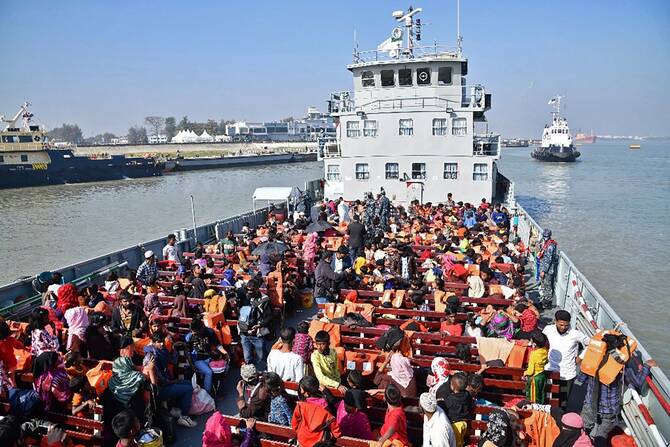
Bangladesh halts controversial relocation of Rohingya refugees to remote island
- Administration of ousted PM Sheikh Hasina spent about $350m on the project
- Rohingya refuse to move to island and 10,000 have fled, top refugee official says
DHAKA: When Bangladesh launched a multi-million-dollar project to relocate Rohingya refugees to a remote island, it promised a better life. Five years on, the controversial plan has stalled, as authorities find it is unsustainable and refugees flee back to overcrowded mainland camps.
The Bhasan Char island emerged naturally from river sediments some 20 years ago. It lies in the Bay of Bengal, over 60 km from Bangladesh’s mainland.
Never inhabited, the 40 sq. km area was developed to accommodate 100,000 Rohingya refugees from the cramped camps of the coastal Cox’s Bazar district.
Relocation to the island started in early December 2020, despite protests from the UN and humanitarian organizations, which warned that it was vulnerable to cyclones and flooding, and that its isolation restricted access to emergency services.
Over 1,600 people were then moved to Bhasan Char by the Bangladesh Navy, followed by another 1,800 the same month. During 25 such transfers, more than 38,000 refugees were resettled on the island by October 2024.
The relocation project was spearheaded by the government of former Prime Minister Sheikh Hasina, who was ousted last year. The new administration has since suspended it indefinitely.
“The Bangladesh government will not conduct any further relocation of the Rohingya to Bhasan Char island. The main reason is that the country’s present government considers the project not viable,” Mizanur Rahman, refugee relief and repatriation commissioner in Cox’s Bazar, told Arab News on Sunday.
The government’s decision was prompted by data from UN agencies, which showed that operations on Bhasan Char involved 30 percent higher costs compared with the mainland camps in Cox’s Bazar, Rahman said.
“On the other hand, the Rohingya are not voluntarily coming forward for relocation to the island. Many of those previously relocated have fled ... Around 29,000 are currently living on the island, while about 10,000 have returned to Cox’s Bazar on their own.”
A mostly Muslim ethnic minority, the Rohingya have lived for centuries in Myanmar’s western Rakhine state but were stripped of their citizenship in the 1980s and have faced systemic persecution ever since.
In 2017 alone, some 750,000 of them crossed to neighboring Bangladesh, fleeing a deadly crackdown by Myanmar’s military. Today, about 1.3 million of them shelter in 33 camps in the coastal Cox’s Bazar district, making it the world’s largest refugee settlement.
Bhasan Char, where the Bangladeshi government spent an estimated $350 million to construct concrete residential buildings, cyclone shelters, roads, freshwater systems, and other infrastructure, offered better living conditions than the squalid camps.
But there was no regular transport service to the island, its inhabitants were not allowed to travel freely, and livelihood opportunities were few and dependent on aid coming from the mainland.
Rahman said: “Considering all aspects, we can say that Rohingya relocation to Bhasan Char is currently halted. Following the fall of Sheikh Hasina’s regime, only one batch of Rohingya was relocated to the island.
“The relocation was conducted with government funding, but the government is no longer allowing any funds for this purpose.”
“The Bangladeshi government has spent around $350 million on it from its own funds ... It seems the project has not turned out to be successful.”


