

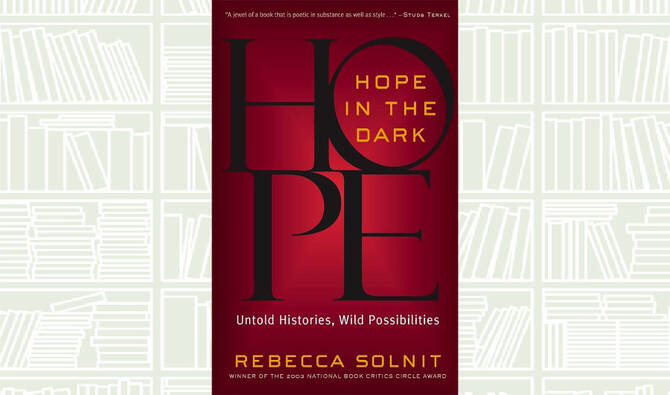

In an era of climate collapse and political upheaval, Rebecca Solnit’s “Hope in the Dark,” first published in 2004 and later updated in 2016, redefines hope not as naivete, but as a radical act of defiance.
Part manifesto, part historical corrective, the book resurrects forgotten victories to prove that progress is often invisible, nonlinear, and collective.
Solnit, a historian and activist, dismantles the myth of powerlessness by spotlighting movements that reshaped history despite seeming futile in their moment.
The Zapatista uprising of 1994, she argues, redefined revolution not as a single explosive event but as a “slow conversation” across generations. The fall of the Berlin Wall — unforeseen by experts — she wrote exposes the fragility of oppressive systems when met with sustained dissent.
Her 2016 update weaves in Black Lives Matter and the Standing Rock protests, framing them as modern iterations of this “subversive hope.”
Central to Solnit’s thesis is the metaphor of darkness, rejecting apocalyptic fatalism: “The future is dark … like the darkness of the womb.”
Hope, for her, is the audacity to act without guarantees, a lesson drawn from anti-nuclear campaigns of the 1980s and post-Katrina mutual-aid efforts like the Common Ground Collective.
Stylistically, Solnit merges lyrical prose with critical urgency. She chastises media narratives that equate activism with failure if immediate victories are not won, noting that the eight-hour workday and abolition of slavery were once deemed impossible.
Her chapters unfold as interconnected essays, blending memoir (her 1980s anti-nuke protests) with global dispatches (Chile’s democratic revival, Ukraine’s Orange Revolution).
Critics may crave more policy prescriptions, but Solnit’s goal is philosophical: to reframe activism as a practice of storytelling, where every protest rewrites the dominant narrative.
The book is not a roadmap but a compass, guiding readers through despair with historical proof that “the impossible is inevitable.”


