

Taiwan says ‘willing’ to talk to China as island boosts defenses

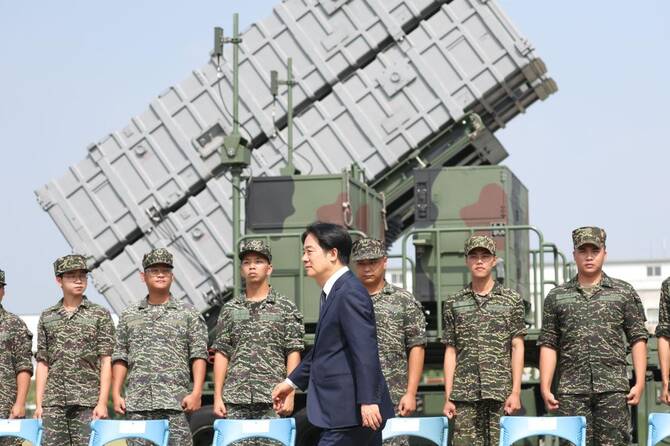
Taiwanese President Lai Ching-te promised to stand up to China and defend democracy when he took office in 2024. (AFP)
Short Url
Updated 20 May 2025
Follow

Taiwan says ‘willing’ to talk to China as island boosts defenses

  • China has rebuffed Lai’s previous offers to talk

Taipei: Taiwan is prepared to talk to China as equals but it will continue to build up its defenses, the island’s President Lai Ching-te said Tuesday as he marked his first year in office.

Lai, a staunch defender of Taiwan’s sovereignty and detested by Beijing, delivered wide-ranging remarks on the need “to prepare for war to avoid war” and also bolster the island’s economic resilience.

After promising to stand up to China and defend democracy at his inauguration, Lai insisted Taiwan was “willing” to communicate with Beijing if there was “parity and dignity.”

China has rebuffed Lai’s previous offers to talk.

“Peace is priceless and there are no winners in war,” Lai said, but added “we cannot have illusions” and vowed to continue “to strengthen our national defense capabilities.”

Taiwan will “actively cooperate with international allies, shoulder to shoulder to exert the power of deterrence, to prepare for war to avoid war, and to achieve the goal of peace,” Lai told journalists at the Presidential Office.

China, which claims Taiwan is part of its territory and has threatened to use force to annex it, has held several rounds of large-scale military drills around the island since Lai took office.

Taiwan’s coast guard warned Monday that China may use “cognitive warfare” to “disrupt public morale” as Lai marks the first anniversary of his inauguration.

As Taiwan comes under pressure from Washington to move more factories to US soil and reduce their trade imbalance, Lai said Taiwan would not “put all our eggs in one basket.”

Taiwan would increase its economic resilience by diversifying markets and boosting domestic demand.

Lai also announced plans to set up a sovereign wealth fund to “boost Taiwan’s economic momentum,” but did not provide details about its size.

The president has seen his first term in the top job engulfed in domestic political turmoil as opposition parties, which control the parliament, seek to stymie his agenda.

The main opposition Kuomintang party (KMT) has called Lai a “dictator” and accused him of pushing Taiwan closer to war with China, while Lai’s Democratic Progressive Party (DPP) suggests the KMT is a tool of Beijing and is undermining Taiwan’s security.

Tensions have escalated into physical fights inside parliament and thousands of supporters of the DPP and opposition parties holding rival street protests.

On Tuesday, Lai said the government wanted to “strengthen cooperation among political parties” and that his national security team would start providing “important national security briefings” to the opposition.

“On the basis of the same facts, we can exchange views frankly and sincerely, discuss national affairs, and work together to face the challenges of the country,” Lai said.

Analysts said Lai’s remarks were more restrained than in previous speeches, which have drawn criticism from Beijing.

“Lai is dialling down the messaging and keeping Taiwan’s head low to avoid getting into anybody’s crosshairs amid this geopolitical uncertainty,” Wen-Ti Sung, a nonresident fellow at the Atlantic Council’s Global China Hub, told AFP.

National Cheng Kung University politial science professor Wang Hung-jen said Lai “was careful to know when to stop.”

Lai has seen his approval rating fall to 45.9 percent from 58 percent nearly a year ago, according to a survey by Taiwanese Public Opinion Foundation in April.

His disapproval rating rose to 45.7 percent — the highest since he took office — which the polling group linked to the Lai government’s handling of US tariffs on Taiwan and the DPP’s unprecedented recall campaign targeting the opposition.

DPP supporters are seeking to unseat around 30 KMT lawmakers through a legal process that allows legislators to be removed before the end of their term.

While the threshold for a successful recall is high, the DPP only needs to win six seats to wrest back control of parliament.

A rival campaign to unseat 15 DPP members has been embroiled in controversy after KMT staffers were accused of forging the signatures of dead people.

The KMT has also threatened to recall Lai.


Israel says Netanyahu will meet with Trump on Wednesday about Iran talks

Updated 2 sec ago
Follow

Israel says Netanyahu will meet with Trump on Wednesday about Iran talks

  • Israeli Prime Minister Benjamin Netanyahu will meet with US President Donald Trump in Washington on Wednesday about the US talks with Iran
JERUSALEM: Israeli Prime Minister Benjamin Netanyahu will meet with US President Donald Trump in Washington on Wednesday about American talks with Iran, his office said Saturday, while Iran’s foreign minister threatened US military bases in the region a day after the discussions.
“The prime minister believes that all negotiations must include limiting the ballistic missiles, and ending support for the Iranian axis,” Netanyahu’s office said in a brief statement, referring to Tehran’s support for militant groups, including Hezbollah in Lebanon and Hamas in the Palestinian territories. Trump and Netanyahu last met in December.
There was no immediate White House comment.
The US and the Islamic Republic of Iran held indirect talks on Friday in Oman that appeared to return to the starting point on how to approach discussions over Tehran’s nuclear program.
Trump called the talks “very good” and said more were planned for early next week. Washington was represented by Middle East special envoy Steve Witkoff and Jared Kushner, Trump’s son-in-law.
Trump has repeatedly threatened to use force to compel Iran to reach a deal on its nuclear program after sending the aircraft carrier USS Abraham Lincoln and other warships to the region amid Tehran’s crackdown on nationwide protests that killed thousands.
Gulf Arab nations fear an attack could spark a regional war, with memories fresh of the 12-day Israel-Iran war in June.
For the first time in negotiations with Iran, the US on Friday brought its top military commander in the Middle East to the table. US Navy Adm. Brad Cooper, head of the military’s Central Command, then visited the USS Abraham Lincoln on Saturday with Witkoff and Kushner, the command said in a statement.
Iranian Foreign Minister Abbas Araghchi told journalists Friday that “nuclear talks and the resolution of the main issues must take place in a calm atmosphere, without tension and without threats.” He said that diplomats would return to their capitals, signaling that this round of negotiations was over.
On Saturday, Araghchi told the Al Jazeera satellite news network that if the US attacks Iran, his country doesn’t have the ability to strike the US “and therefore has to attack or retaliate against US bases in the region.”
He said there is “very, very deep distrust” after what happened during the previous talks, when the US bombed Iranian nuclear sites during last year’s Israel-Iran war.
Araghchi also said the “missile issue” and other defense matters are “in no way negotiable, neither now nor at any time in the future.”
Tehran has maintained that these talks will be only on its nuclear program.
However, Al Jazeera reported that diplomats from Egypt, Turkiye and Qatar offered Iran a proposal in which Tehran would halt enrichment for three years, send its highly enriched uranium out of the country and pledge to “not initiate the use of ballistic missiles.”
US Secretary of State Marco Rubio said Wednesday that the talks needed to include all those issues.
Israel, a close US ally, believes Iran is pursuing a nuclear weapon and wants its program scrapped, though Iran has insisted that its atomic plans are for peaceful purposes. Israel also wants a halt to Iran’s ballistic missile program and its support for militant groups in the region.
Araghchi, speaking at a forum in Qatar on Saturday, accused Israel of destabilizing the region, saying that it “breaches sovereignties, it assassinates official dignitaries, it conducts terrorist operations, it expands its reach in multiple theaters.” He criticized Israel’s treatment of Palestinians and called for “comprehensive and targeted sanctions against Israel, including an immediate arms embargo.”