

Pakistan regulator unveils new measures to strengthen Shariah-compliant market intermediaries

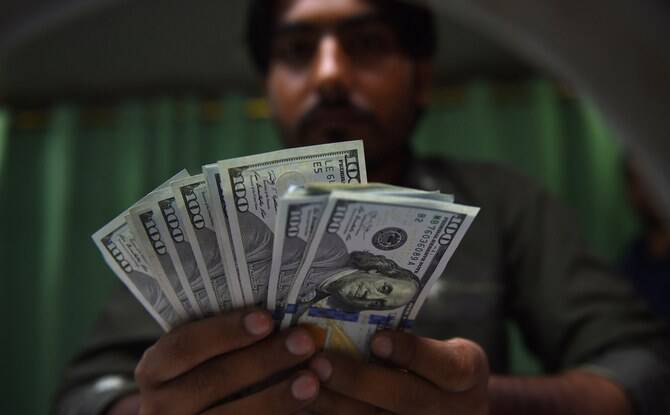
This photo taken on July 17, 2018 shows a Pakistani currency dealer counting US dollars banknotes at a currency exchange shop in Karachi. (AFP/File)
Short Url
Updated 20 May 2025
Follow

Pakistan regulator unveils new measures to strengthen Shariah-compliant market intermediaries

  • SECP has outlined phased approach encouraging institutional investors to engage with Shariah-compliant brokers
  • Islamic financial institutions being urged to channel takaful, investment activities through specialized intermediaries

KARACHI: The Securities and Exchange Commission of Pakistan (SECP) is proposing new measures aimed at strengthening the presence and operations of Shariah-compliant intermediaries within the capital market, the regulator said in a statement this week.

Pakistan’s Federal Shariat Court (FSC) directed the government in April 2022 to eliminate interest and align the country’s entire banking system with Islamic principles by 2027. Following the order, the government and the State Bank have taken several measures ranging from changing laws to issuing sukuk bonds to replace interest-based treasury bills and investment bonds.

However, documents seen by Arab News earlier this year showed Pakistan’s government had failed to achieve a target set by the central bank to increase the share of Islamic banking deposits in the country by 50 percent by January this year.

“The paper proposes a phase-wise approach for Shariah-compliant institutional investors to route their business through Shariah-compliant brokers based on a plan to be prepared by their respective boards of directors,” the SECP said about the latest proposal. 

“The paper encourages Islamic financial institutions, including providers of Islamic window services, to utilize Shariah-compliant intermediaries for takaful and investment purposes in situations where they are not obligated to do so.”
 
Other proposed measures include creating a specific category for Shariah-compliant intermediaries for greater visibility on the Centralized Gateway Portal and a dedicated list of Shariah-compliant asset management companies on EMLAAK Financials, Pakistan’s first digital mutual fund aggregator. The platform brings together multiple Asset Management Companies (AMCs) and their mutual funds under one roof. It is a venture of ITMinds Limited, a wholly owned subsidiary of the Central Depository Company of Pakistan (CDC).

In order to facilitate Roshan Digital Account (RDA) clients, creating a separate category of Shariah-compliant intermediaries on the websites and mobile apps of Islamic banks would also be explored in coordination with relevant stakeholders, the SECP said.


Pakistan offers Kyrgyzstan Arabian Sea access as two states sign 15 cooperation accords

Updated 05 December 2025
Follow

Pakistan offers Kyrgyzstan Arabian Sea access as two states sign 15 cooperation accords

  • Pakistan and Kyrgyzstan sign MOUs spanning trade, energy, agriculture, ports, education, security cooperation
  • Kyrgyz president is on first visit to Pakistan in 20 years as both sides push connectivity and CASA-1000 power links

ISLAMABAD: Pakistan on Thursday offered Kyrgyzstan the shortest and most economical route to the Arabian Sea as the two countries signed 15 agreements and memoranda of understanding aimed at boosting cooperation across trade, energy, agriculture, education, customs data-sharing and port logistics.

The accords were signed during a visit to Islamabad by President Sadyr Zhaparov, the first by a Kyrgyz head of state to Pakistan in two decades, and part of Islamabad’s renewed push to link South Asia with landlocked Central Asian economies through ports, power corridors and transport routes.

For Pakistan, Kyrgyzstan offers access to hydropower through CASA-1000, a $1.2 billion regional electricity transmission project designed to carry surplus summer electricity from Kyrgyzstan and Tajikistan through Afghanistan into Pakistan. For Bishkek, Pakistan provides overland access to warm-water ports on the Arabian Sea, creating a shorter commercial route to global markets.

“President Asif Ali Zardari has reiterated Pakistan’s readiness to offer Kyrgyzstan the shortest and most economical route to the Arabian Sea,” Radio Pakistan reported after Zhaparov met the Pakistani president. 

The two leaders also discussed expanding direct flights to deepen business, tourism and people-to-people ties.

Zardari welcomed Kyrgyzstan’s completion of its segment of the CASA-1000 project and “reaffirmed Pakistan’s commitment to completing its part of the project, which is now at an advanced stage,” the state broadcaster said. 

Zhaparov thanked Islamabad for supporting Bishkek’s candidacy for a non-permanent UN Security Council seat and invited Zardari to visit Kyrgyzstan at a time of his convenience. Both sides expressed satisfaction with progress under the Quadrilateral Traffic in Transit Agreement, designed to facilitate road movement between Pakistan, Kyrgyzstan, Kazakhstan and China.

Earlier, both governments exchanged 15 sectoral cooperation documents covering commerce, mining, geosciences, power, agriculture, youth programs, the exchange of convicted persons, customs electronic data systems and a sister-city linkage between Islamabad and Bishkek.

According to APP, the MOUs were signed by ministers representing foreign affairs, commerce, economy, energy, power, railways, interior, culture, health and tourism. Agreements also covered cooperation between Pakistan’s Foreign Service Academy and the Diplomatic Academy of Kyrgyzstan, as well as collaboration between universities, youth ministries and cultural institutions.

“Our present mutual trade, comprising of about $15–16 million will be enhanced to $200 million in the next two years,” Prime Minister Shehbaz Sharif said after the agreements were signed, calling them “a framework for structured, result-oriented engagement and closer institutional linkages.”

Sharif said Pakistan was ready to serve as a maritime outlet for the landlocked Central Asian republic, offering access to Karachi, Port Qasim and Gwadar to help Kyrgyz goods reach regional and global markets.