

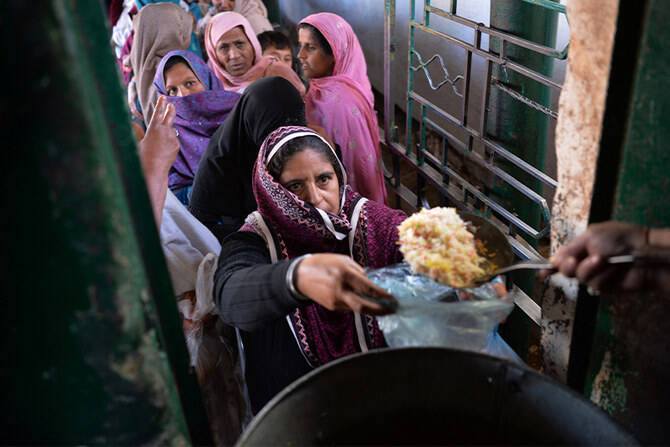

ISLAMABAD: More than 11 million Pakistanis faced acute food insecurity between November 2024 and March 2025 amid erratic changes in Pakistan’s weather patterns, the Food and Agriculture Organization (FAO) said in a report this week, as food insecurity and child malnutrition rose for the sixth consecutive year in 2024.
Since 2017, flood-affected rural districts of Pakistan’s Balochistan, Khyber Pakhtunkhwa and Sindh provinces as well as drought-affected areas in Balochistan and Sindh have witnessed persistent high levels of acute food insecurity, according to the 2025 Global Report on Food Crises.
While above-average rainfall supported agricultural production in Pakistan, abnormally heavy monsoon rains from July 2024 to September 2024 resulted in flooding and landslides in parts of Balochistan and Sindh provinces, causing localized crop losses and damage to housing and agricultural infrastructure.
Agricultural recovery remained uneven as regions affected by the 2022 climate-induced floods continued to struggle with limited access to inputs, livestock losses and economic constraints in the South Asian country of over 240 million people.
“In Pakistan, 11 million people or 22 percent of the analyzed population were facing high levels of acute food insecurity in 68 flood-affected rural districts across Balochistan, Sindh and Khyber Pakhtunkhwa,” the report read.
“This includes 1.7 million people in emergency.”
The FAO’s population coverage in Pakistan increased by 38 percent between 2024 and 2025, from 36.7 million people to 50.8 million, covering 25 additional districts.
The South Asian country ranks among the nations that are most vulnerable to the effects of climate change, which scientists say is making extreme weather events more common and more severe.
A “severe” drought ravaged several crops in the country’s breadbasket this winter, with officials stressing the need to build more water reservoirs and restore wetlands. In 2022, devastating floods killed more than 1,700 Pakistanis, affected another 33 million and caused the country over $30 billion in economic losses.
“Low female workforce participation also creates a substantial loss of income in Pakistan (24.3 percent), limiting households’ access to food,” the report said.
Globally, more than 295 million people across 53 countries and territories experienced acute levels of hunger in 2024, an increase of 13.7 million from 2023, according to the report.
Conflict remained the top driver of acute food insecurity, affecting around 140 million people in 20 countries and territories. Famine has been confirmed in Sudan, while other hotspots, which have people experiencing catastrophic levels of acute food insecurity, include the Gaza Strip, South Sudan, Haiti, and Mali.
Economic shocks including inflation and currency devaluation, drove hunger in 15 countries affecting 59.4 million people — still nearly double pre-COVID-19 levels despite a modest decline from 2023. Some of the largest and most protracted food crises were primarily driven by economic shocks, including in Afghanistan, South Sudan, Syrian Arab Republic, and Yemen.
“The 2025 Global Report on Food Crisis paints a staggering picture,” said Rein Paulsen, a senior FAO official.
“The main factors behind these increasing numbers are threefold. In the first instance, conflict and insecurity is the primary driver, remains the primary driver for acute food insecurity. Weather extremes is the second most important factor. And economic issues and challenges the third most important factor.
And the analysis shows, of course, that in many of the crisis contexts, these three factors are often overlapping.”
Malnutrition, particularly among children, reached extremely high levels, including in the Gaza Strip, Mali, Sudan, and Yemen. Nearly 38 million children under five were acutely malnourished across 26 nutrition crises.
“When we talk about the most extreme form of acute hunger, what we classify as IPC five, as we are seeing in Gaza, as we are seeing in Sudan, as we are seeing in Haiti and Mali, that these contexts are all touched by conflict and violence in different ways,” Paulsen said.
“And in practical terms, what this often means is an inability to physically access people who are most urgently in need of assistance.”


