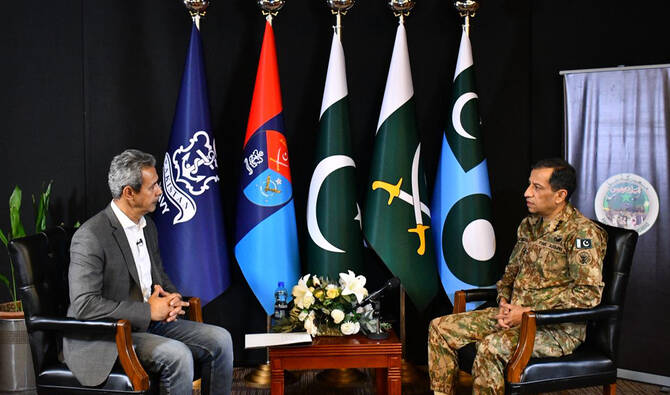

RAWALPINDI, Pakistan: The Pakistani military warns that any Indian attempt to follow through on recent threats to cut Islamabad’s share of the Indus River water system would trigger consequences lasting for generations, as tensions between the nuclear-armed neighbors are running high.
New Delhi unilaterally suspended a decades-old water-sharing agreement with Pakistan last month, as it blamed it for a deadly militant attack on tourists in Indian-administered Kashmir — Islamabad denied any involvement.
The incident was followed by days of cross-border fire as India launched on May 6 a series of strikes across the Line of Control — the de facto border that separates the Indian-controlled and Pakistani-controlled parts of the disputed Kashmir territory. It also hit other sites on the Pakistani mainland, targeting what it claimed were militant positions.
Pakistan retaliated with strikes on Indian military targets before a US-brokered ceasefire took effect on May 10. Despite the ceasefire, Indian Prime Minister Narendra Modi announced this week that his country would stop the water from flowing — a move Pakistan has earlier said was a direct threat to its survival and an act of war.
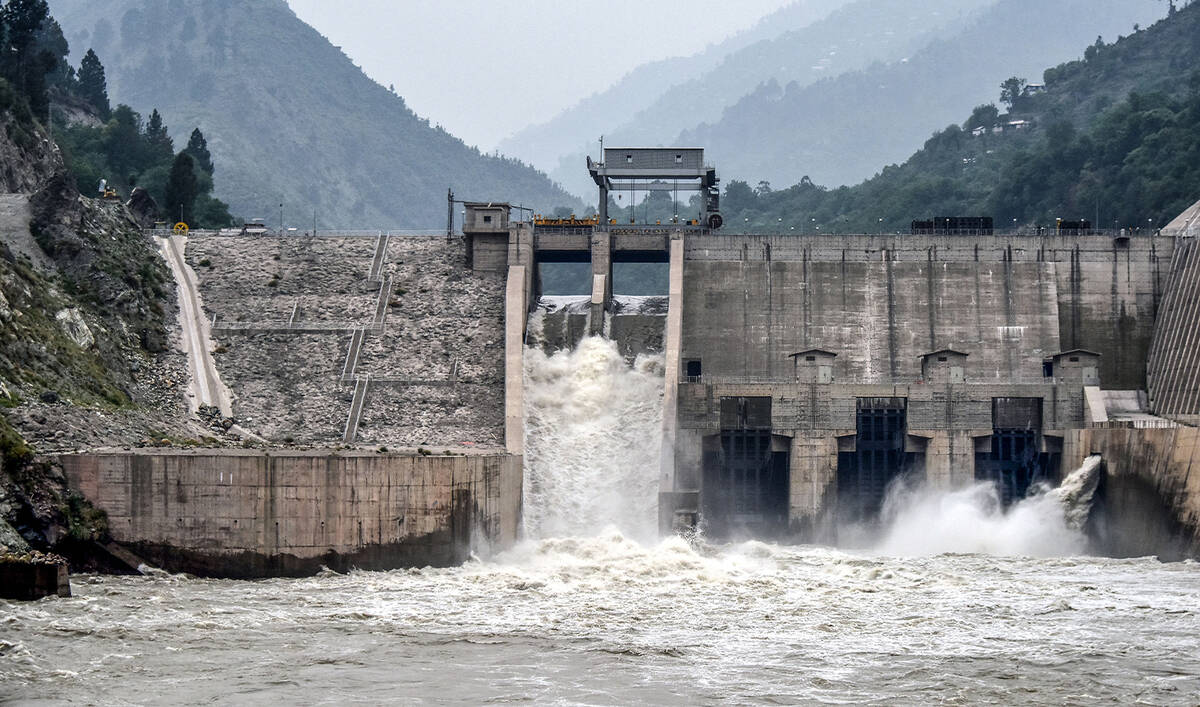
A general view of the partially damaged Neelum Jhelum Hydropower Project following Indian strikes in Nausari, about 40kms from Muzaffarabad, the capital of Pakistan-administered Kashmir, on May 8, 2025. (AFP)
Brokered by the World Bank, the 1960 Indus Waters Treaty has withstood multiple Indian-Pakistani wars. If India weaponizes water and blocks the flow of an Indus River tributary — vital to Pakistan’s food security — its military says it will act.
“I hope that time doesn’t come, but it will be such actions that the world will see and the consequences of that we will fight for years and decades to come. Nobody dares stop water from Pakistan,” Lt. Gen. Ahmed Sharif Chaudhry, spokesperson of the Pakistan Armed Forces, told Arab News on Friday.
“It is some madman who can think that he can stop water of 240 million plus people of this country.”
India’s recent attacks have killed 40 civilians, including 22 women and children, according to Pakistan’s official figures. As Pakistan retaliated, it hit 26 Indian military targets. It stopped the retaliatory strikes as soon as the ceasefire was reached.
“Pakistan armed forces are a professional armed forces and we adhere to the commitments that we make, and we follow in letter and spirit the instructions of the political government and the commitments that they hold,” Chaudhry said.
“As far as Pakistan army is concerned, this ceasefire will hold easily and there have been confidence building measures in communication between both the sides.”
Both countries have already blamed each other for violating the ceasefire multiple times since it took effect.
“If any violation occurs, our response is always there ... but it is only directed at those posts and those positions from where the violations of the ceasefire happen. We never target the civilians. We never target any civil infrastructure,” Chaudhry said.
According to the Pakistani military, India has lost six airplanes and an S-400 air defense system — Russia’s most advanced surface to air missile system — in the four-day conflict. Among the downed warplanes were several French aircraft Rafale.
Earlier reports suggested India had lost five fighter jets, but Pakistan’s prime minister announced earlier this week that there were six.
“I can confirm that the sixth aircraft is a Mirage 2000,” Chaudhry said. “We only targeted the aircraft ... We could have taken out more, but we showed restraint.”
Satellite photos captured after India’s strikes on May 6, show significant damage to multiple Pakistani air bases. High-resolution images from Maxar Technologies show large craters on runways and destruction of hangars and support structures at these facilities.
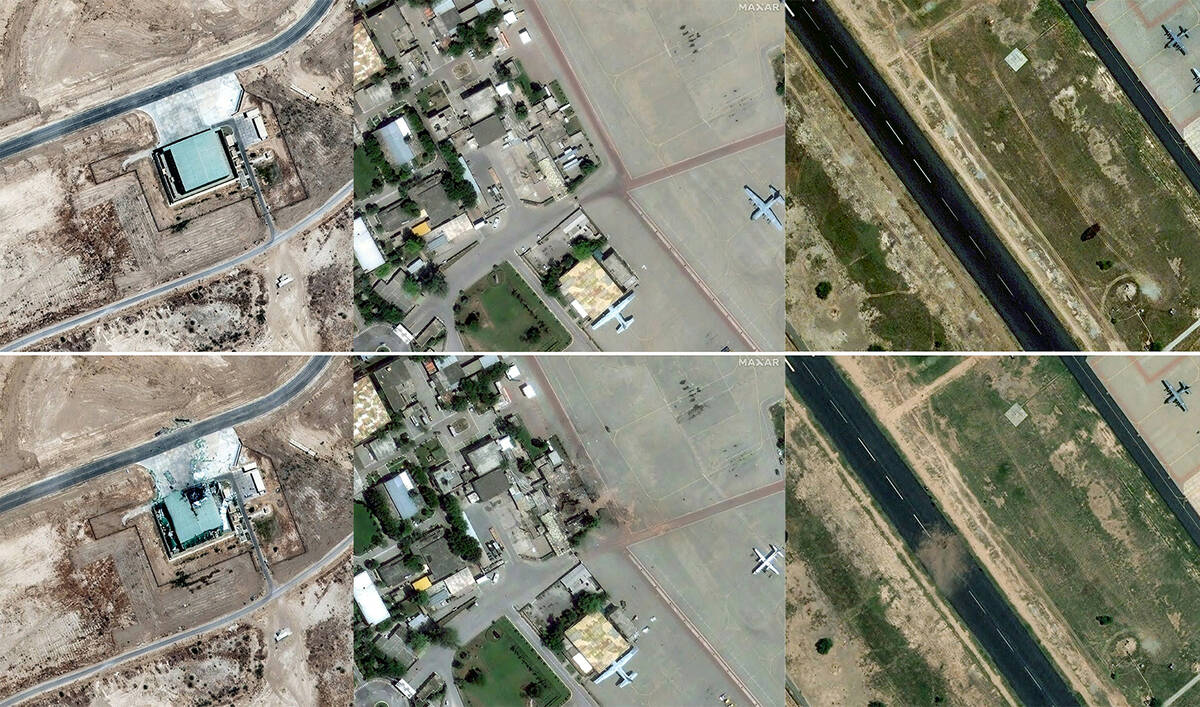
(COMBO, L-R) The combinations of handout satellite images courtesy of Maxar Technologies created on May 12, 2025, shows (top) a structure at Bholari Air Base in northern Thatta District on April 27, 2025, Nur Khan Air Base in Rawalpindi on April 25, 2025, and Pakistan Air Force base Mushaf in Sargodha April 30, 2025, and (bottom) damaged buildings and runway on May 10-11, 2025. (AFP/ Satellite Image ©2025 Maxar Technologies)
Chaudhry said that despite damage to infrastructure, they remained active: “There are ways through which Pakistan Air Force immediately sets these bases operational — they are all operational.”
He warned of a high potential for renewed conflict despite the ceasefire, as long as the core issue, Kashmir, remains unaddressed.
Predominantly Muslim, Kashmiri territory has been the subject of international dispute since the 1947 partition of the Indian subcontinent into Hindu-majority India and Muslim-majority Pakistan. Both countries claim Kashmir in full, and rule in part.
Indian-administered Kashmir has for decades witnessed outbreaks of separatist insurgency to resist control from the government in New Delhi.
In 2019, the Indian government revoked the region’s constitutional semi-autonomy and downgraded it from a state to a union territory under New Delhi’s direct control.
Indian officials have repeatedly said that the move aimed at tackling separatism and bringing economic development and peace to Kashmir.
“Their policy on Kashmir — of oppression and trying to internalize it — is not working,” Chaudhry said.
“Till the time Indians don’t sit and talk about Kashmir, then (as) two countries we sit, and we find a solution to it, the conflict potential is there.”