

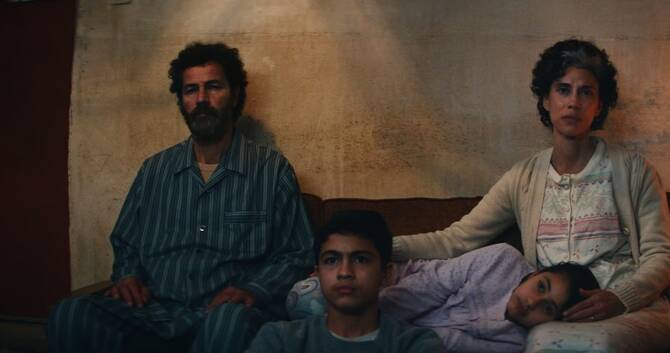
Palestinian Film Institute amplifies local stories at Cannes

PFI is hosting a special spotlight session on Palestinian producers, as well as a reception featuring filmmakers Arab and Tarzan Nasser, whose film “Once Upon a Time in Gaza” is part of the Un Certain Regard lineup. (Supplied)
Short Url
Updated 18 May 2025
Follow

Palestinian Film Institute amplifies local stories at Cannes

DUBAI: The Palestinian Film Institute is making a resounding statement at the Cannes Film Festival with its largest presence to date under the banner #HereThereAndForever.

This year’s Pavilion Program spans a range of activities including exhibitions, screenings, producer talks, and intimate meet-and-greet sessions, reflecting a commitment to amplifying Palestinian voices on the global stage.

“We’re not celebrating being in Cannes,” PFI programmer Mohanad Yaqubi said in an interview with The Hollywood Reporter. “There’s nothing to celebrate for us … it’s really about orienting the narrative surrounding Palestinian cinema and Palestinian stories through the filmmakers themselves.

“We feel the responsibility, and it’s very hard,” he said. “Some of our members actually have families in Gaza now, and they are here in Cannes. It’s uncomfortable, but this is not an industry only for rich people. We have to make that industry accommodate us and our needs as an oppressed and underrepresented (group).”

A major highlight of the program is the official launch of the PFI Film Fund. According to Yaqubi, the fund represents a dream long in the making. “The aim for the first three rounds is to fund or support four to six projects in different formats, at least, to give them a base so that they can start working,” he said.

In addition, PFI is hosting a special spotlight session on Palestinian producers, as well as a reception featuring filmmakers Arab and Tarzan Nasser, whose film “Once Upon a Time in Gaza” is part of the Un Certain Regard lineup. Another notable event is the screening and reception for “From Ground Zero,” an initiative spearheaded by filmmaker Rashid Masharawi. The anthology film is a collection of eight short documentaries and two feature-length films by 22 Palestinian directors, each offering raw glimpses into life under airstrikes in Gaza.

With four Palestinian producers participating in the Producers’ Network, Yaqubi encouraged attendees to explore their slates, which he described as “the upcoming Palestinian films and narratives that need to be supported.”

Yaqubi’s aims are clear. “We hope to be here every year,” he said. “The presence is important, and to stay away won’t make a change. We have to dip our toes in the cold water and change things.”


Global gems go under the hammer 

Updated 16 January 2026
Follow

Global gems go under the hammer 

  • International highlights from Sotheby’s ‘Origins II’ auction, which takes place Jan. 31 in Diriyah 

Andy Warhol 

‘Muhammad Ali’ 

Arguably the most famous name in pop art meets arguably the most famous sportsman of the 20th century in this set of four screen prints from 1978, created at the behest of US investment banker Richard Weisman. “I felt putting the series together was natural, in that two of the most popular leisure activities at the time were sports and art, yet to my knowledge they had no direct connection,” Weisman said in 2007. “Therefore I thought that having Andy do the series would inspire people who loved sport to come into galleries, maybe for the first time, and people who liked art would take their first look at a sports superstar.” Warhol travelled to Ali’s training camp to take Polaroids for his research, and was “arrested by the serene focus underlying Ali’s power — his contemplative stillness, his inward discipline,” the auction catalogue states. 

Jean-Michel Basquiat 

‘Untitled’ 

Basquiat “emerged from New York’s downtown scene to become one of the most influential artists of the late 20th century,” Sotheby’s says. The largely self-taught artist’s 1985 work, seen here, “stands as a vivid testament to (his) singular ability to transform drawing into a site of intellectual inquiry, cultural memory, and visceral self-expression.” Basquiat, who was of Caribbean and Puerto Rican heritage, “developed a visual language of extraordinary immediacy and intelligence, in which image and text collide with raw urgency,” the catalogue continues. 

Camille Pissarro 

‘Vue de Zevekote, Knokke’ 

The “Knokke” of the title is Knokke-sur-Mer, a Belgian seaside village, where the hugely influential French-Danish Impressionist stayed in the summer of 1894 and produced 14 paintings, including this one. The village, Sotheby’s says, appealed to Pissarro’s “enduring interest in provincial life.” In this work, “staccato brushstrokes, reminiscent of Pissarro’s paintings of the 1880s, coalesce with the earthy color palette of his later work. The resulting landscape, bathed in a sunlit glow, celebrates the quaint rural environments for which (he) is best known.” 

David Hockney 

‘5 May’ 

This iPad drawing comes from the celebrated English artist’s 2011 series “Arrival of Spring in Woldgate, East Yorkshire in 2011,” which Sotheby’s describes as “one of the artist’s most vibrant and ambitious explorations of landscape, perception, and technological possibility.” Each image in the series documents “subtle shifts in color, light and atmosphere” on the same stretch of the Woldgate, “showing the landscape as something experienced over time rather than frozen in an instant.” The catalogue notes that spring has long been an inspiration for European artists, but says that “no artist has ever observed it so closely, with such fascinated and loving attention, nor recorded it in such detail as an evolving process.” 

Zarina  

‘Morning’ 

Sotheby’s describes Indian artist Zarina Hashmi — known by her first name — as “one of the most compelling figures in post-war international art — an artist whose spare, meditative works distilled the tumult of a peripatetic life into visual form.” She was born in Aligarh, British India, and “the tragedy of the 1947 Partition (shaped) a lifelong meditation on the nature of home as both physical place and spiritual concept.” This piece comes from a series of 36 woodcuts Zarina produced under the title “Home is a Foreign Place.” 

George Condo 

‘Untitled’ 

This 2016 oil-on-linen painting is the perfect example of what the US artist has called “psychological cubism,” which Sotheby’s defines as “a radical reconfiguration of the human figure that fractures identity into simultaneous emotional and perceptual states.” It’s a piece that “distills decades of inquiry into the mechanics of portraiture, drawing upon art-historical precedent while decisively asserting a contemporary idiom that is at once incisive and darkly humorous,” the catalogue notes, adding that the work is “searing with psychological tension and painterly bravura.”