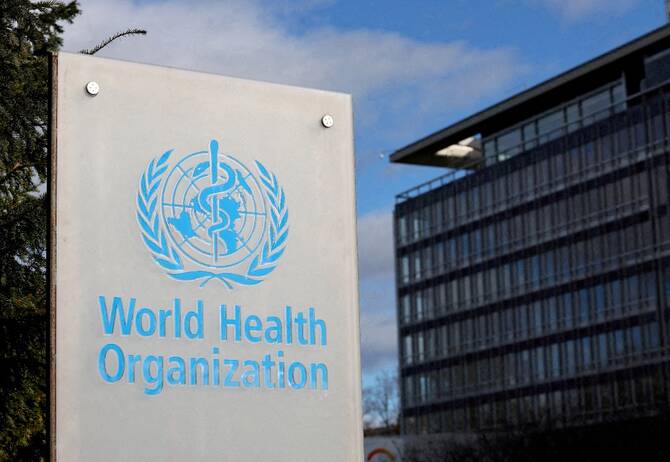

LONDON/GENEVA: Hundreds of officials from the World Health Organization will join donors and diplomats in Geneva from Monday with one question dominating their thoughts — how to cope with crises from mpox to cholera without their main funder, the United States.
The annual assembly, with its week of sessions, votes and policy decisions, usually showcases the scale of the UN agency set up to tackle disease outbreaks, approve vaccines and support health systems worldwide.
This year — since US President Donald Trump started the year-long process to leave the WHO with an executive order on his first day in office in January — the main theme is scaling down.
“Our goal is to focus on the high-value stuff,” Daniel Thornton, the WHO’s director of coordinated resource mobilization, told Reuters.
Just what that “high-value stuff” will be is up for discussion. Health officials have said the WHO’s work in providing guidelines for countries on new vaccines and treatments for conditions from obesity to HIV will remain a priority.
One WHO slideshow for the event, shared with donors and seen by Reuters, suggested work on approving new medicines and responding to outbreaks would be protected, while training programs and offices in wealthier countries could be closed.
The United States had provided around 18 percent of the WHO’s funding. “We’ve got to make do with what we have,” said one Western diplomat who asked not to be named.
Staff have been getting ready — cutting managers and budgets — ever since Trump’s January announcement in a rush of directives and aid cuts that have disrupted a string of multilateral pacts and initiatives.
The year-long delay, mandated under US law, means the US is still a WHO member — its flag still flies outside the Geneva HQ — until its official departure date on January 21, 2026.
Trump — who accused the WHO of mishandling COVID, which it denies — muddied the waters days after his statement by saying he might consider rejoining the agency if its staff “clean it up.”
But global health envoys say there has since been little sign of a change of heart. So the WHO is planning for life with a $600 million hole in the budget for this year and cuts of 21 percent over the next two-year period.
CHINA TAKES LEAD
As the United States prepares to exit, China is set to become the biggest provider of state fees — one of the WHO’s main streams of funding alongside donations.
China’s contribution will rise from just over 15 percent to 20 percent of the total state fee pot under an overhaul of the funding system agreed in 2022.
“We have to adapt ourselves to multilateral organizations without the Americans. Life goes on,” Chen Xu, China’s ambassador to Geneva, told reporters last month.
Others have suggested this might be a time for an even broader overhaul, rather than continuity under a reshuffled hierarchy of backers.
“Does WHO need all its committees? Does it need to be publishing thousands of publications each year?” said Anil Soni, chief executive of the WHO Foundation, an independent fund-raising body for the agency.
He said the changes had prompted a re-examination of the agency’s operations, including whether it should be focussed on details like purchasing petrol during emergencies.
There was also the urgent need to make sure key projects do not collapse during the immediate cash crisis. That meant going to donors with particular interests in those areas, including pharmaceutical companies and philanthropic groups, Soni said.
The ELMA Foundation, which focuses on children’s health in Africa with offices in the US, South Africa and Uganda, has already recently stepped in with $2 million for the Global Measles and Rubella Laboratory Network known as Gremlin — more than 700 labs which track infectious disease threats, he added.
Other business at the assembly includes the rubber-stamping a historic agreement on how to handle future pandemics and drumming up more cash from donors at an investment round.
But the focus will remain on funding under the new world order. In the run up to the event, a WHO manager sent an email to staff asking them to volunteer, without extra pay, as ushers.