Pakistan says eyeing transit hub role to connect South, Central Asian economies

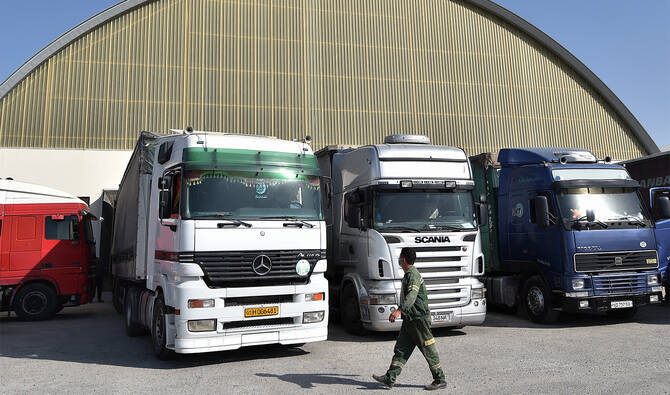
A driver walks near trucks in Termez Cargo Centre near the city of Termez, some 800 kms from Uzbekistan capital Tashkent, on October 18, 2021. (AFP/File)
Short Url
Updated 18 May 2025
Follow

Pakistan says eyeing transit hub role to connect South, Central Asian economies

  • Pakistan Communications Minister Abdul Aleem Khan attends Kazan trade and investment forum in Russia 
  • Minister says Islamabad wants to increase landlocked Central Asian countries’ access to warm waters for trade 

Islamabad: Pakistan’s Communications Minister Abdul Aleem Khan has said that Islamabad aims to emerge as a key transit hub connecting the economies of South and Central Asia, state-run media reported on Sunday. 

Pakistan has been working to strengthen its position as a key trade and transit hub, connecting landlocked Central Asian states to the global market through its strategic location. Last year saw a surge in visits, investment discussions and economic activity between Pakistan and Central Asian nations as well as Gulf countries. 

Khan was speaking at the “Russia-Islamic World: Kazan Forum” being held from May 13-18 in the country’s Kazan region. This forum is the main platform for economic cooperation between Russia and Islamic countries as per its website. 

“Minister for Communications Abdul Aleem Khan says Pakistan aims to emerge as a key transit hub, bridging the economies of South Asia and Central Asia,” state broadcaster Radio Pakistan reported. 

Addressing the closing session of the Kazan Forum, Khan noted the Gwadar Port in southwestern Pakistan has already started shipment and cargo services. He added that Islamabad intends to facilitate landlocked Central Asia’s access to warm waters.

Khan spoke about Pakistan’s strategic plans to connect its Karachi, Quetta and Gwadar cities with Central Asia and Europe through road networks. 

“Abdul Aleem Khan welcomed the holding of the Kazan Forum and reaffirmed Pakistan’s strong commitment to playing an active role in regional development,” the report said. 

Pakistan’s recent push to engage Central Asian countries and the Middle East takes place as Islamabad seeks to escape a prolonged macroeconomic crisis that has drained its country of financial resources and weakened its balance of payment position and currency. 

Islamabad has sought to attract international investment in key economic sectors since it narrowly avoided a sovereign default in 2023 before a last-gasp International Monetary Fund (IMF) bailout helped it avoid that. 


Pakistan to promote mineral sector at Saudi forum this month with 13 companies

Updated 02 January 2026
Follow

Pakistan to promote mineral sector at Saudi forum this month with 13 companies

  • Delegation will take part in the Future Minerals Forum in Riyadh from Jan. 13-15
  • Petroleum minister will lead Pakistan, participate in a 90-minute country session

ISLAMABAD: Around 13 Pakistani state-owned and private companies will attend the Future Minerals Forum (FMF) in Saudi Arabia from Jan. 13 to 15, an official statement said on Friday, as the country seeks to ramp up global engagement to develop its mineral resources.

The FMF is an international conference and investment platform for the mining sector, hosted by mineral-rich countries to attract global investors, companies and governments.

Petroleum Minister Ali Pervaiz Malik confirmed Pakistan’s participation in a meeting with the Saudi envoy, Nawaf bin Said Al-Malki.

Pakistan hosts one of the world’s largest copper-gold zones. The Reko Diq mine in southwestern Balochistan, with an estimated 5.9 billion tons of ore, is partly owned by Barrick Gold, which calls it one of the world’s largest underdeveloped copper-gold deposits. Its development is expected to boost Pakistan’s struggling economy.

“Upon an invitation of the Government of the Kingdom of Saudi Arabia, the Federal Minister informed the Ambassador that Pakistan will fully participate in the upcoming Future Minerals Forum (FMF), scheduled to be held in Riyadh later this month,” Pakistan’s Press Information Department (PID) said in an official statement.

The Pakistani minister will lead his country’s delegation at the FMF and take part in a 90-minute country showcase session titled “Unleashing Potential: Accelerating Pakistan’s Mineral Revolution” along with local and foreign investors.

Pakistan will also establish a dedicated pavilion to highlight the vast potential of its rich geological landscape to the global mineral community.

The Saudi envoy welcomed Pakistan’s decision to participate in the forum and discussed enhancing bilateral cooperation in the minerals and energy sectors during the meeting.

According to the statement, he highlighted the potential for cooperation between Saudi Arabia and Pakistan in the minerals and energy sectors, expressing confidence that the FMF would provide a platform to expand collaboration.
Pakistan’s mineral sector, despite its rich reserves of salt, copper, gold and coal, contributes only 3.2 percent to the country’s GDP and just 0.1 percent to global mineral exports.

However, many countries, including the United States, have shown interest in Pakistan’s underdeveloped mineral sector, particularly in copper, gold and other critical resources.

In October, Pakistan dispatched its first-ever shipment of rare earth and critical minerals to the United States, according to a Chicago-based US public relations firm’s report.