

Pakistan says eyeing transit hub role to connect South, Central Asian economies

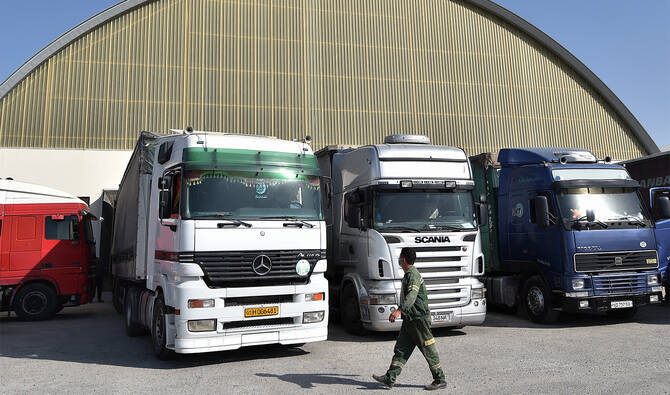
A driver walks near trucks in Termez Cargo Centre near the city of Termez, some 800 kms from Uzbekistan capital Tashkent, on October 18, 2021. (AFP/File)
Short Url
Updated 18 May 2025
Follow

Pakistan says eyeing transit hub role to connect South, Central Asian economies

  • Pakistan Communications Minister Abdul Aleem Khan attends Kazan trade and investment forum in Russia 
  • Minister says Islamabad wants to increase landlocked Central Asian countries’ access to warm waters for trade 

Islamabad: Pakistan’s Communications Minister Abdul Aleem Khan has said that Islamabad aims to emerge as a key transit hub connecting the economies of South and Central Asia, state-run media reported on Sunday. 

Pakistan has been working to strengthen its position as a key trade and transit hub, connecting landlocked Central Asian states to the global market through its strategic location. Last year saw a surge in visits, investment discussions and economic activity between Pakistan and Central Asian nations as well as Gulf countries. 

Khan was speaking at the “Russia-Islamic World: Kazan Forum” being held from May 13-18 in the country’s Kazan region. This forum is the main platform for economic cooperation between Russia and Islamic countries as per its website. 

“Minister for Communications Abdul Aleem Khan says Pakistan aims to emerge as a key transit hub, bridging the economies of South Asia and Central Asia,” state broadcaster Radio Pakistan reported. 

Addressing the closing session of the Kazan Forum, Khan noted the Gwadar Port in southwestern Pakistan has already started shipment and cargo services. He added that Islamabad intends to facilitate landlocked Central Asia’s access to warm waters.

Khan spoke about Pakistan’s strategic plans to connect its Karachi, Quetta and Gwadar cities with Central Asia and Europe through road networks. 

“Abdul Aleem Khan welcomed the holding of the Kazan Forum and reaffirmed Pakistan’s strong commitment to playing an active role in regional development,” the report said. 

Pakistan’s recent push to engage Central Asian countries and the Middle East takes place as Islamabad seeks to escape a prolonged macroeconomic crisis that has drained its country of financial resources and weakened its balance of payment position and currency. 

Islamabad has sought to attract international investment in key economic sectors since it narrowly avoided a sovereign default in 2023 before a last-gasp International Monetary Fund (IMF) bailout helped it avoid that. 


Pakistan says defense pact with Saudi Arabia elevated brotherly ties to ‘new heights’

Updated 25 February 2026
Follow

Pakistan says defense pact with Saudi Arabia elevated brotherly ties to ‘new heights’

  • Pakistan, Saudi Arabia signed strategic defense pact last year pledging aggression against one will be treated as attack on both
  • Deputy PM Ishaq Dar says enduring bonds with Islamic and Arab nations form vital pillar of Pakistan’s foreign policy 

ISLAMABAD: Deputy Prime Minister Ishaq Dar said on Wednesday that Pakistan’s defense pact with Saudi Arabia elevated its brotherly ties with the Kingdom to “new heights,” stressing that close ties with Arab and Islamic nations form a key pillar of Islamabad’s foreign policy. 

Pakistan and Saudi Arabia signed a Strategic Mutual Defense Agreement on Sept. 17 last year, pledging that aggression against one country would be treated as an attack on both, enhancing joint deterrence and formalizing decades of military and security cooperation.

Both nations agreed in October 2025 to launch an economic cooperation framework to strengthen trade and investment ties. 

“In the Middle East, our landmark Strategic Mutual Defense Agreement with Saudi Arabia has elevated our brotherly ties to new heights,” Dar said while speaking at the Pakistan Governance Forum 2026 event in Islamabad. 

The Pakistani deputy prime minister was speaking on the topic “Navigating International Relations Amidst Changing Geo-Politics.”

Dar noted that Pakistan has reinforced partnerships with other Middle Eastern nations such as the UAE, Qatar, Jordan, Oman, Egypt and Bahrain. He said these partnerships have yielded “concrete agreements” in investment, agriculture, infrastructure, and energy sectors. 

“Our enduring bonds with Islamic and Arab nations form a vital pillar of our foreign policy, and we will continue to expand our partnerships across Asia, Latin America, and Africa,” he said. 

Dar pointed out that the presidents of Kazakhstan, Uzbekistan and Kyrgyzstan have undertaken visits to Pakistan in recent months, reflecting Central Asian nations’ desire to boost cooperation with Islamabad.

On South Asia, the Pakistani deputy PM said Pakistan has successfully transformed its fraternal ties with Bangladesh into “a substantive partnership.”

“Similarly, the trilateral mechanism involving China, Pakistan, and Bangladesh has been launched with a view to expanding and deepening regional cooperation and synergy,” the Pakistani minister said. 

He said Islamabad has strengthened its “all-weather” partnership with China via the second phase of the multi-billion-dollar China-Pakistan Economic Corridor agreement and “unwavering support” from both sides for each other’s core interests. 

Dar said Pakistan had also reinvigorated its partnership with the US, advancing cooperation in trade, technology, investment, and regional stability. 

“This calibrated approach has enhanced our ability to navigate complexity with skill and confidence, ensuring that our national interests are served without compromising our core foreign policy principles,” he said.