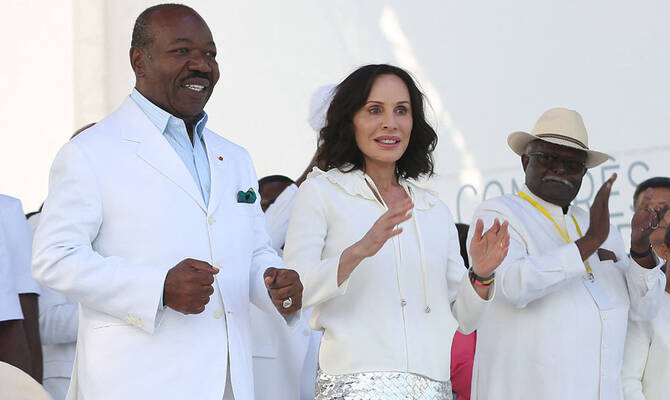

LUANDA: Gabon’s former leader, Ali Bongo Ondimba, who was detained after being ousted in a 2023 coup, has been released and has gone to Angola with his family, the Angolan presidency said.
Bongo, whose family ruled Gabon for 55 years, had been under house arrest in the capital, Libreville, since being overthrown in August 2023.
His wife and son had also been in detention, accused of embezzling public funds.
A statement on the Angolan presidency’s Facebook page announcing the arrival of the Bongo family in the capital, Luanda, was accompanied by photographs showing the former leader being welcomed at an airport.
The “Bongo family has been released and has just arrived in Luanda,” it said.
The release of the family followed talks between Angolan President Joao Lourenço and Gabon’s new leader, Brice Clotaire Oligui Nguema, the statement said.
Lawyers for the Bongos in France said their release had been the “result of long efforts on both the judicial and diplomatic levels.
“After 20 months of arbitrary and cruel detention accompanied by torture, the family is finally reunited around the former president Ali Bongo,” they said in a statement.
But a prosecutor in Libreville said Bongo’s French-born wife Sylvia, 62, and son Noureddin, 33, had only been provisionally freed, awaiting a trial for alleged embezzlement.
Prosecutor Eddy Minang said the pair’s release “does not in any way interrupt the normal course of the proceedings, which will continue until a fair, transparent, equitable and timely trial is held.”
Oligui, a former junta leader, seized power in the August 2023 coup that ended the 55-year rule of the Bongo dynasty.
The general was sworn in earlier this month after winning 94.85 percent in an April 12 vote in which international observers signaled no major irregularities.
Oligui’s main rival, Alain-Claude Bilie By Nze, the last prime minister under Bongo, said the family’s release demonstrated that their detention “did not respect the framework of law and justice.
“President Oligui Nguema did not show clemency: He had to bow to international demands after what everyone understood to be an abuse of power,” he said.
Lawyers for Sylvia and Noureddin alleged they had suffered torture while in detention.
Several Gabonese news media reported recently that they had been moved from cells in an annex of the presidency to a family residence in Libreville.
A member of Gabon’s transitional parliament, Geoffroy Foumboula Libeka, said the move of the family “in the middle of the night and total silence” was “a real disgrace for the first days” of the new government. “Where is Gabon’s sovereignty?” he asked on social media.
The Bongo family’s release, he said, was “the price to pay” for the country’s reintegration into the African Union, which Angolan leader Lourenco currently heads.
The African Union announced on April 30 that it had lifted sanctions against Gabon, which was suspended from the organisation following the coup.
The country of 2.3 million people has endured high unemployment, regular power and water shortages, and heavy government debt despite its oil wealth.
The Gabon presidency announced on social media on May 12 that Lourenco had met Oligui in Libreville for talks focused “on strengthening bilateral cooperation, the smooth running of democratic elections marking the end of the transition in Gabon.”
They also discussed lifting sanctions following Gabon’s reintegration into the AU.
Bongo, 66, who is suspected to be in poor health, came to power in 2009, taking over from his father, Omar Bongo Ondimba, who ruled for 41 years.
In 2016, he was narrowly reelected for a second term by a few thousand votes, beating opposition challenger Jean Ping after a campaign marred by bloody clashes and allegations of fraud.
He suffered a stroke in October 2018 while on a visit to Saudi Arabia, and there was speculation about his health and fitness to govern when he returned home.
His public appearances were rare, and the times when he spoke live outside the confines of the presidential palace were rarer still.
Bongo ruled for 14 years until he was overthrown moments after being proclaimed the winner in a presidential election the army and opposition declared fraudulent.