

Pakistani woman police officer wins Global Investigation Award in Dubai

Pakistan’s Anam Sher Khan, assistant superintendent of Punjab Police, receives the “Excellence in Criminal Investigation” award at the 2025 World Police Summit held at the World Trade Center in Dubai on May 16, 2025. (Photo courtesy: X/@DubaiPoliceHQ)
Short Url
Updated 17 May 2025
Follow

Pakistani woman police officer wins Global Investigation Award in Dubai

  • ASP Anum Sher Khan was awarded at the World Police Summit 2025 for the rescue of two young girls from human traffickers and arrest of suspects
  • Another Pakistani officer, Muhammad Isa Khan, secured the second position in the ‘Best Artificial Intelligence Implementation in Policing’ category

KARACHI: A Pakistani woman police officer, Anum Sher Khan, has won the prestigious ‘Excellence in Criminal Investigation’ award at the 2025 World Police Summit Awards in Dubai, the Punjab police said on Friday.

The World Police Summit 2025 featured conferences, strategic sessions and workshops that focused on four main areas, including combating organized crime and promoting community policing, the use of artificial intelligence in policing, capacity-building for junior officers, and enhancing road safety and traffic enforcement.

Themed as “Beyond the Badge: Envision the Next Era of Policing,” this year’s summit explored critical global challenges such as cross-border crime, public-private security collaboration, and AI integration across law enforcement. The four-day event featured 12 core policing tracks delivered across four specialized conferences, covering topics like cybercrime, border security, anti-narcotics efforts, road safety, and human trafficking.

Khan said she was recognized for her successful rescue of two young girls from human traffickers and bringing the perpetrators to justice, adding the award validates her team’s dedication and acknowledges the positive impact of their work on the lives of victims and their families.

“I’m deeply honored to have received the Criminal Investigation Award, representing the Police Service of Pakistan at an international forum,” Khan, who currently serves as Sub-Divisional Police Officer (SDPO) Sargodha, told Arab News.
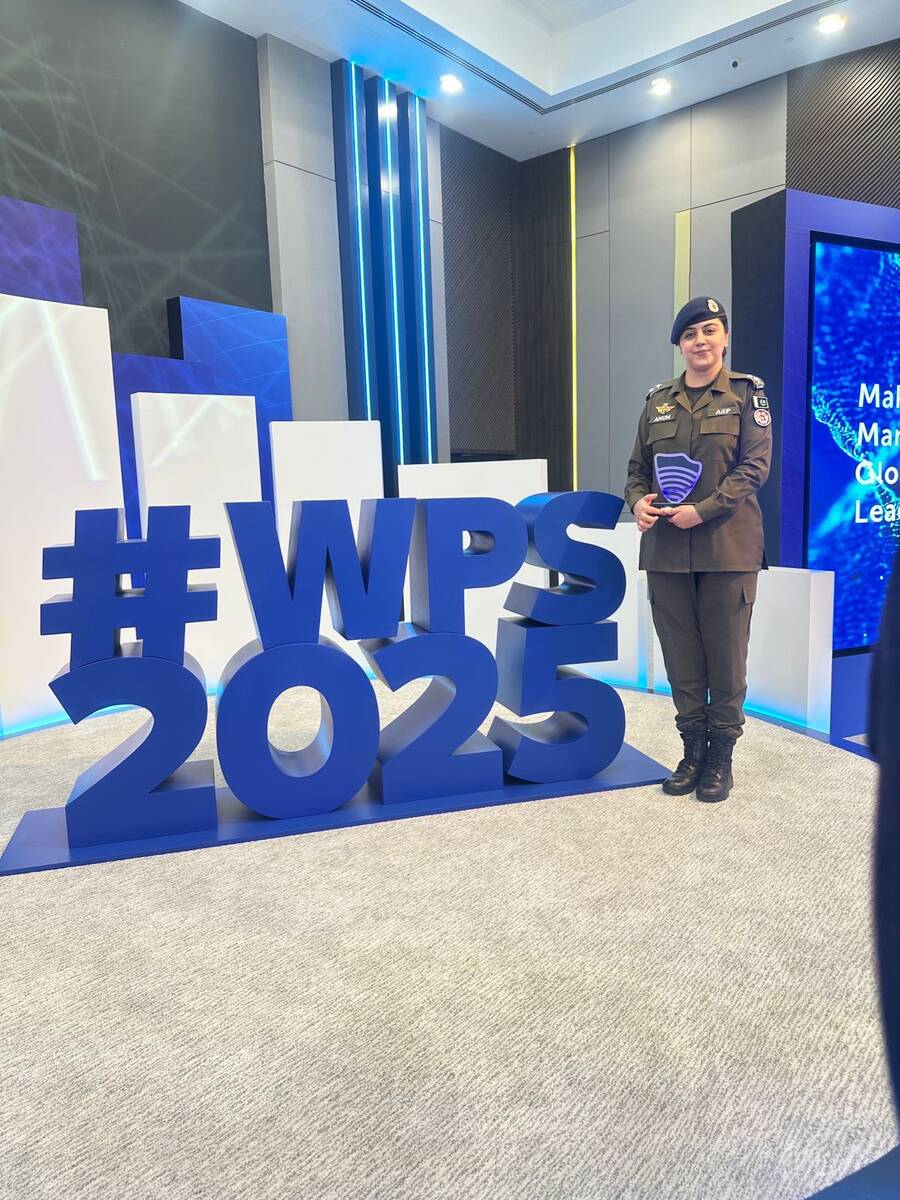


Pakistan’s Anam Sher Khan, assistant superintendent of Punjab Police, gestures for a photograph with the “Excellence in Criminal Investigation” award at the 2025 World Police Summit held at the World Trade Center in Dubai on May 16, 2025. (Photo courtesy: Facebook/Punjab Police)

“This case underscores the critical role of law enforcement in safeguarding vulnerable populations. I’m grateful for the recognition and look forward to continuing Punjab Police’s efforts in making our communities safer. The World Police Summit provides a valuable platform for sharing best practices and recognizing excellence, and I’m proud to be part of it.”

In a post on Facebook, Punjab Inspector-General Dr. Usman Anwar congratulated Khan on winning first position in the Excellence in Criminal Investigation Award 2025 category for her “outstanding performance in criminal investigation.”
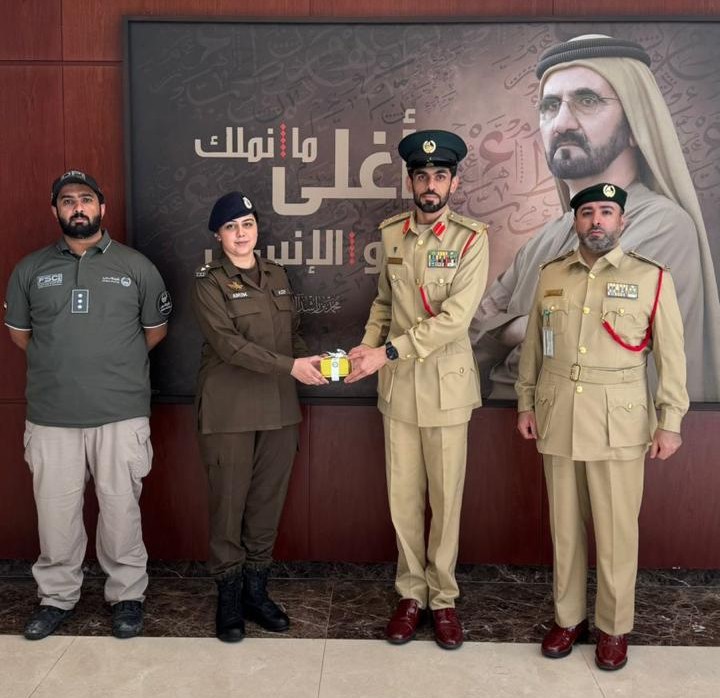


Pakistan’s Anam Sher Khan, assistant superintendent of Punjab Police, receives souvenir at the 2025 World Police Summit held at the World Trade Center in Dubai on May 16, 2025. (Photo courtesy: Facebook/Punjab Police)

“Talented police officers like ASP Anum Sher Khan are the pride and valuable asset of Punjab Police,” Dr. Anwar was quoted as saying.

The jury considered police officers from 192 countries for the awards in various categories, and Khan was not the only Pakistani police officer whose exceptional services were recognized at the event.

“DPO [District Police Officer] Kasur Muhammad Isa Khan was awarded second position for his high performance in the ‘Best Artificial Intelligence Implementation in Policing Award’ category,” the Punjab police said.

Organized under the patronage of the UAE government, the World Police Summit is one of the most prominent global platforms for recognizing excellence in policing. The recognition of Pakistani police officers.


Macroeconomic instability, inconsistent policies hinder FDI in Pakistan— economists, OICCI

Updated 4 sec ago
Follow

Macroeconomic instability, inconsistent policies hinder FDI in Pakistan— economists, OICCI

  • Pakistan’s foreign direct investment fell 26 percent to $748 million from $1.01 billion a year earlier — data
  • Foreign investors also avoid Pakistan due to its repeated reliance on loans from the IMF, say economists

KARACHI: Despite being the fifth-largest consumer market in the world, Pakistan has failed to attract its “due share” of foreign direct investment (FDI) due to inconsistent policies, regional conflicts and macroeconomic stability, economists and a senior official of the Overseas Investors Chamber of Commerce and Industry (OICCI) said this week. 

Prime Minister Shehbaz Sharif has pursued economic diplomacy recently, traveling frequently to the China, Saudi Arabia, the UAE and other countries. However, these efforts have yet to translate into sustained inflows, as Pakistan has attracted a mere $3 billion in annual FDI over the past two decades, according to the SBP’s data.

Pakistan’s FDI fell 26 percent to $748 million from $1.01 billion a year earlier, extending the downward trend from $2.5 billion recorded in FY25 and $2.3 billion in FY24.

“Pakistan has not been able to attract its due share of the foreign direct investment,” OICCI Secretary General Abdul Aleem said on Friday.
 
The OICCI represents over 200 multinational companies operating in Pakistan, which have collectively reinvested $23 billion over the decade to 2023, according to the group’s website.

“One of the reasons that Pakistan has not been able to attract as much FDI as it should is also a situation in a region where there are conflicts.”

Aleem was referring to Pakistan’s recent border skirmishes with Afghanistan and its four-day military conflict with India in May this year. 

Portfolio investment has also been far from impressive, rising to $160 million in July–Oct in FY26 from $97.2 million a year earlier. Portfolio investment reflects how much money foreigners invest in or withdraw from a country’s stock market.

Last month, Karachi-based market research firm Topline Securities reported that Pakistan had lost around $4 billion in portfolio investments over the past decade.

Arab News reached out to Pakistan’s finance adviser Khurram Schehzad and Jamil Ahmad Qureshi, the secretary-general of the Special Investment Facilitation Council but they were not immediately available for comment. 

Finance Minister Muhammad Aurangzeb told Arab News last month that Pakistan was now better positioned to seek foreign investment due to early signs of macroeconomic stabilization after a prolonged crisis.

‘GREATER CLARITY, CONTINUITY’

Sana Tawfik, head of research at Arif Habib Limited, said Pakistan could see more sustained foreign investment flows through consistent reforms and “clear policies.”

“But foreign investors look for greater clarity and continuity before committing large and long-term capital,” she noted. 

Pakistan’s former finance adviser, Khaqan Najeeb, agreed. He said macroeconomic instability and policy shifts complicate business planning.

“Infrastructure gaps and regulatory hurdles further soften investor confidence,” Najeeb said, noting that Pakistan’s net FDI was hovering around the $1.5-2 billion mark, far below the country’s potential. 

Najeeb pointed out that Islamabad’s repeated reliance on bailouts from the International Monetary Fund (IMF) is also a major reason why foreign investors avoid Pakistan’s debt-burdened yet resilient economy.

Pakistan has secured at least 26 loans from the IMF since joining the organization in 1950, according to the Fund’s website. Pakistan secured a $7 billion bailout program from the global lender last year and is expecting a $1.2 billion tranche after the Executive Board’s meeting next week.

“I think chronic macroeconomic instability, currency volatility, reserves positions going down, going back to the IMF so many times have played a role in this,” he said. 

He said Pakistan’s FDI inflows had remained “modest” due to its recurring balance of payments pressures, noting that periodic IMF programs create “uncertainty for long-term investors.”

Aleem said he was working with the government to streamline Pakistan’s tax structure and ease of doing business, noting that foreign investors often had concerns about the South Asian country’s “slow” legal system.

“It is not enough to say improvements have been made internally,” he said. 

“You have to stand up internationally and at the right forums, share transparently what is good and what is not good in the country.”
