

Pakistan rejects Indian media reports of radiation leak, warns against regional arms buildup

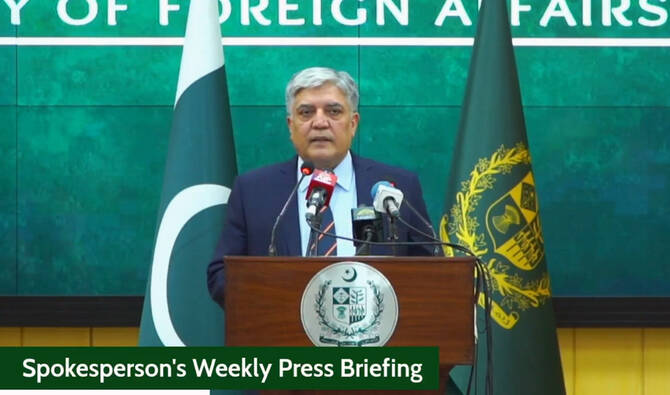
The screengrab taken from the press conference of Pakistan’s Ministry of Foreign Affairs shows the foreign office’s spokesperson Shafqat Ali Khan addressing the weekly media briefing in Islamabad on May 16, 2025. (Screengrab/MOFA)
Short Url
Updated 16 May 2025
Follow

Pakistan rejects Indian media reports of radiation leak, warns against regional arms buildup

  • Foreign office says India is following ‘hegemonic policy’ by procuring ‘advanced weaponry’
  • It says Pakistan is mindful of the threat and remains ready to deal with any military challenge

ISLAMABAD: Pakistan’s foreign office on Friday dismissed Indian media reports alleging radiation leaks during last week’s conflict between the two nuclear-armed neighbors as “preposterous,” while voicing concern over India’s acquisition of advanced weaponry, calling it a threat to regional stability.

The remarks came amid heightened tensions following a brief but intense military exchange that included missile and drone strikes.

Some Indian media outlets speculated that Pakistani nuclear facilities were compromised during the hostilities, leading to potential radiation leaks.

“What I can say about radiation leakage in Pakistan is that these reports are absurd and preposterous,” foreign office spokesperson Ambassador Shafqat Ali Khan said during his weekly news briefing. “This is part of disinformation and fake news peddled by Indian media, which has distinguished itself recently with blatant lies and fabrication.”

“As a responsible nuclear weapon state,” he added, “Pakistan categorically rejects this irresponsible reporting with the contempt it deserves. India will be well advised to check such manufactured falsehoods and stop the fall of its media to new low.”

Some recent reports have also quoted the International Atomic Energy Agency (IAEA) as saying “no radiation leak or release from any nuclear facility in Pakistan” had occurred, dismissing the Indian media claims as unfounded.

Ambassador Khan also criticized India’s military posture during the news briefing, saying New Delhi’s ambitions were destabilizing the region.

“India is pursuing aggressive, or rather hegemonic policy in the region, and its defense budget reflects that,” he said. “We remain concerned about the acquisition and procurement of advanced weaponry by India which creates security imbalance in the region.”

“At the same time, we remain mindful of the threat,” he added. “We are prepared and we are ready, and our forces remain ready to deal with the challenges.”

The recent India-Pakistan standoff, which lasted several days, saw both nations engage in conventional military operations, including missile and drone strikes.

A ceasefire was brokered and announced on May 10, though the potential for escalation between the two nuclear-armed nations persists.



Pakistan, UK sign £35 million Green Compact to strengthen climate resilience

Updated 4 sec ago
Follow

Pakistan, UK sign £35 million Green Compact to strengthen climate resilience

  • Pakistan ranks among nations most vulnerable to climate change and has seen erratic changes in its weather patterns
  • UK will help Pakistan mobilize climate finance, strengthen regulatory frameworks and develop bankable climate projects

ISLAMABAD: Pakistan and the United Kingdom (UK) have formalized a comprehensive climate partnership with the launch of a Green Compact that aims to enhance climate resilience, accelerate clean energy transition and scale up nature-based solutions, including mangrove conservation, Pakistani state media reported on Sunday.

The agreement, signed in Islamabad by Federal Minister for Climate Change and Environmental Coordination Dr. Musadik Malik and UK Minister for International Development Jennifer Chapman, unlocks £35 million in targeted support for green development and long-term climate action, according to Radio Pakistan broadcaster.

Pakistan ranks among nations most vulnerable to climate change and has seen erratic changes in its weather patterns that have led to frequent heatwaves, untimely rains, storms, cyclones, floods and droughts in recent years. In 2022, monsoon floods killed over 1,700 people, displaced another 33 million and caused over $30 billion losses, while another 1,037 people were killed in floods this year.

Mohammad Saleem Shaikh, a spokesperson for Pakistan’s Ministry of Climate Change, described the compact as a “decisive move toward action-oriented climate cooperation,” noting that its implementation over the next decade will be critical for Pakistan which regularly faces floods, heatwaves and water stress.

“The Compact is structured around five core pillars: climate finance and investment, clean energy transition, nature-based solutions, innovation and youth empowerment, and adaptation and resilience,” the report read.

“Under the agreement, the UK will work with Pakistan to mobilize public and private climate finance, strengthen regulatory frameworks for green investment, and develop bankable climate projects.”

Clean energy forms a central component of Pakistan’s transition, with Islamabad planning to expand solar and wind generation to reduce fossil fuel dependence, improve energy security and stabilize power costs, according to Shaikh.

“Renewable energy is now economically competitive, making the transition both environmentally and financially viable,” he was quoted as saying.

“Nature-based solutions, particularly large-scale mangrove restoration, will protect coastal communities from storm surges and erosion while enhancing biodiversity and carbon sequestration.”

Under the Compact, technical support, mentoring and access to investors will be provided to climate-smart startups and young innovators, reflecting Pakistan’s recognition of youth-led initiatives as central to future climate solutions.

On the occasion, Chapman, on her first official visit to Pakistan, underscored the urgency of climate action, highlighting the UK’s support for renewable energy, mangrove and ecosystem restoration, early-warning systems, climate budgeting and international investment flows into Pakistan.

Shaikh described the Green Compact as “a strategic turning point” in Pakistan–UK relations on climate change, saying its effective implementation is essential for Pakistan to meet its national climate targets.