

Center’s agreement aims at combating desertification

1 / 2
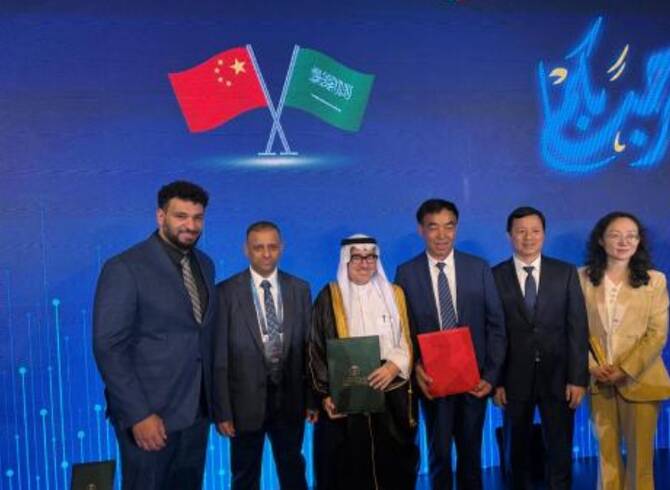
CEO of NCVC signs MoU with the Gansu Institute and meets with major Chinese companies to explore areas of cooperation. (Supplied)
2 / 2
CEO of NCVC signs MoU with the Gansu Institute and meets with major Chinese companies to explore areas of cooperation. (Supplied)
Short Url
Updated 17 May 2025
Follow

Center’s agreement aims at combating desertification

  • Solutions contribute to sustainable environmental development
  • The signing followed a decision by the Council of Ministers in December 2024

JEDDAH: The National Center for Vegetation Cover Development and Combating Desertification has signed an agreement with the Gansu Desert Control Research Institute to enhance cooperation in combating desertification.

The deal was signed by Khaled bin Abdullah Al-Abdulkader, the CEO of the center, during the visit of Abdulrahman Al-Fadli, the Saudi minister of environment, water and agriculture, to China.

The signing followed a decision by the Council of Ministers in December 2024.

The agreement aims to foster collaboration in combating desertification, sand encroachment, drought, land degradation, and the impact of drought in arid areas, while promoting the sustainable management of drylands.

Al-Abdulkader also held strategic meetings with several prominent Chinese companies to explore potential collaborations with a view to attracting investment to Saudi Arabia.

Discussions took place on initiatives such as natural asset management, rangeland rehabilitation, desert resort development, and the transfer of greening and desertification control technologies, supporting Saudi Arabia’s vision for a green economy and sustainable land use.

Al-Abdulkader met BGI Group representatives in Beijing to explore cutting-edge technologies for mangrove cultivation, which plays a key role in coastal protection, vegetation expansion, and environmental sustainability.

He also held discussions at Shanghai Mengfu Environmental Protection Technology Company, focusing on innovative solutions for converting invasive plant species into marketable, eco-friendly products.

In the field of environmental design, Al-Abdulkader met representatives from LWK Engineering and Landscape to oversee the company’s portfolio of ecological design projects and examine opportunities for collaboration in the planning and development of national parks, botanical gardens, and wetland areas.

These engagements reflect the center’s commitment to strengthening international partnerships, promoting green investment, and adopting forward-looking solutions that contribute to sustainable environmental development, in line with Saudi Arabia’s strategic objectives.


Saudi reserve records critically endangered Ruppel’s vulture

Updated 4 sec ago
Follow

Saudi reserve records critically endangered Ruppel’s vulture

RIYADH: King Abdulaziz Royal Reserve Development Authority has announced the sighting and documentation of a Ruppel’s vulture (Gyps rueppellii) within the boundaries of the reserve — a landmark environmental and historical event.

This is the third officially documented record of the species at national level and the first of its kind in the central and eastern regions of the Kingdom, the Saudi Press Agency reported.

The sighting carries global significance given the conservation status of the vulture, which is classified as critically endangered by the International Union for Conservation of Nature, following the loss of more than 90 percent of its population throughout its original range in Africa over the past three decades.

The appearance of this rare bird in King Abdulaziz Royal Reserve adds a new entry to the limited record of its sightings in the Kingdom, which began in Aseer region in 1985, followed by a sighting in 2018, and another in AlUla in September 2025. 

Its latest recording in central and eastern Saudi Arabia is considered an important environmental indicator of the quality of natural habitats provided by the reserve.

Globally, Ruppel’s vulture faces major threats, including poisoning from pesticides, electrocution, collisions with power lines, and the loss of nesting sites as a result of urban expansion and land-use change. 

Additional challenges include the decline of carrion resulting from changes in livestock-rearing practices, illegal hunting for use in traditional beliefs, and the adverse effects of climate change on its breeding areas and migratory routes.

The vulture is primarily found in the African Sahel and is considered extremely rare in the Arabian Peninsula. Its sighting in King Abdulaziz Royal Reserve underscores the Kingdom’s leading role in conserving biodiversity and supporting the objectives of Saudi Vision 2030 for protecting ecosystems.

It also reflects the success of the authority’s efforts to protect wildlife and restore ecosystems, positioning the reserve as a safe and attractive habitat for rare and native species.