

Gaza, Sudan most at risk as global starvation approaches 300m: Report

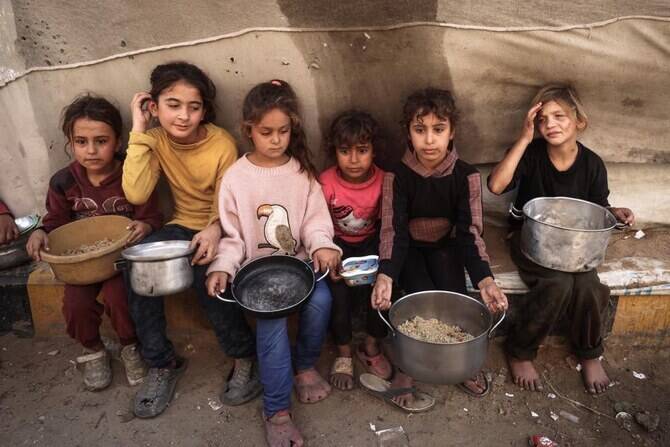
Almost 300 million people face death from starvation, with the most at risk in war-torn Gaza and Sudan, the latest Global Report on Food Crises has warned. (AFP/File)
Short Url
Updated 16 May 2025
Follow

Gaza, Sudan most at risk as global starvation approaches 300m: Report

  • Populations of both face ‘starvation, death, destitution and high rates of acute malnutrition’
  • War, aid cuts, climate among issues causing food shortages in Yemen, Afghanistan, Pakistan, Somalia

LONDON: Almost 300 million people face death from starvation, with the most at risk in war-torn Gaza and Sudan, the latest Global Report on Food Crises has warned.

The report said 295.3 million people have been identified as facing “high levels of acute food insecurity” after a sixth consecutive year of the global number growing, with people in South Sudan, Yemen, Somalia, Afghanistan and Pakistan also noted as being at particular risk.

Cuts to humanitarian aid budgets and escalating conflicts were highlighted as having pushed as many as 13.7 million people into chronic food insecurity over the past 12 months.

The report noted that the number of people most at risk of food shortages as defined by the UN-backed Integrated Food Security Phase Classification had more than doubled in that period, and that 95 percent of those were in Gaza and Sudan.

It added that the populations of both face “starvation, death, destitution and high rates of acute malnutrition.”

More than half of Gaza’s approximately 2.1 million people face “catastrophe,” while Sudan has as many as 24 million people suffering food insecurity. Famine has been officially declared in the African country.

“Intensifying conflict, increasing geopolitical tensions, global economic uncertainty and profound funding cuts are deepening acute food insecurity,” the GRFC said.

“Following the closure of all crossings into the Gaza Strip in early March, and the collapse of the two-month ceasefire, food access has been severely restricted.”

The GRFC said 19 other countries are suffering from worsening food security “aggravated” by drought, highlighting Somalia, Afghanistan, Pakistan, Ethiopia and Kenya.

War is also increasing several other countries’ food security, especially Nigeria and Myanmar.


Syria’s growth accelerates as sanctions ease, refugees return

Updated 06 December 2025
Follow

Syria’s growth accelerates as sanctions ease, refugees return

  • Economy grows much faster than World Bank’s 1% estimate, fueling plans for currency’s relaunch

NEW YORK: Syria’s economy is growing much faster than the World Bank’s 1 percent estimate for 2025 as refugees flow back after the end of a 14-year civil war, fueling plans for the relaunch of the country’s currency and efforts to build a new Middle East financial hub, central bank Governor AbdulKader Husrieh has said.

Speaking via video link at a conference in New York, Husrieh also said he welcomed a deal with Visa to establish digital payment systems and added that the country is working with the International Monetary Fund to develop methods to accurately measure economic data to reflect the resurgence. 

The Syrian central bank chief, who is helping guide the war-torn country’s reintegration into the global economy after the fall of Bashar Assad’s regime about a year ago, described the repeal of many US sanctions against Syria as “a miracle.”

The US Treasury on Nov. 10 announced a 180-day extension of the suspension of the so-called Caesar sanctions against Syria; lifting them entirely requires approval by the US Congress. 

Husrieh said that based on discussions with US lawmakers, he expects the sanctions to be repealed by the end of 2025, ending “the last episode of the sanctions.”

“Once this happens, this will give comfort to our potential correspondent banks about dealing with Syria,” he said.

Husrieh also said that Syria was working to revamp regulations aimed at combating money laundering and the financing of terrorism, which he said would provide further assurances to international lenders. 

Syria’s central bank has recently organized workshops with banks from the US, Turkiye, Jordan and Australia to discuss due diligence in reviewing transactions, he added.

Husrieh said that Syria is preparing to launch a new currency in eight note denominations and confirmed plans to remove two zeroes from them in a bid to restore confidence in the battered pound.

“The new currency will be a signal and symbol for this financial liberation,” Husrieh said. “We are glad that we are working with Visa and Mastercard,” Husrieh said.