

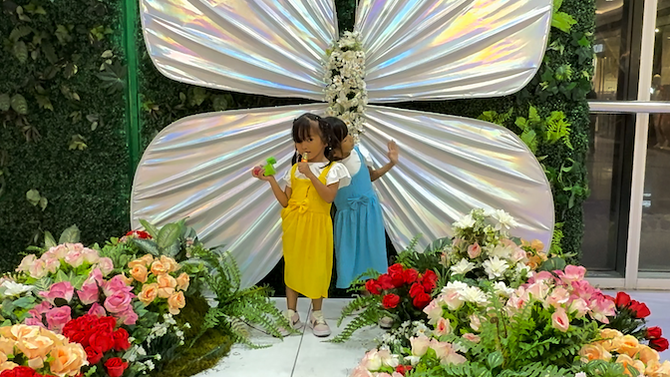

MANILA: When Maricel Misa saw a social media post about Filipino conjoined twins separated in Saudi Arabia last year, she congratulated them and said she hoped her daughters would also get that chance one day. Little did she know that a few months later, they would be flying to Riyadh for the same life-changing help.
Misa, who owns a small shop with her husband in Lubang, a municipality on the island of Mindoro, learned that her children were joined at the head in her sixth month of pregnancy. At first, they did not believe the ultrasound reading and hoped everything would still be fine.
When the girls were born, their parents’ world suddenly turned upside down, but they soon overcame the shock and organized themselves to give Maurice Ann and Klea all the support they could afford.
“My husband gave up his work so that someone could stay home to take care of our children as they grew up. We know that they are not like other children. They need constant care, someone to assist them when walking, bathing, and eating every single day,” Misa told Arab News.
“What we are going through right now is really very tough, especially when it comes to their schooling … One of them, I’m not even sure if she’s learning well, because she’s always facing sideways. But by God’s grace, they’re learning a lot and have made friends. And thankfully, they’re not getting bullied by their classmates.”
Like all parents, she and her husband have always hoped their daughters would one day live like other children and become independent. Misa knew it was possible after the separation of another pair of Filipino conjoined twins made headlines last year.
“We saw a post from Saudi Arabia about conjoined twins from the Philippines who had undergone surgery there, and I commented, saying I hope we can be helped too. Someone noticed my comment and reached out to me,” she said.
“Not long after that, the Saudi Embassy called me and told me that our trip to Saudi Arabia for a medical evaluation had been approved. Now, we’re just waiting a few more days before we travel. We are really thankful for the help of the Saudi government. This is a huge blessing for us. I truly want my children to have a normal life. We are so incredibly thankful that the Saudi government noticed us, even though we are not their own people.”

Maurice Ann and Klea Misa and their parents meet Saudi Ambassador Faisal bin Ibrahim Al-Ghamdi at the Kingdom's embassy in Manila on May 15, 2025. (Saudi Embassy, Manila)
Maurice Ann and Klea will be traveling to Riyadh on Saturday. The Saudi Embassy in Manila announced this week that all the costs will be borne by the Kingdom under the Saudi Conjoined Twins Program and that they will receive specialized medical care in King Abdulaziz Medical City.
“Their case will be overseen by the esteemed medical and surgical team led by His Excellency Dr. Abdullah Al-Rabeeah, supervisor-general of the King Salman Humanitarian Aid and Relief Center,” the embassy said.
“This case marks the third instance of Filipino conjoined twins to be treated under this pioneering humanitarian program.”
Dr. Al-Rabeeah, who leads the Saudi Conjoined Twins Program, is one of the world’s most renowned pediatric surgeons. Since the establishment of the program in 1990, he and his team have separated more than 140 children who were born sharing internal organs with their siblings.
Next week, as Maurice Ann and Klea start their treatment in Riyadh, they will observe their seventh birthday.
“I have no other wish but for them to live a normal life, to be like other children. I want them to finish their studies and achieve their dreams. Even if one day we are no longer around, we want to be at peace knowing that they can take care of themselves because they are living normal lives. That’s all I truly hope for,” their mother said.
“This upcoming surgery of our twins, if it becomes successful, will bring such a huge change in our lives … They’ll finally have the freedom to live their own lives, thanks to the support of the Saudi government. This is truly a life-changing help for us.”
Conjoined twins are a rare phenomenon, estimated to occur once in every 50,000 to 60,000 births.
The first pair of Filipino conjoined twins, Ann and Mae Manz, were separated by Dr. Al-Rabeeah and his team in March 2004. They were joined at the abdomen, pelvis, and perineum. The second pair, Akhizah and Ayeesha Yusoph, were joined at the lower chest and abdomen and shared one liver. They were successfully separated under the Saudi Conjoined Twins Program in September 2024.


