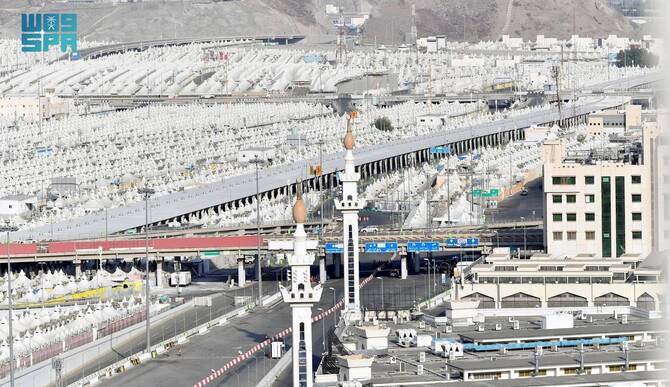
Royal Commission highlights new and improved services for Hajj pilgrims
Upgrades include enhanced bus network with 400 vehicles, plus 170,000 sq. m. pedestrian area with rubber flooring and 10,000 trees for shade
Healthcare provisions include a fully equipped hospital in the Mina valley with a capacity of 200 beds
Updated 15 May 2025
Arab News
MAKKAH: Saudi Arabia stands ready to serve the pilgrims who have started to arrive in the country for this year’s Hajj, the Royal Commission for Makkah City and Holy Sites said on Thursday. It follows the development and enhancement of infrastructure in Makkah, Mina and Muzdalifah, including several transport and healthcare projects, it added.
Pedestrian sidewalks and shaded tracks in central of Makkah have been improved, and prayer yards have been expanded to accommodate Hajj crowds, the commission said.
Makkah’s bus network will operate with enhanced services during the period of the pilgrimage, with 400 buses serving 12 routes, 431 stops and four central bus stations.
A 170,000-square-meter pedestrian area in Muzdalifah, a key pilgrimage site southeast of Makkah, has been upgraded with rubber flooring and 10,000 trees to provide shade and reduce the effects of heat on pilgrims.
Healthcare provisions include a fully equipped hospital with a capacity of 200 beds in Mina, a remote valley, also southeast of Makkah, where pilgrims spend the night in tents before performing a Hajj ritual the next day.
The commission has also provided two-story tents to increase the accommodation for pilgrims spending the night in the valley, along with as multistory toilet facilities and electric-scooter services serving three routes, the Saudi Press Agency reported.
In addition, the commission has set up 71 emergency centers at various locations in Mina, as well as rest areas, shaded spots and 400 chilled water stations.
Hajj is expected to begin on June 4 and continue until June 9.
Balad Beast brings global beats to historic streets
‘MDLBEAST put us on the international map,’ say Saudi electronic duo Dish Dash
Updated 31 January 2026
Afshan Aziz
JEDDAH: The music festival Balad Beast concluded its fourth edition this weekend, having transformed Jeddah’s UNESCO World Heritage district of Al-Balad into an open-air celebration of music, culture and creativity that attracted thousands of music lovers over two nights.
The festival, organized by Saudi music platform MDLBEAST, featured more than 70 local, regional and international artists across four stages, offering audiences a diverse journey through electronic, hip-hop and global sounds.
French Haitian singer-songwriter Naïka performed on the second night of Balad Beast. (Supplied)
Speaking to Arab News, MDLBEAST chief creative officer Ahmad Al-Ammary, also known as DJ Baloo, described Balad Beast as a “cultural takeover” adding that finding the right spaces for dance floors was a challenge, “but Balad is constantly evolving and we work with that change.”
Addressing the challenges of working in a heritage area, he said: “Balad is sensitive and condensed, so logistics can be complex. In our first year, heavy rain flooded one of the planned squares and we had to relocate the Souq Stage to a much smaller space, but it worked and it has remained there ever since.
HIGHLIGHT
Reggae superstar Shaggy noted that the reality of playing live in Saudi Arabia often surprises those who arrive with preconceptions.
“Yes, the alleys are narrow and the district is old, but they’re full of ideas, patterns, colors and visuals. Everything flows here,” he continued. “As a festival, it’s hard to define Balad, because it gives so much of itself creatively. It’s incredibly generous with its ideas and details, and inspiration comes from everywhere.”
Balad Beast featured more than 70 local, regional and international artists across four stages, offering audiences a diverse journey through electronic, hip-hop and global sounds. (Supplied)
Balad Beast featured performances from international artists including US rapper Playboi Carti, making his first appearance in Saudi Arabia; US rapper Destroy Lonely; Swedish DJ and producer Alesso; and Bosnian-German DJ Solomun on the opening night. The following night saw French-Haitian singer-songwriter Naïka, reggae superstar Shaggy, Dutch DJ Franky Rizardo, British DJ Pawsa, and US rapper Tyga, and more take the stage, while Saudi and regional artists including Cosmicat, TUL8TE, Zeina, Vinyl Mode, Moayed, Dish Dash, Musab, Varoo and HiFi appeared across the festival, offering audiences a mix of global and local talent.
Saudi electronic duo Dish Dash reflected on the festival organizer’s impact for local artists.
As a festival, it’s hard to define Balad, because it gives so much of itself creatively. It’s incredibly generous with its ideas and details, and inspiration comes from everywhere.
Ahmad Al-Ammary, MDLBEAST chief creative officer
“MDLBEAST put us on the international map,” the brothers told Arab News. “It helped us get recognized by festivals, promoters and event organizers abroad. When we travel, people don’t expect this level of talent coming from Saudi Arabia, especially considering we didn’t have this scene before.”
Shaggy, who performed a hit-filled set during the festival, told Arab News: “I’ve been blessed with some incredible songs, and I see music as a gift and a tool for service. When I go on stage, I’m there to entertain people, to make them smile and feel good, but that service also supports many livelihoods from the people working at this festival to those who work with me. These songs have become part of people’s lives, and I don’t take that lightly.”
Balad Beast featured more than 70 local, regional and international artists across four stages, offering audiences a diverse journey through electronic, hip-hop and global sounds. (Supplied)
Shaggy also noted that the reality of playing live in Saudi Arabia often surprises those who arrive with preconceptions.
“I’ve performed in Saudi Arabia more than once, and while there are certain rules that are different, it’s not an issue for me. My focus is always on delivering the hits and giving the audience a great time,” he said.
“There’s a big misconception. People have more freedom than (outsiders) think. Everyone has been extremely nice.”
Asked what advice he would offer to aspiring artists, Shaggy said: “Understand that what you’re given is a gift and a form of service. Stay humble, do the work, and remember why you’re doing it.”
As Al-Ammary noted, there are many such aspiring artists now making a name for themselves in the Kingdom.
“Talent is emerging everywhere, at different levels,” he said. “The scene is still in a mysterious and surprising phase. There’s a rawness to it.”