

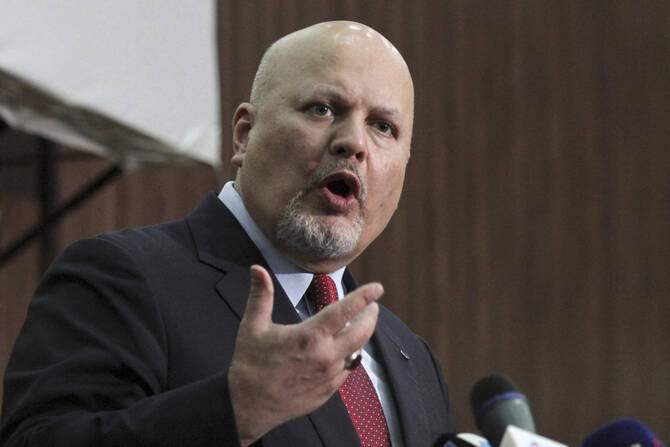

THE HAGUE: The International Criminal Court ‘s chief prosecutor has lost access to his email, and his bank accounts have been frozen.
The Hague-based court’s American staffers have been told that if they travel to the US they risk arrest.
Some nongovernmental organizations have stopped working with the ICC and the leaders of one won’t even reply to emails from court officials.
Those are just some of the hurdles facing court staff since US President Donald Trump in February slapped sanctions on its chief prosecutor, Karim Khan, according to interviews with current and former ICC officials, international lawyers and human rights advocates.
The sanctions will “prevent victims from getting access to justice,” said Liz Evenson, international justice director at Human Rights Watch.
Trump sanctioned the court after a panel of ICC judges in November issued arrest warrants for Israeli Prime Minister Benjamin Netanyahu and his former defense minister, Yoav Gallant.
Judges found there was reason to believe that the pair may have committed war crimes by restricting humanitarian aid and intentionally targeting civilians in Israel’s campaign against Hamas in Gaza — charges Israeli officials deny.
Staffers and allies of the ICC said the sanctions have made it increasingly difficult for the tribunal to conduct basic tasks, let alone seek justice for victims of war crimes or genocide.
A spokesperson for the ICC and for Khan declined to comment. In February, ICC President Judge Tomoko Akane said that the sanctions “constitute serious attacks against the Court’s States Parties, the rule of law based international order and millions of victims.”
Order targets chief prosecutor
The February order bans Khan and other non-Americans among the ICC’s 900 staff members from entering the US, which is not a member of the court. It also threatens any person, institution or company with fines and prison time if they provide Khan with “financial, material, or technological support.”
The sanctions are hampering work on a broad array of investigations, not just the one into Israel’s leaders.
The ICC had been investigating atrocities in Sudan and had issued arrest warrants for former Sudanese President Omar Al-Bashir on charges that include genocide. That probe has ground to a halt even as reports mount of new atrocities in Sudan, according to an attorney representing ICC prosecutor Eric Iverson, who is fighting the sanctions in US courts. Iverson filed a federal lawsuit against the Trump administration seeking protection from the sanctions.
Iverson “cannot do, what I would describe as, basic lawyer functions,” said Allison Miller, who is representing Iverson in the suit.
American staffers at the organization, like Iverson, have been warned by its attorneys that they risk arrest if they return home to visit family, according to ICC officials. Six senior officials have left the court over concerns about sanctions.
One reason the the court has been hamstrung is that it relies heavily on contractors and non-governmental organizations. Those businesses and groups have curtailed work on behalf of the court because they were concerned about being targeted by US authorities, according to current and former ICC staffers.
Microsoft, for example, canceled Khan’s email address, forcing the prosecutor to move to Proton Mail, a Swiss email provider, ICC staffers said. His bank accounts in his home country of the UK have been blocked.
Microsoft did not respond to a request for comment.
Staffers at an NGO that plays an integral role in the court’s efforts to gather evidence and find witnesses said the group has transferred money out of US bank accounts because they fear it might be seized by the Trump administration.
Senior leadership at two other US-based human rights organizations told the AP that their groups have stopped working with the ICC. A senior staffer at one told the AP that employees have stopped replying to emails from court officials out of fear of triggering a response from the Trump administration.
The cumulative effect of such actions has led ICC staffers to openly wonder whether the organization can survive the Trump administration, according to ICC officials who spoke on condition of anonymity out of fear of reprisal.
One questioned whether the court would make it through the next four years.
Trump alleged ICC’s actions were baseless
Trump, a staunch supporter of Netanyahu, issued his sanctions order shortly after re-taking office, accusing the ICC of “illegitimate and baseless actions targeting America and our close ally Israel.” Washington says the court has no jurisdiction over Israel.
Trump’s order said the ICC’s “actions against Israel and the United States set a dangerous precedent, directly endangering current and former United States personnel, including active service members of the Armed Forces.” He said the court’s “malign conduct” threatens “the sovereignty of the United States and undermines the critical national security and foreign policy work of the United States Government.”
The White House did not respond to a request for comment.
Netanyahu has dismissed the ICC’s allegations as “absurd,” and Israel’s Knesset is considering legislation that would make providing evidence to the court a crime.
Israel launched its offensive after Hamas-led militants stormed into southern Israel in October 2023, killing about 1,200 people, mostly civilians, and abducting scores of others. Hamas is believed to be holding about two dozen hostages.
Coping with dark humor
Inside the court, staffers have been coping with dark humor, joking about how they cannot even loan Khan a pen or risk appearing on the US radar.
This is not the first time the ICC has drawn Trump’s ire. In 2020, the former Trump administration sanctioned Khan’s predecessor, Fatou Bensouda, and one of her deputies over the court’s investigation into alleged crimes committed in Afghanistan while the US military was operating in the country.
President Joe Biden rescinded the sanctions when he took office several months later.
Three lawsuits are now pending from US court staff and consultants against the Trump administration arguing that the sanctions infringe on their freedom of expression. Earlier this week Iverson, the lawyer investigating genocide in Sudan, won temporary protection from prosecution. But if other US citizens at the court want a similar assurance, they would have to bring their own complaint.
Meanwhile, the court is facing a lack of cooperation from countries normally considered to be its staunchest supporters.
The ICC has no enforcement apparatus of its own and relies on member states. In the last year, three countries – including two in the European Union – have refused to execute warrants issued by the court.
Also in recent months, judges have banned Khan from publicizing his requests for warrants in several investigations. The first such ban, imposed in February and obtained by AP, targeted warrants in the court’s investigation into war crimes in Afghanistan. Subsequent orders, also seen by AP, include a ban on the publication of warrant requests in the investigation into crimes in the Palestinian territories.
The court was already facing internal challenges. Last year, just weeks before Khan announced he was requesting arrest warrants for the Israeli officials, two court staff reported the British barrister had harassed a female aide, according to reporting by the AP.
Khan has categorically denied the accusations that he groped and tried to coerce a female aide into a sexual relationship. A United Nations investigation is underway, and Khan has since been accused of retaliating against staff who supported the woman, including demoting several people he felt were critical of him.


