Pakistan PM reaffirms India ceasefire commitment, says Kashmir resolution key to regional peace

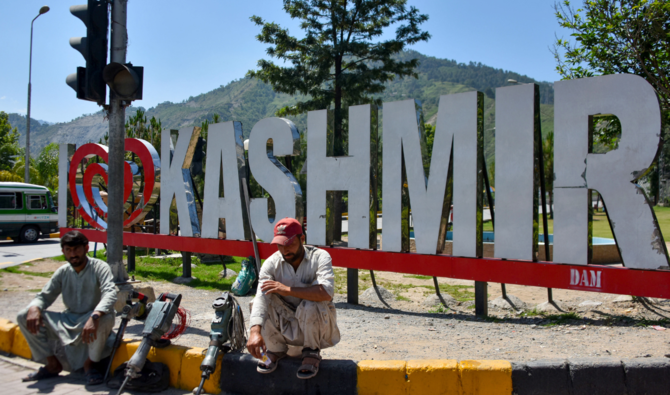
Workers wait along a road in Muzaffarabad, the capital of Pakistan-administered Kashmir, on May 14, 2025. (AFP)
Short Url
Updated 15 May 2025
Follow

Pakistan PM reaffirms India ceasefire commitment, says Kashmir resolution key to regional peace

  • Shehbaz Sharif expresses concern over ‘provocative statements’ by Indian leaders following the ceasefire
  • He tells Azerbaijani president Pakistan remains prepared to defend its sovereignty against any attack

ISLAMABAD: Prime Minister Shehbaz Sharif on Thursday reaffirmed Pakistan’s commitment to a recently agreed ceasefire with India but stressed that lasting peace in South Asia would only be possible through the resolution of the Kashmir dispute in line with UN Security Council resolutions.

Sharif made the statement during a phone call with Azerbaijani President Ilham Aliyev, days after cross-border hostilities between India and Pakistan were halted under a ceasefire announced by US President Donald Trump.

According to an official statement, Sharif said his country had accepted ceasefire in the interest of regional peace but warned that it remained prepared to defend its sovereignty and territorial integrity in the face of another attack.

“The Jammu and Kashmir dispute is the root cause of instability in South Asia, which should be resolved in accordance with the UN Security Council’s resolutions,” he said, according to the Prime Minister’s Office.

He also expressed concern over recent “provocative statements” by Indian leaders following the agreement.

Sharif thanked Azerbaijan for its stance on Kashmir and reiterated Pakistan’s appreciation for the solidarity shown by its leadership and people during the recent standoff.

The two leaders also discussed bilateral ties, with the Pakistani prime minister welcoming progress on proposals for up to $2 billion in Azerbaijani investments in Pakistan across multiple sectors.

He said Islamabad was committed to transforming its relations with Baku into a mutually beneficial economic partnership.

President Aliyev congratulated Sharif on Pakistan’s handling of the recent crisis and expressed support for the ceasefire agreement.

He reaffirmed Azerbaijan’s commitment to strengthening bilateral cooperation.

The Pakistani premier extended an invitation to Aliyev to undertake an official visit to Pakistan, which the Azerbaijani leader accepted.


Pakistan, UK discuss regional security, cross-border attacks as senior official visits Islamabad

Updated 20 January 2026
Follow

Pakistan, UK discuss regional security, cross-border attacks as senior official visits Islamabad

  • British envoy for Afghanistan Richard Lindsay’s visit comes at a time of a surge in militancy in Pakistan’s border regions
  • Pakistani diplomat says both sides reviewed broader security challenges, emphasized coordination to address ‘shared concerns’

ISLAMABAD: Pakistani and British officials have discussed regional security challenges and cross-border attacks during talks in Islamabad, a Pakistani diplomat said on Tuesday, during a visit of the United Kingdom’s Afghanistan envoy, Richard Lindsay, to the Pakistani capital.

Pakistan and the UK regularly cooperate on counterterrorism and security, with a focus on intelligence-sharing to combat militant activity. Lindsay’s visit comes at a time of a rise in militancy in Pakistan’s western provinces, which border Afghanistan.

Mohammad Sadiq, Pakistan’s special representative for Afghanistan, said the discussions in Islamabad focused on the regional security situation, particularly the urgent challenge posed by cross-border attacks.

“We also exchanged views on the latest regional security developments and broader security challenges,” he said on X. “We emphasized the importance of continued cooperation and coordination to address shared concerns and promote regional stability.”

Islamabad frequently accuses Afghanistan of allowing its soil and India of backing militant groups, such as the Tehreek-e-Taliban Pakistan (TTP) and the Balochistan Liberation Army (BLA), for attacks against Pakistan. Kabul and New Delhi deny this.

In recent years, Pakistan and the UK have engaged with each other on counterterrorism and cross-border crimes as part of bilateral cooperation.

Both sides held the second round of the Pakistan-UK Counter Terrorism Dialogue in London in February last year, reviewing global and regional threats and exchanging best practices. Over the years, armed forces of both countries have also maintained close cooperation, particularly in counterterrorism efforts and professional military training.