BASEL: Most contestants at the Eurovision Song Contest are seeking as much publicity as possible.
Israel’s Yuval Raphael is keeping a low profile.
The 24-year-old singer has done few media interviews or appearances during Eurovision week, as Israel’s participation in the pan-continental pop music competition draws protests for a second year.
Raphael is due to perform Thursday in the second semifinal at the contest in the Swiss city of Basel. Oddsmakers suggest Raphael is likely to secure a place in Saturday’s final with her anthemic song “New Day Will Rise.”
Israel has competed in Eurovision for more than 50 years and won four times. But last year’s event in Sweden drew large demonstrations calling for Israel to be kicked out of the contest over its conduct in the war against Hamas in Gaza.
More than 52,800 people in Gaza have been killed in Israel’s military offensive, according to the territory’s health ministry.
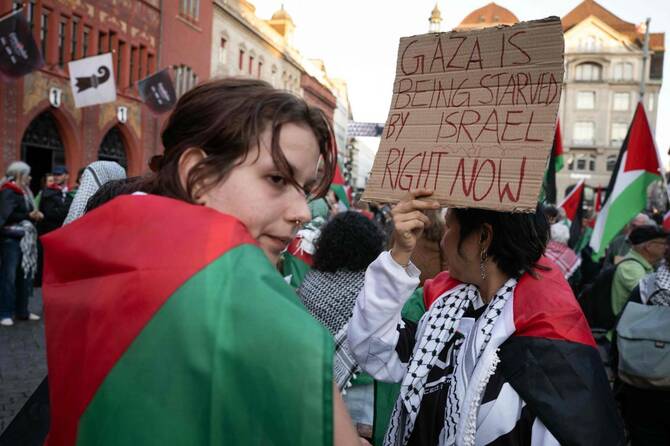
About 200 people, many draped in Palestinian flags, protested in central Basel on Wednesday evening, demanding an end to Israel’s military offensive and the country’s expulsion from Eurovision. They marched in silence down a street noisy with music and Eurovision revelry.
Many noted that Russia was banned from Eurovision after its 2022 invasion of Ukraine.
“It should be a happy occasion that Eurovision is finally in Switzerland, but it’s not,” said Lea Kobler, from Zurich. “How can we rightfully exclude Russia but we’re still welcoming Israel?”
Last year, Israeli competitor Eden Golan received boos when she performed live at Eurovision. Raphael told the BBC that she expects the same and has rehearsed with background noise so she won’t be distracted.
“But we are here to sing and I’m going to sing my heart out for everyone,” she said.
Anti-Israel protests in Basel have been much smaller than last year in Malmo. Another protest is planned for Saturday in downtown Basel, 2 miles (3.2 kilometers) from the contest venue, St. Jakobshalle arena.
But concern by some Eurovision participants and broadcasters continues.
More than 70 former Eurovision contestants signed a letter calling for Israel to be excluded. Several of the national broadcasters that fund Eurovision, including those of Spain, Ireland and Iceland, have called for a discussion about Israel’s participation.
Swiss singer Nemo, who brought the competition to Switzerland by winning last year, told HuffPost UK that “Israel’s actions are fundamentally at odds with the values that Eurovision claims to uphold — peace, unity, and respect for human rights.”
At Wednesday’s protest, Basel resident Domenica Ott held a handmade sign saying “Nemo was right.”
She said the nonbinary singer was “very courageous.”
“If Russia couldn’t participate, why should Israel?” she said.
The European Broadcasting Union, which runs Eurovision, pointed out that Israel is represented by its public broadcaster, KAN, not the government. It has called on participants to respect Eurovision’s values of “universality, diversity, equality and inclusivity” and its political neutrality.


Israel’s presence still roils Eurovision a year after major protests over the war in Gaza
https://arab.news/vdkhd
Israel’s presence still roils Eurovision a year after major protests over the war in Gaza

- About 200 pro-Palestinian demonstrators marched Wednesday in the Swiss host city of Basel
- Oddsmakers suggest Raphael is likely to secure a place in Saturday’s final with her song “New Day Will Rise”


BBC slammed for ‘shameful’ cut to ‘free Palestine’ comment at BAFTA Awards
- Broadcaster removes from broadcast part of filmmaker Akinola Davies Jr.’s acceptance speech at the British Academy Film Awards
- Amnesty UK praises filmmaker for speaking up for those ‘facing and fleeing from persecution and mass atrocities’
LONDON: The BBC was accused on Monday of a “shameful” decision after it cut part of an acceptance speech at the previous night’s British Academy Film Awards in which a filmmaker uttered the phrase “free Palestine.”
British-Nigerian director and co-writer Akinola Davies Jr. and his brother, co-writer Wale Davies were collecting the award for outstanding debut by a British writer, director or producer for their film “My Father’s Shadow” when the former made the comment.
The BBC chose not to include the final part of his speech when it broadcast the BAFTAs ceremony later in the evening. However, the corporation did broadcast an inadvertent racist slur shouted by a person with Tourette syndrome while Black actors Michael B. Jordan and Delroy Lindo were presenting an award.
Akinola thanked industry figures and family for their support as he accepted the award, before dedicating it to “all those whose parents migrated to obtain a better life for their children.”
In the final part of his speech, cut by the BBC, he said: “To the economic migrant, the conflict migrant, those under occupation, dictatorship, persecution and those experiencing genocide, you matter and your stories matter more than ever.
“Your dreams are an act of resistance. To those watching at home, archive your loved ones, archive your stories yesterday, today and forever. For Nigeria, for London, Congo, Sudan, free Palestine. Thank you.”
The BBC, which broadcast the ceremony with a two-hour time delay, said the cut was made for timing reasons.
A spokesperson told Deadline: “The live event is three hours, and it has to be reduced to two hours for its on-air slot. The same happened to other speeches made during the night, and all edits were made to ensure the program was delivered to time. All winners’ speeches will be available to watch via BAFTA’s YouTube Channel.”
Human rights campaign group Amnesty UK described the decision by the BBC to cut part of the speech as “shameful.”
It added: “Thank you Akinola Davies Jr. for using your platform to speak out for the rights of migrants and people facing and fleeing from persecution and mass atrocities, from the Congo to Sudan to Palestine.”
In June last year, the BBC was at the center of a row after it broadcast a Glastonbury Festival performance by the duo Bob Vylan, during which the lead singer chanted “death to the IDF” in protest against the Israeli Defense Forces’ assault on Gaza.


