

Ireland’s RTE urges talks on Israel’s Eurovision participation amid growing pressure

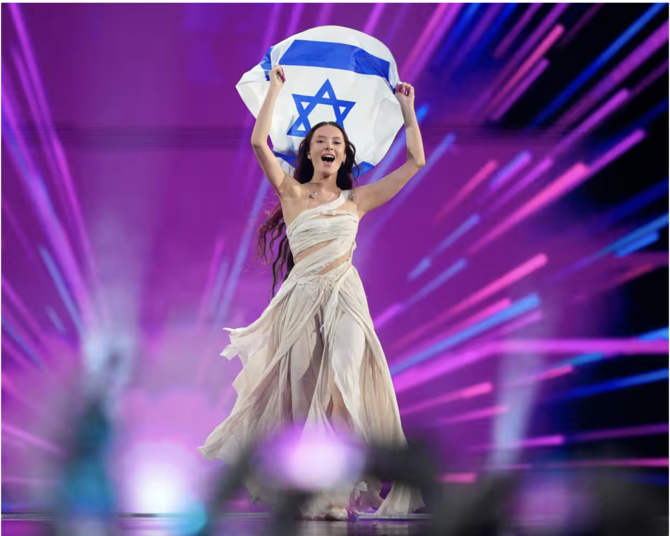
Israel’s entry in last year’s Eurovision was Eden Golan. (File/AP)
Short Url
Updated 09 May 2025
Follow

Ireland’s RTE urges talks on Israel’s Eurovision participation amid growing pressure

  • European Broadcasting Union ‘whitewashing’ Israeli war crimes
  • EBU must ban Israel like it did with Russia in 2022, say activists

DUBAI: Ireland’s national broadcaster RTE has invited the European Broadcasting Union for talks on Israel’s participation in the upcoming Eurovision Song Contest, as pressure mounts from dozens of former contestants demanding the country’s exclusion.

RTE’s Director-General Kevin Bakhurst has expressed deep concern over the humanitarian crisis in Gaza and the situation of Israeli hostages, emphasizing the need for RTE to remain objective in its coverage of the war.

He also pointed to political pressure on Israel’s public broadcaster, Kan, from the Israeli government.

Israel, a Eurovision participant since 1973, is set to compete in this year’s contest, running from May 13 to 17, in Basel, Switzerland, with singer Yuval Raphael, a survivor of the Oct. 7 Hamas attack at the Nova music festival.

Earlier this week, in an open letter, 72 former Eurovision contestants called on the EBU to ban Israel and its national broadcaster, KAN, from this year’s contest.

They cited the country’s war in Gaza and accused the union of “normalizing and whitewashing” alleged Israeli war crimes.

They argued that Israel’s participation would be inconsistent with the EBU’s decision to ban Russia in 2022 over its invasion of Ukraine.

The EBU previously said it acknowledges the concerns but aims to keep Eurovision a positive, inclusive event that transcends politics and unites people through music.


BBC slammed for ‘shameful’ cut to ‘free Palestine’ comment at BAFTA Awards

Updated 23 February 2026
Follow

BBC slammed for ‘shameful’ cut to ‘free Palestine’ comment at BAFTA Awards

  • Broadcaster removes from broadcast part of filmmaker Akinola Davies Jr.’s acceptance speech at the British Academy Film Awards
  • Amnesty UK praises filmmaker for speaking up for those ‘facing and fleeing from persecution and mass atrocities’

LONDON: The BBC was accused on Monday of a “shameful” decision after it cut part of an acceptance speech at the previous night’s British Academy Film Awards in which a filmmaker uttered the phrase “free Palestine.”

British-Nigerian director and co-writer Akinola Davies Jr. and his brother, co-writer Wale Davies were collecting the award for outstanding debut by a British writer, director or producer for their film “My Father’s Shadow” when the former made the comment.

The BBC chose not to include the final part of his speech when it broadcast the BAFTAs ceremony later in the evening. However, the corporation did broadcast an inadvertent racist slur shouted by a person with Tourette syndrome while Black actors Michael B. Jordan and Delroy Lindo were presenting an award.

Akinola thanked industry figures and family for their support as he accepted the award, before dedicating it to “all those whose parents migrated to obtain a better life for their children.”

In the final part of his speech, cut by the BBC, he said: “To the economic migrant, the conflict migrant, those under occupation, dictatorship, persecution and those experiencing genocide, you matter and your stories matter more than ever.

“Your dreams are an act of resistance. To those watching at home, archive your loved ones, archive your stories yesterday, today and forever. For Nigeria, for London, Congo, Sudan, free Palestine. Thank you.”

The BBC, which broadcast the ceremony with a two-hour time delay, said the cut was made for timing reasons.

A spokesperson told Deadline: “The live event is three hours, and it has to be reduced to two hours for its on-air slot. The same happened to other speeches made during the night, and all edits were made to ensure the program was delivered to time. All winners’ speeches will be available to watch via BAFTA’s YouTube Channel.”

Human rights campaign group Amnesty UK described the decision by the BBC to cut part of the speech as “shameful.”

It added: “Thank you Akinola Davies Jr. for using your platform to speak out for the rights of migrants and people facing and fleeing from persecution and mass atrocities, from the Congo to Sudan to Palestine.”

In June last year, the BBC was at the center of a row after it broadcast a Glastonbury Festival performance by the duo Bob Vylan, during which the lead singer chanted “death to the IDF” in protest against the Israeli Defense Forces’ assault on Gaza.