Pakistan resolves to enhance UAE ties into ‘mutually beneficial economic partnership’

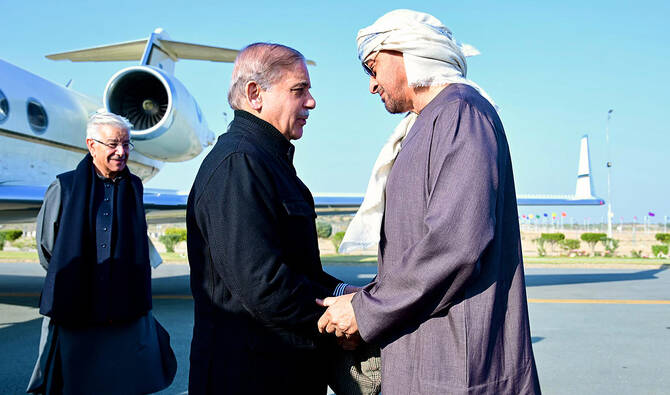
In this file photo, taken on January 5, 2025, Pakistan Prime Minister Shehbaz Sharif meets the UAE President Sheikh Mohamed bin Zayed Al Nahyan in Rahim Yar Khan, Pakistan. (Photo courtesy: PMO/File)
Short Url
Updated 14 May 2025
Follow

Pakistan resolves to enhance UAE ties into ‘mutually beneficial economic partnership’

  • Shehbaz Sharif speaks to UAE President Sheikh Mohammed bin Zayed Al-Nahyan
  • Pakistan PM thanks UAE for playing constructive role to defuse South Asia tensions

ISLAMABAD: Prime Minister Shehbaz Sharif on Wednesday reaffirmed his country’s resolve to strengthen Pakistan’s ties with the United Arab Emirates (UAE) into a “mutually beneficial economic partnership,” his office said in a statement.

Sharif’s government has moved closer to the UAE in recent months in its efforts to attract international investment and ensure stability for Pakistan’s fragile $350 billion economy.

In January last year, Pakistan and the UAE signed multiple agreements worth more than $3 billion for cooperation in railways, economic zones and infrastructure, a Pakistani official said.

Sharif spoke to UAE President Sheikh Mohammed bin Zayed Al-Nahyan over the telephone, the Pakistani Prime Minister’s Office (PMO) said. He noted “with great satisfaction” that bilateral cooperation between the two countries was progressing, especially in the areas of economy and investment.

“He [Sharif] renewed his strong resolve to transform the existing Pakistan-UAE ties into a mutually beneficial economic partnership,” the statement said.

Both leaders discussed Pakistan’s recent tensions with India which triggered an armed conflict between the two nations recently.

India and Pakistan pounded each other with missiles, drones, and artillery fire last week. The conflict erupted when India fired missiles into Pakistan last Wednesday after weeks of tensions over an attack on tourists in Indian-administered Kashmir on Apr 22. New Delhi blamed the attack on Pakistan, while Islamabad denied involvement.

US President Donald Trump announced Washington had brokered a ceasefire between the two states on Saturday after Pakistan launched retaliatory strikes.

“During their warm and cordial conversation, the Prime Minister conveyed profound gratitude for UAE’s diplomatic efforts and constructive role to defuse the recent crisis in South Asia,” the PMO said.

“He added the UAE had always stood by Pakistan, through thick and thin.”

Sharif’s office said he reaffirmed Pakistan’s commitment to uphold the ceasefire understanding, as well as its resolve to defend its sovereignty and territorial integrity at all costs.

“The UAE President welcomed the ceasefire understanding, while appreciating Pakistan’s efforts for peace,” the PMO said.

Separately, Sharif also spoke to UN chief Antonio Guterres to thank him for his efforts to defuse tensions in South Asia, the PMO said.

The UAE holds immense importance for Pakistan, given that it is Islamabad’s third-largest trading partner after China and the United States, and a major source of foreign investment, valued at over $10 billion in the last 20 years, according to the UAE foreign ministry.

It is also home to more than a million Pakistani expatriates. Policymakers in Pakistan consider the UAE an optimal export destination due to its geographical proximity, which minimizes transportation and freight costs while facilitating commercial transactions.


ADB, Pakistan sign over $300 million agreements to undertake climate resilience initiatives

Updated 30 December 2025
Follow

ADB, Pakistan sign over $300 million agreements to undertake climate resilience initiatives

  • Pakistan ranks among nations most vulnerable to climate change and has seen erratic changes in weather patterns
  • The projects in Sindh and Punjab will restore nature-based coastal defenses and enhance agricultural productivity

ISLAMABAD: The Pakistani government and the Asian Development Bank (ADB) have signed more than $300 million agreements to undertake two major climate resilience initiatives, Pakistan’s Press Information Department (PID) said on Tuesday.

The projects include the Sindh Coastal Resilience Sector Project (SCRP), valued at Rs50.5 billion ($180.5 million), and the Punjab Climate-Resilient and Low-Carbon Agriculture Mechanization Project (PCRLCAMP), totaling Rs34.7 billion ($124 million).

Pakistan ranks among nations most vulnerable to climate change and has seen erratic changes in its weather patterns. In 2022, monsoon floods killed over 1,700 people, displaced another 33 million and caused over $30 billion losses, while another 1,037 people were killed in floods this year.

The South Asian country is ramping up climate resilience efforts, with support from the ADB and World Bank, and investing in climate-resilient infrastructure, particularly in vulnerable areas.

“Both sides expressed their commitment to effectively utilize the financing for successful and timely completion of the two initiatives,” the PID said in a statement.

The Sindh Coastal Resilience Project (SCRP) will promote integrated water resources and flood risk management, restore nature-based coastal defenses, and strengthen institutional and community capacity for strategic action planning, directly benefiting over 3.8 million people in Thatta, Sujawal, and Badin districts, according to ADB.

The Punjab project will enhance agricultural productivity and climate resilience across 30 districts, improving small farmers’ access to climate-smart machinery, introducing circular agriculture practices to reduce residue burning, establishing testing and training facilities, and empowering 15,000 women through skills development and livelihood diversification.

Earlier this month, the ADB also approved $381 million in financing for Pakistan’s Punjab province to modernize agriculture and strengthen education and health services, including concessional loans and grants for farm mechanization, Science, Technology, Engineering and Mathematics (STEM) education, and nursing sector reforms.